Did NZ’s most brazen electoral fraud just take place in Papatoetoe?

The Papatoetoe-Ōtara Action Team didn’t just win, they dominated.
In court, they opened up 53 wrongfully cast ballots. Fifty of them had gone to the winning side. Hayden Donnell was there.
The hearing at Manukau District Court has only been going 20 minutes and judge Richard McIlraith is taking off his glasses and rubbing his forehead. He seems to do that when he’s mulling a thorny issue and this case is full of them. It involves murky statistical extrapolations. Scraps of tangential case law dating back to the 19th century. A bunch of hastily cobbled together maps. At the end he has to decide whether, on the balance of probabilities, the country’s most brazen and systematic electoral fraud has been carried out in pursuit of the ultimate political prize: control of the Papatoetoe division of the Ōtara-Papatoetoe Local Board.
The case has its origins in what seemed to be a surprise win for democracy. When the final results were announced for Auckland’s local body elections on October 18, voting numbers were disastrous. Turnout dipped to 29% across the city, plunging in every ward from Aotea Great Barrier to Franklin. Papatoetoe was a lone bright spot in the ocean of democratic gloom. Its local board race turnout went up 7.5%, in defiance of the trend seen literally everywhere else.

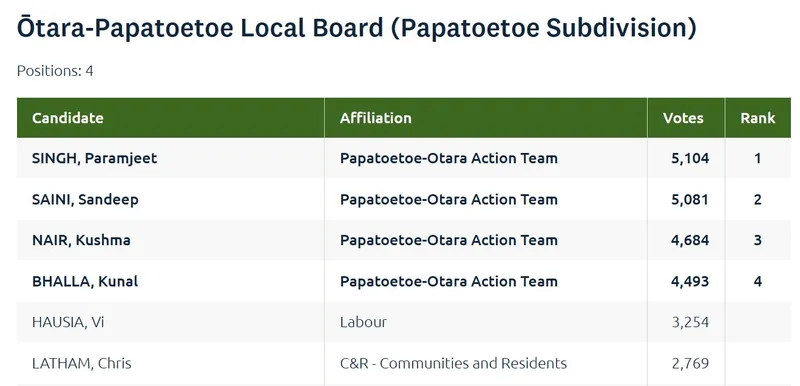
It didn’t take long for people to start smelling an electoral rat. All four of the area’s board seats were won by members of a new ticket, the Papatoetoe-Ōtara Action Team. They didn’t just win, they dominated, with the lowest-polling member beating the next candidate down by 1,239 votes.
Since the results came out, the Papatoetoe-Ōtara Action Team has been at the centre of a host of allegations. Rival candidates have accused its campaign of engaging in “treating”, or offering food to voters, and instructing people inside temples and churches on how to vote. But most seriously, a complaint has been lodged about “nightly vote stealing by a team of young boys”.
Police are carrying out an investigation into the allegations. But no one outside the constabulary has put more thought and effort into proving them than Vi Hausia. The Labour candidate came fifth in the local board race, missing out on a seat despite increasing his vote count from 2022. Over the last two months, he’s put hundreds of hours into compiling evidence to show the result was fraudulent, in preparation for his petition to the Manukau District Court. If he succeeds, McIlraith will void the Papatoetoe board election result, triggering a byelection.
Some might dismiss Hausia as an embittered losing candidate. He rejects the characterisation. “I’ve got a good job as an engineer, so it’s not about the position,” he says outside court. “This is about democracy.” His case is being supported by candidates from across the political spectrum, all of whom have concerns over the result. “In an election, there’s two outcomes, you win or you lose. This is a third option that I never thought I’d have to deal with,” he says.
Hausia sits in court with his laptop open during the hearing, regularly giving instructions to his barrister, Simon Mitchell. His case is expansive, but it boils down to a few numbers. The first is 79. That’s how many votes everyone in court agrees were “irregular”, though lawyers sometimes mistakenly use the word interchangeably with “fraudulent”. Some of those were from people who didn’t vote at all but were recorded as having voted anyway. But 53 were from Papatoetoe constituents who thought they hadn’t received their voting papers and went to a library to lodge a special vote, only to find they were already recorded as having cast a ballot.

In court on November 25, returning officer Dale Ofsoske dug out those 53 votes to check who they’d initially been cast for before the irregularity was discovered. Fifty, or 94%, had gone to the Papatoetoe-Ōtara Action Team. Lawyers acting for both Hausia and Ofsoske agree those votes were, in the words of McIlraith, “wrongly cast”, and almost all helped prop up the winning side.
That’s not great. But it’s also only 79 votes, and there are two other, much bigger numbers at play. The most important is that margin of victory. To void the election result, McIlraith has to be satisfied that the irregularities “materially” impacted the result. On the face of it, 79 doesn’t get you there, representing less than 10% of the votes Hausia needs to regain his board seat.
In court, Mitchell asks McIlraith to consider what he believes is a strong possibility that the brushfire of irregularities is actually just part of a raging inferno of election fraud. He notes Auckland’s turnout is generously 30%. What, then, are the chances that someone in Papatoetoe would even realise their voting papers had been stolen, let alone go to the trouble of trying to rectify the situation by casting a special vote? “Most wouldn’t have even noticed,” Mitchell says.
He thinks the 79 wrongful votes they’ve discovered are just the “tip of the iceberg”; with most only found because the people who wanted to cast them were far more fervent about local democracy than the average Aucklander. There’s another big number at play: more than 3,000 more votes were cast in Papatoetoe in the 2025 local election than in the 2022 one and there are no real explanations for the suburb’s “sudden interest in democracy”, he says. He argues the “high-tide mark” for his case is that thousands of extra votes are the result of election fraud.
Though he isn’t accused of any wrongdoing, Ofsoske is the respondent to Hausia’s petition as the chief electoral officer who ran the Papatoetoe election. In court, his lawyer David Collins sounds a note of caution. This case is so unusual that it’s almost unprecedented, but he’s dug up case law, some of which dates back 150 years. Generally it shows that in the rare cases where elections have been overturned here and in Australia, it’s happened in situations where the result is close and the irregular votes would have made a clear difference to the outcome.
In his closing statement, Mitchell notes the potential perverse incentive at play if Collins’ argument is accepted. Essentially, if widespread vote theft has taken place, the perpetrators may actually be saved by the sheer scale of their offending. By conjuring a massive majority, they’ve made it harder to prove voting irregularities that have a material effect on the result of the election. The message to offenders from that outcome would be clear: go big or go home. “If the wider margin becomes the defence, it does have a chilling effect on democracy,” he says.
“That is the effect of the case law, isn’t it?” McIlraith replies. “The greater the margin, the harder it is to void the result.” It’s yet another thorny problem, and the judge is taking his glasses off to massage his temples again. He has a difficult task ahead. A judgment is due out by Christmas.
At least one thing is clear from the proceedings though: this case starkly reveals the shortcomings of our postal voting system. McIlraith repeatedly refers to its potential “frailties” and talks about widespread vote stealing as the “worst-nightmare” way the system could fail.
After the judge adjourns the hearing, Hausia says whatever decision is handed down, he’ll be happy if the case provides some impetus for putting an end to what he sees as an increasingly archaic voting method. “Change the system,” he says. “People need to be confident that the vote that’s recorded as having been cast in their name is actually their vote. It’s important.”

Hayden Donnell
Hayden Donnell is a senior writer for The Spinoff. He previously worked at RNZ, TVNZ and the New Zealand Herald, alongside other media companies that have since closed down or been renamed. His primary passions are local politics and the Big Fresh animatronic fruit and veggies.


