Chris Bishop is the minister for abundance

Minister for RMA reform Chris Bishop.
After two years of major housing, infrastructure and planning reforms, Chris Bishop may have done more for the abundance agenda than any other politician on Earth.
When he unveiled the two bills that will replace the Resource Management Act, minister Chris Bishop celebrated it as “the single largest economic reform in a generation”. Simplified planning, easier processes and less ability for litigious neighbours or annoying bureaucrats to stop you from building. “Gone are the days of every man and his dog having a say over what you do with your own property,” he said.
The new legislation revealed on Tuesday is the culmination of a policy approach Bishop has embraced wholeheartedly in his roles as minister for housing, infrastructure, transport, and RMA reform; a general view that the government needs to lessen restrictions on development.
That may sound like traditional right-libertarianism, but when you look at the groups that supported and opposed his various decisions, it gets more complicated. Bishop sided with former Wellington mayor Tory Whanau’s call to allow more housing in the capital, even though every conservative councillor was opposed. He made Christchurch zone for high-density housing, which centre-right mayor Phil Mauger called a “kick in the guts”. In Auckland he could barely disguise his glee in forcing the left-leaning areas of Eden-Albert to allow 15-storey buildings around City Rail Link stations.
He championed the Fast-track Approvals Act, which allowed major infrastructure projects to skip the usual consenting process. It was strongly opposed by environmental groups, but already, 30 renewable energy projects have applied to the scheme.
If there’s a single idea that summarises Bishop’s actions this term, it’s the abundance agenda. That term was coined by writer Derek Thompson in 2022, then made famous by the book Abundance, which he co-wrote with Ezra Klein in 2025. Thanks to New Zealand’s notoriously fast legislative system, you could fairly make the argument that Bishop has done more over the past two years to advance the abundance agenda than any other politician in the world.

Klein and Thompson’s central thesis is that liberal cities have become expensive and inefficient due to well-intentioned but excessive regulations. This leads to higher housing costs and a shortage of green infrastructure. They specifically highlight California’s failure to complete a high-speed rail network despite spending billions of dollars on it.
The parallels to New Zealand are obvious: expensive housing, especially in inner-city suburbs with restrictive zoning, a $200bn infrastructure deficit, and a light rail project that we spent $228m not building.
The policy prescription set out in Abundance is for a “liberalism that builds” or a “supply-side liberalism”. In short, that means removing regulatory hurdles that make it difficult to achieve the things liberals want, such as faster trains, cheaper housing and more effective government programmes. Of course, many regulations exist for good reason and removing them willy-nilly would lead to negative outcomes.
Bishop owns a copy of Abundance, which he says is on his summer reading list – “but I feel like I’ve read it because I’ve read so many articles about it”.
“I’ve been quite taken by the movement in both the US and UK that identifies planning as the root cause of so much of the low growth we’ve experienced in the west,” he told The Spinoff. “Obviously housing is the most visible manifestation in New Zealand, but it’s not just that – it’s everything.”
Bishop paid particular attention to the UK’s HS2 high-speed rail line between London and Birmingham, which is massively over budget and behind schedule. Unhappy residents in the Chilterns, a legally recognised “area of outstanding national beauty”, demanded that much of the line be tunnelled to stop it from spoiling their view. In another area, authorities had to spend £216 million on a one-kilometre-long mesh structure to prevent rare bats from colliding with the train.

Abundance was written specifically to suggest how US Democrats could position themselves as a pro-growth party. Klein describes it as taking the best from multiple ideologies; the left’s focus on human welfare, libertarians’ obsession with cutting regulations and the right’s ambition for national greatness.
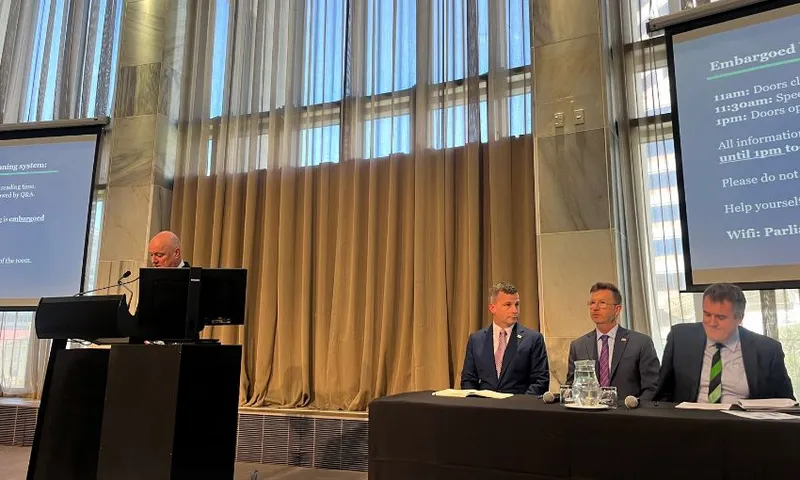
That may be why Bishop has been such an effective advocate for Abundance policies. He’s on the liberal wing of a centre-right party and hails from Wellington, the most progressive city in the country. He’s used to dealing with people who disagree with him on both sides. That’s turned him into the political animal he is today.
The truly innovative thing about Abundance isn’t the policy, it’s the framing; pitching deregulation as part of the language and goals of the left. That’s what Bishop has picked up on. He’s found allies in the Greens and Labour to support more affordable housing, in Act to cut red tape, and within his own party as part of a broader narrative of economic growth.
There was broad political consensus that an overhaul of the RMA was necessary. Although Labour passed its own reform last term, opposition leader Chris Hipkins has indicated that there is no great appetite to keep relitigating this issue. Bishop will get to claim this law as his legacy. And while opposition MPs will raise issues with certain aspects, many on the left will be secretly pleased with the outcome, and glad they weren’t the ones who had to push it through.

Joel MacManus
Joel MacManus is a senior writer for The Spinoff. He previously worked at RNZ and Stuff, and began his career at Critic Te Ārohi. His writing explores the political, economic and cultural systems that underpin modern New Zealand. He won the 2025 Voyager Media Award for Best Columnist, Opinion or Critique.


