


Remember the pandemic? Well you’re going to – if Simeon Brown and Christopher Luxon have anything to do with it.
The 2020 election was defined by the Covid-19 pandemic. The 2023 election was about its economic fallout. The 2026 election, it seems, is going to be fought over its ghost.
Newly appointed National Party campaign chair Simeon Brown, who got the job from Chris Bishop after a caucus reshuffle earlier this month, posted an abnormally long thread on X in which he laid out the core argument he thinks National needs to make to win the election. It reads like it was adapted from a pitch document he presented to Luxon before he was given the role.
Brown begins by acknowledging the uncertainty of the world and the oil supply chain: “It’s real, it’s tough, and I’m not going to pretend otherwise.” But rather than dwell on the current situation, he asks readers to focus on the past. “But I want you to cast your mind back. Remember when inflation hit 7.3% and the cost of everything – groceries, power, rent – started piling up faster than wages ever could?”
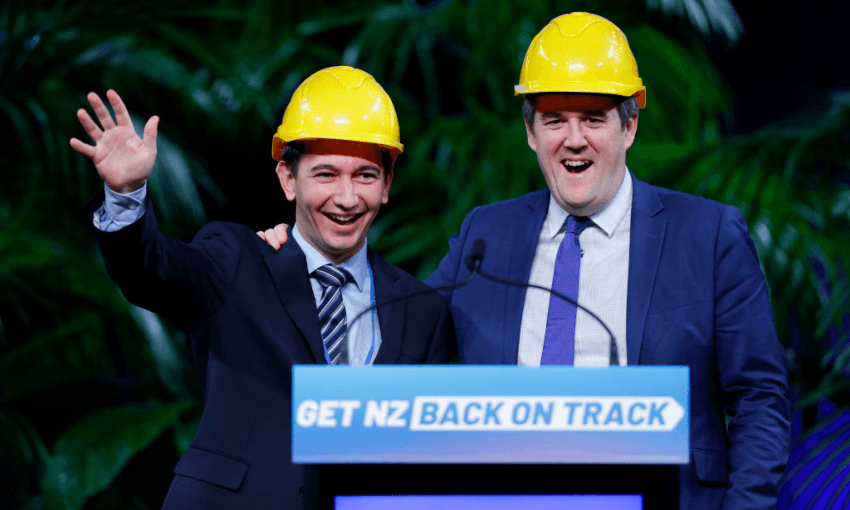
He draws a direct contrast between Labour’s Covid response, which he categorises as “spend first, ask questions later, and send Kiwis the bill”, and the government’s response to the oil crisis. “National is doing it differently,” he says. Over the course of 588 words, Brown namechecks Labour seven times and Chris Hipkins twice.
That’s as clear a sign as any that National is planning an aggressively negative campaign in 2026 centred around the Labour government’s Covid-19 response. It’s a formula that worked in 2023, so why not play the hits again?
The Covid attack-dog strategy is a necessary pivot for National. For most of the term, the party’s strategy has been to hope for better economic conditions by election day. The war in Iran made that impossible and forced a rethink.

More than any petty personal feuds, it’s this dynamic that likely explains Luxon’s decision to switch from Bishop to Brown. Bishop is the campaign manager you pick for an election decided on economic management, housing and infrastructure, where National wants to position itself as the responsible adult in the room. Brown is the man you pick if you’re marching into a culture war.
Brown and Bishop are both political animals who will do what it takes to win. While they both represent urban electorates, they come from polar opposite ends of the National Party. Bishop is arguably the most liberal MP in caucus and Brown the most conservative.
Their campaign philosophies are shaped by their environments. Consider the electorates they represent: for Bishop it’s Hutt South, the ultimate bellwether seat (the winner of the party vote in Hutt South has gone on to form the government in every election since 1999), where he consistently overperforms his party by appealing to centrist swing voters. Brown represents Pakuranga, one of the most conservative seats in the country, where he has racked up huge margins by appealing to the right-wing base.
Brown’s Covid-focused strategy will appeal to voters who are still disgruntled about lockdowns and vaccine mandates – the kind of voters National has been rapidly losing to NZ First. It also gives Christopher Luxon a line of argument he is comfortable with. The prime minister is not particularly quick on his feet and likes to resort to hyperbolic Covid attack lines whenever he gets stuck.

The government has already announced an independent review of New Zealand’s monetary policy response to the Covid-19 pandemic, which is conveniently due for release in September and should give National plenty of ammo for the campaign trail.
Whether the government gets the finding it hopes for doesn’t really matter. The royal commission of inquiry into New Zealand’s Covid response found that New Zealand had “one of the best pandemic responses in the world”, but that didn’t stop Simeon Brown from making a number of arguably misleading claims that implied the inquiry reached the conclusions he preferred.
National will focus on Labour’s poorly targeted stimulus spending – “using a crisis as cover to push through spending they could never have justified in normal times”, as Brown put it – but that relies on voters blaming their current conditions on fiscal policy from five years ago rather than the decisions of those who are currently in charge.
This strategy comes with risks. Brown and Luxon could turn out to be living in a bubble. Hardline social conservatives who harbour a deep-seated resentment to Labour’s Covid response aren’t necessarily reflective of the wider electorate.
Polling by Talbot Mills in 2025 found that 63% of respondents rated Jacinda Ardern’s pandemic leadership as good or very good compared to 23% who said it was poor or very poor. Many moderate voters were broadly happy with Labour’s response. They accept that mistakes were made in tough situations but don’t hold it against Labour the way some on the right do.
The most significant risk is simply that it makes National look like they aren’t focused on the things that matter right now. As voters clamour for leadership in an increasingly uncertain world, nothing looks more pathetic than politicians relitigating the past rather than focusing on the future.