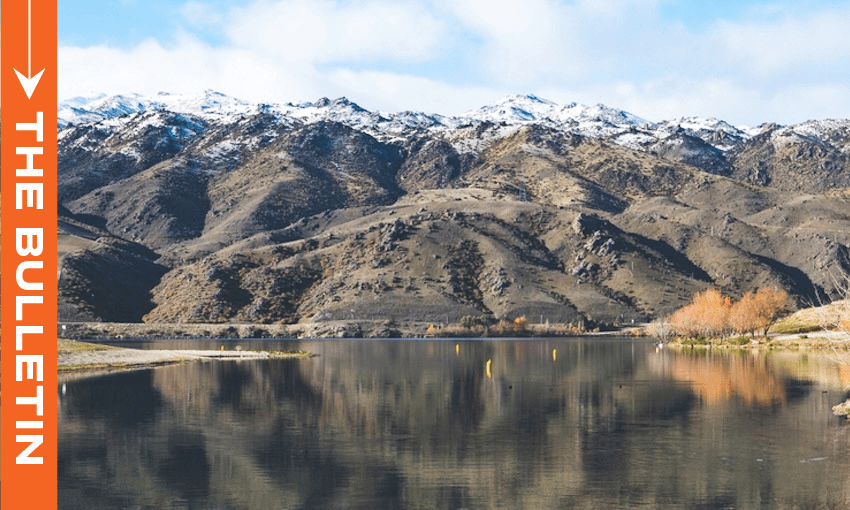

The proposed Bendigo-Ophir goldmine has drawn opposition from Sam Neill, Helen Clark, and now the government’s own environment watchdog, writes Catherine McGregor in today’s excerpt from The Bulletin.
To receive The Bulletin in full each weekday, sign up here.
‘One opportunity to get this right’
The parliamentary commissioner for the environment has issued a stark warning over the proposed Bendigo-Ophir gold mine in Central Otago: if the fast-track panel cannot receive independent assurance that the project’s considerable environmental risks can be mitigated, the application should be declined. Simon Upton’s submission to the panel, reported by Mike White in The Post (paywalled), arrives as scrutiny of the project intensifies – Sam Neill gave an interview to the Guardian over the weekend, giving the controversy an international profile.
Australian company Santana Minerals has applied to build four open pits in the Dunstan Range near Cromwell, the largest of which would be 1km long and 300m deep, alongside a 2km tailings storage dam that would remain in perpetuity. The company says the project follows the most significant gold discovery in New Zealand for 40 years and would generate $6 billion in revenue, more than $1 billion in taxes and royalties, and 357 direct jobs. The fast-track panel has until October 29 to make its decision. “Importantly,” Upton wrote, “the panel has one opportunity to get this right.”
What Upton is worried about
Upton’s primary concerns are water and earthquakes: the proposed tailings storage facility would hold what he described as “large quantities of potentially hazardous mining residues in the headwaters of one of New Zealand’s largest river systems – an area that is also susceptible to very large earthquakes”. He flagged the risk of seepage into groundwater and noted that Santana’s own experts could not give certain assurances this could be entirely prevented. Polluting leachate from tailings facilities, he wrote, “can continue for decades and even centuries after mine closure”.
Upton was also troubled by imprecise language in Santana’s application, citing the objective that “contamination caused by the operation is appropriately remediated or managed”. “What ‘appropriately’ means in this context,” he wrote, “is anyone’s guess.” The risks of acid mine drainage and tailings failures are, he said, “arguably greater” in New Zealand than elsewhere given the country’s seismic exposure. “It is what happens if things do not go to plan that is my concern.”
A movie star makes his voice heard
In his Guardian interview, Neill is careful not to come across as an anti-mining zealot. “I’m not against mining. I’m against this mine,” says the actor and winemaker, who has grown pinot noir under his Two Paddocks label in the region for 30 years and whose family has been in Central Otago for over 150 years. His concern extends beyond the single application: with Santana holding permits over a vast surrounding area, he warned that approval would set off a chain reaction. “There will be mining all around us, and that’ll be the end.” Neill has fronted a short documentary on the issue, Into the Dunstan Mountains.
The Santana project has created deep divisions in the community. Supporters, represented by a Facebook group with 8,500 members, point to the economic relief those jobs would bring to a region where many are under financial pressure. Opponents, including former prime minister Helen Clark, warn that the fast-track law under which the application is being processed has “little regard” for the environment.
The rush behind the mine
Bendigo-Ophir does not exist in isolation. As Newsroom’s Jill Herron reported in February, nearly a million hectares across Otago – and another 100,000 in Southland – are now at various stages of being “pegged” by gold mining companies, driven by a gold price hovering around $8,000 an ounce. New Zealand Petroleum and Minerals reported “record levels” of permit applications last year; 36 new permits targeting gold were approved in Otago alone.
If approved, Bendigo-Ophir would be the first mine to get consent under the fast-track process. NZ Minerals Council chief executive Josie Vidal remains sanguine. “It’s a bog standard gold mine,” she told The Detail. “I’m mystified by the attention…There’s no reason for it not to proceed.” Upton’s submission suggests the panel may see things rather differently.