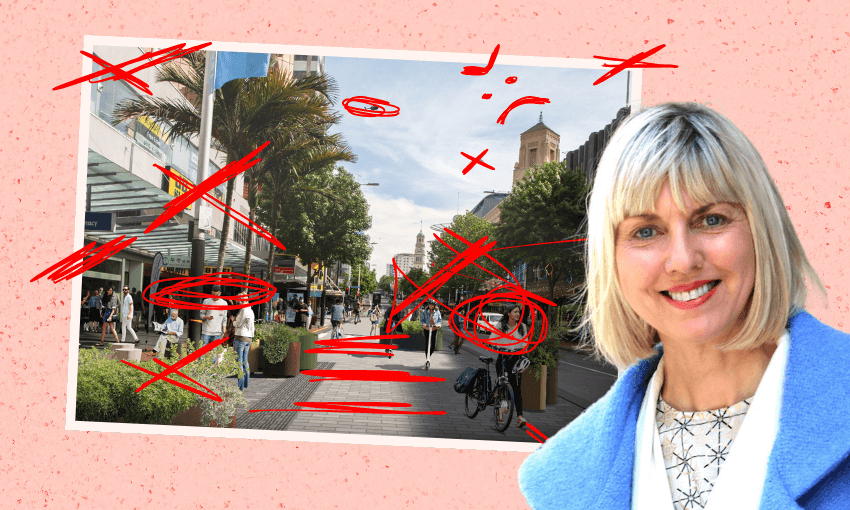



The chief executive of Heart of the City is meant to be luring people into Auckland’s city centre. Politicians, officials and even some inside her own organisation are worried she’s doing the opposite.
As Auckland Council was talking up its “magical pathway of festive light” along Queen Street in December, the person whose job it is to lure shoppers to the high-profile thoroughfare was on the radio complaining it had been undermined by anti-car officials. Heart of the City chief executive Viv Beck told Newstalk ZB’s Ryan Bridge the council had been overzealous in setting up low-traffic areas on Queen Street. Bringing cars back to a section between Wellesley and Wakefield Streets after 7pm was a necessary corrective. “We’re not averse to the vision but the execution has been lousy,” she said. “Other cities I’ve been to, they just don’t seem to be so obsessed with making it difficult.”
It was one of several recent examples of Beck using her platform at the head of the business association representing the city centre to highlight what she sees as its failings. Even as the council and businesses have scrambled to pull the area out of its post-Covid slump, she’s complained in the media about its street design and levels of homelessness, while offering comparatively little public commentary on its selling points. Now some politicians and officials seem to have had enough. They’re worried her commentary is hurting the place she’s supposed to promote. If things don’t change, it could see some tough questions asked about Beck’s role, and whether her organisation is providing value for money for the millions of dollars in council funding it receives.

In a statement to The Spinoff, Beck defended her media commentary as an effort to ensure that the “voice of business is heard”.
“We have had to highlight persisting issues in order to create positive change for the city, the results of which we are starting to see,” she said. Beck said she sees Auckland as a “vibrant city with a bright future” and noted that Heart of the City regularly promotes the city centre through its social media channels, runs events like Restaurant Month and plays a key role in bringing in attractions like the giant Christmas tree in Te Komititanga.
That explanation isn’t convincing to everyone. Mayor Wayne Brown, when told by The Spinoff that some businesses and politicians appeared to be fed up with Beck, replied with “everyone is”. His response hints at the growing frustration over Beck’s media appearances. She has regularly criticised the council’s plans for the city centre and opposed its proposed sale of the downtown carpark building despite the fact that Heart of the City’s single-largest member, Precinct Properties, was looking to invest $1.5bn into redeveloping the site. The exasperation came to a head last October, when Beck released what the Herald billed as a “scathing” Heart of the City survey of city centre businesses. The story, which came out ahead of the Black Friday and Christmas shopping periods, painted a picture of a “lawless” area overrun by homelessness and drug use.

The Spinoff understands Heart of the City’s board didn’t approve the survey’s release and were blindsided when its results were sent out to the media. The story’s timing caused consternation. Businesses rely on Christmas sales to see them through the year and headlines about drug use and crime don’t exactly paint the picture of an alluring shopping destination. There have also been questions raised about the survey’s methodology. A Heart of the City statement said it sent its questionnaire out to 500 businesses of “varying types and sizes in and around Queen Street” and received a “statistically sound response rate of 18%”. But those 102 respondents only make up a sliver of the 15,500 businesses in the area Heart of the City is tasked with representing.
KPMG manager Malcolm McCracken was voted in as Heart of the City’s board chair on February 13. He replaced former chair Martin Snedden, who quit unexpectedly in October, days after the survey’s release and a year before the end of his term. When approached by The Spinoff, McCracken declined to comment on Beck’s performance or discuss the survey, saying he still hadn’t had a chance to meet with her. But he pointed out that Heart of the City services a wider area than Queen Street. “Being in the city every day, and having done so for nearly a decade, I am personally seeing more and more evidence of a city on the move. There is no doubt that there is always more work to be done to improve things, as with any of the best cities in the world, and it’s important we don’t become complacent.” McCracken said he would be further investigating concerns raised by politicians over Heart of the City. He invited those who wanted to discuss the organisation to speak to him directly.
Beck said the survey had driven meaningful change. “Since the survey, there has been an improvement in multi-agency collaboration to address both social and economic issues, and this work continues. We appreciate the support we have received from business, social agencies, policymakers and government,” she said. Heart of the City’s work was aimed at ensuring Auckland was “vibrant, accessible and safe, and a great place to do business”.
Despite that, some officials appear to believe the survey has put people off visiting the city. The Ministry of Business, Innovation and Employment’s Auckland policy office chief Michael Quinn highlighted the impact of Beck’s commentary in a briefing document sent to Simeon Brown, the minister for Auckland, ahead of his meeting with the Heart of the City chief on November 12. The document noted Beck focused regularly on homelessness and economic challenges in the city centre. Under the heading “Revised public narrative for the city centre”, Quinn wrote, “While these concerns remain valid, continued emphasis on homelessness and safety issues risk entrenching negative perceptions”. Quinn suggested Brown remind Beck she could voice her frustrations in official channels rather than the media.

Heart of the City board member Les Morgan told The Spinoff he had seen first-hand how much some of the city centre coverage had impacted people’s perceptions. Though he works in the city as chief operating officer at Sudima Hotels, he lives in Pukekohe. His wife went for a stay in town recently with friends. “They decided to go out of the hotel for dinner, and they were both clasping my wife’s arms,” he said. “People out here are afraid of the crime.” Auckland Central MP Chlöe Swarbrick, meanwhile, recounted a conversation with a Wellington Uber driver. “He said ‘you’re from Auckland central. Isn’t it dangerous?’.”
Morgan and Swarbrick paint a far sunnier picture of the city centre. Though homelessness has risen – attributed to a mix of a nationwide recession and the government’s emergency housing policy – places like downtown’s Te Komititanga and midtown’s Freyberg Square are thriving both economically and culturally. Precinct Properties is investing around $2 billion into the area. The City Rail Link is set to come online in the second half of this year and the NZ International Convention Centre has already opened its doors. Browny’s pool is busy. The waterfront and Wynyard Quarter have been transformed. Morgan said he wished Beck and others would dwell more on what he sees as a plentiful supply of good stories to tell about the city. “I think if the interested parties took a more positive view on the city centre, then that would help us all.”
Swarbrick said she had regularly told Beck that contributing to a media narrative of the city centre being all “chaos and crime and knives and guns” resulted in less foot traffic, less vibrancy and less safety. “I have personally contacted Viv and spoken to her at a number of meetings about how I think that her approach, or I guess you could plausibly call it a strategy, is hugely detrimental to the city. I can’t make heads nor tails of how it is supposed to be successful.”
Auckland Council’s planning committee chairman Richard Hills echoed the sentiment. “It constantly makes me confused that someone who is in a position called CEO of Heart of the City, which is about promoting how great the city is, usually does the opposite,” he said.
Hills said his confusion was compounded by the amount the council was investing in Heart of the City. It received $5.9 million from Auckland Council last year, most of which was levied through a targeted rate on central city businesses which is meant to go toward efforts to “develop economic activities… and provide value to the business community”. According to Heart of the City’s audit report, the largest share of that funding went towards events and advertising, but the organisation has nine staff members and a wage bill of $1.59 million. That averages out to $180,000 per employee, though The Spinoff understands some staff are part-time. “The public and especially the city centre residents and businesses are investing significant amounts of money into promoting positive things in the city. So when it is undermined, sometimes on the day that money is being spent, it does call into question the return on investment,” Hills said.

Beck seems undeterred. Recently she’s been helping out a new incorporated society set up to represent lower Queen Street businesses. The Spinoff understands the society’s goals include restoring car parking outside luxury stores like Louis Vuitton and Dior along that stretch, which could mean scaling back some of the council’s pedestrian-friendly upgrades to Queen Street. In a text to The Spinoff, Beck said she was working with the group “and will continue to support them as we do with other precincts”.
The woman in charge of the city’s premier business association appears to be set on doing things her way. As she’s said, it’s the best method she knows to achieve change. But that approach is meeting increasing friction from the politicians with a strong interest in the city centre and potentially some of the people who govern her own organisation. Profound change is on its way to the city centre. There’s a chance it may even happen within Heart of the City.