Simeon Brown deemed speed limit cuts ‘anti-car ideology’ – a new analysis shows they saved lives

A new analysis from Timothy Welch shows lower speed limits likely saved lives.
The National-led government has raised speed limits. New data reveals the potential human cost of that move.
A witness described a car flying through the air at speed ahead of a fatal crash in east Tāmaki on March 15. It blew through an intersection on Te Irirangi Drive and ploughed into the side of another car stationed at a traffic light, killing nine-year-old Linda Tulumi and injuring four others.
Though the crash is still under investigation, minds quickly turned to the road’s safety settings. Te Irirangi Drive’s speed limit was lowered from 80km/h to 60km/h in January 2023. That change was reversed in March 2025 at the behest of the National-led government, meaning a higher limit was in place when Tulumi died. But one person at the scene told the Herald the road had always been dangerous and lower speed settings hadn’t made a difference. “It’s just one of those things. It’s just people make mistakes in the rain, most of the time at night,” he said.
That wasn’t quite right. Dr Timothy Welch, an Auckland University lecturer specialising in transport, ran the numbers on Te Irirangi Drive before, during and after its limit change was instituted. Though the road has always been dangerous, there were no fatal accidents on it when its speed limit was lower. There was one in the 60 months prior to that period and one after. After adjusting for Auckland-wide traffic trends, the crash rate on Te Irirangi Drive was 32% lower while speed limits were reduced. It went up 3% after they were raised again. A lower limit may or may not have saved Tulumi, but the stricter speed rules appear to have prevented a lot of pain.
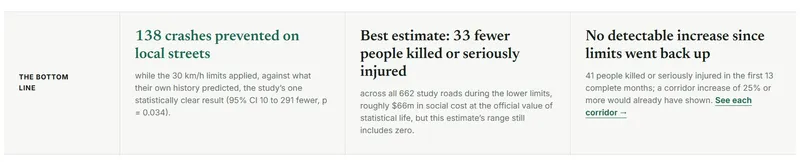
Doing that work spurred Welch on to a much wider effort. He has now carried out a similar assessment on the entirety of Auckland. After accounting for traffic flows, weather and contributing factors such as driver impairment, he has concluded that the lower speed limits put in place by Auckland Council between 2022 and 2025 likely averted 138 crashes. Though the numbers come with a statistical range, Welch’s best estimate is the changes were responsible for preventing 29 serious injuries and four deaths. “There’s a lot of cases where you really have to talk carefully about the data, because it’s so confusing. In this case, it’s very clear: more people died, and more people were seriously injured because we had higher speeds,” he says.
Auckland Council implemented speed limit reductions on 662 roads across 2022 and 2023 and kept those revised limits in place for 30 months. Welch compared that period with the 60 months prior to come up with his findings, while adjusting for Covid disruptions. The difference is stark. Crashes on the local streets with reduced limits were down 17% compared to the period prior to the changes. On corridors with higher traffic volumes, they were down 7%.

The picture gets more complicated when you look at the period after speed limits were raised. Though there’s some evidence crash frequency is trending up following the reversals, particularly on roads like Te Irirangi Drive, the dataset is still relatively small and Welch doesn’t feel comfortable drawing firm conclusions yet. “I think these numbers are very conservative,” he says. “They would be the lowest attributable change that we’d find, and the numbers that we’ll likely see publicly available from our agencies will probably be higher in the near future.”
Former transport minister Simeon Brown cited lost productivity from slower travel times as a reason to reverse speed limit changes made during the term of the last Labour government. “The previous government’s untargeted approach slowed Kiwis and the economy down, rather than targeting high crash areas of the network,” he said. His successor Chris Bishop says the government campaigned on reversing the speed limit changes and its effort to deliver on that promise has been broadly popular, with 65% of submitters to the Ministry of Transport supporting the move. It’s now focused on reducing drug and alcohol impairment, which he says is the leading factor in road deaths, rather than speed limits. “Road safety is a responsibility we all share. Crashes are caused by a number of different factors, and the government is investing in a range of actions and initiatives that target the highest contributors to fatal road crashes.”
Welch argues his latest analysis undermines the productivity case for higher speeds. Even minor crashes can have a massive economic impact, causing large traffic delays and summoning an expensive emergency response. That extends further with serious injury crashes. Using the NZTA’s value of a statistical life, Welch estimates lower speed limits saved $66 million in social cost. “One single serious injury, or one death on the road, is enough to cancel out all of the productivity savings you might gain from a slightly higher speed,” he says.
They also, in his view, saved real, literal non-statistical lives. “We don’t know who, but we do know that somebody’s loved one was saved or not seriously injured,” he says. The limits he believes spared those people are now gone, and Welch expects deaths and serious injuries to rise on the affected roads. “Unfortunately, there will be some deaths in the future because of these speeds, and we’ll continue to record those. That’s inevitable,” he says.
Despite that, the new settings are unlikely to change. Government MPs have continually rubbished what they’ve called “Labour’s blanket speed limit reductions”. Brown has accused the party of being motivated by “anti-car ideology”. Deputy prime minister David Seymour has done the same, saying the limits were borne out of “nanny state ideology, not evidence”. But that evidence is starting to pile up. There’s Welch’s, but also a multitude of local and international studies linking higher speed limits with worse and more frequent crashes. Ignoring mounting research and data in favour of your preferred outcome? It might seem a bit like ideology.

Hayden Donnell
Hayden Donnell is a senior writer for The Spinoff. He previously worked at RNZ, TVNZ and the New Zealand Herald, alongside other media companies that have since closed down or been renamed. His primary passions are local politics and the Big Fresh animatronic fruit and veggies.


