Everyone wants to break up the supermarkets. How would it actually work?

Pak’nSave is owned by Foodstuffs, one of the big two supermarket chains in New Zealand. (The Spinoff)
Four different parties want to break up the supermarkets in four different ways – and each proposal has its downsides.
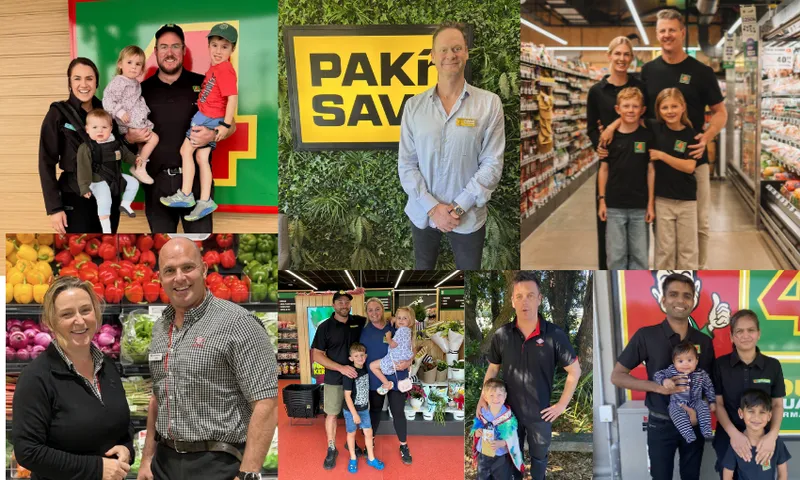
If you went anywhere near Mark Zuckerberg’s social media hellscape in the last few days, you probably saw a heartfelt plea from the owner of your local Foodstuffs supermarket, complete with a smiling photo in a grocery aisle.
The post likely discussed the long hours they work, the investment they put back into the community, and their concerns about the various proposals by political parties to break up the Foodstuffs corporation. Each owner explained that they are humble individuals, combining together into a co-operative to make distribution cheaper and more efficient for everyone.
Brendan Smith of Pak’nSave Hastings shared his thoughts, saying: “As a local owner, I can’t see how splitting that scale up would bring prices down. I believe it would push them up.”
Nick and Kaylea Bradshaw of New World Masterton added, “As local owner’s [sic], we can’t see how splitting that scale up would bring prices down. We believe it would push them up.”
Stacey and Troy Huston of Four Square St Heliers shared a slightly different view: “From where we sit as local grocery owners, we simply cannot see how breaking that scale apart makes groceries cheaper. Our strong belief is that it would do the opposite.”
Despite the smiling faces and the efforts to evoke a small town community spirit, the eerily similar scripts and co-ordinated timing of the posts that overtook everyone’s feed was just an added reminder of how much power the supermarket duopoly has over New Zealanders’ lives.
Foodstuffs runs Pak’nSave, New World and Four Square, as well as the wholesale supplier Gilmours and the Liquorland franchise. Each store is individually owned and managed but the branding, promotion, wholesale purchasing and distribution is all run by a centralised company.
The other player in the duopoly is Woolworths New Zealand, a subsidiary of the Australian company of the same name, which runs Woolworths and Fresh Choice, as well as the four remaining SuperValue stores. Together Foodstuffs and Woolworths control 82% of the grocery market share in New Zealand.
According to the Ipsos Issues Monitor poll, the cost of living is the top concern on voters’ minds this election. In fact, it’s been the top issue in every poll since November 2021. Many of the factors driving increasing food prices are outside the government’s direct control – global inflation, a war that makes fertiliser and fuel harder to get, and the growing impact of climate change. Reorganising the local supermarket industry is one of the few levers the government can pull that might address people’s concerns about the cost of food.
This moment of public pushback from Foodstuffs has been several years in the making. In November 2020, the Labour government asked the Commerce Commission to do a market study looking into the grocery sector. The report highlighted a bunch of problems: supermarkets were land banking and using restrictive covenants to prevent competitors opening nearby, and many suppliers felt they were getting shaken down due to the power of the two main buyers.
The Labour government created new laws that included a mandatory code of conduct for how supermarkets negotiate with suppliers and a grocery commissioner to oversee the industry. After a few years, those changes are largely seen as a failure. The Commerce Commission’s latest report, released in June, found that margins were unchanged and prices continued to rise.
After the 2023 election of the National-led coalition, Nicola Willis tried and failed to entice an international supermarket chain to enter New Zealand. The problem, it seems, was that setting up a nationwide chain of supermarkets requires buying 100+ large plots of land in built up residential areas. It turns out those sections don’t really exist, mostly because they’ve already been snapped up by existing chains.
After two failed attempts at reform, the nuclear option of forcibly breaking up the duopoly started to rise in popularity. NZ First was the first to jump. In April, it called for the government to restructure Foodstuffs from its current North-and-South-Island split to two separate companies for Pak’nSave and New World. The Greens took it a step further earlier this month, saying the government should forcibly acquire 120 stores from both Foodstuffs and Woolworths and turn them into a new, government-run chain they dubbed KiwiMart.
National caused the biggest splash when last week it announced that it also wanted to split Foodstuffs into two retail companies while leaving Woolworths untouched. A Sense Partners report commissioned by MBIE concluded that splitting up Woolworths would add a bunch more cost and hassle without a lot of additional benefit. Labour, meanwhile, announced it would introduce laws against price gouging and proposed its own form of splitting up Foodstuffs – but rather than split the company into separate Pak’nSave and New World divisions, it would split it into separate retail and wholesale arms.

What’s the difference?
Splitting up the retail end of the market, as National and NZ First propose, is the solution you’d look to if you thought the biggest problem with the grocery market was a lack of competition at the retail end; that consumers are forced to pay higher prices due to a lack of price competitiveness from other supermarkets.
Splitting the wholesale from the retail, as Labour proposes, is the solution you’d look to if you thought the issue was a lack of competition among buyers; the only big wholesalers are the ones owned by the supermarkets, which makes it harder for smaller grocery stores or new entrants to the market to get access to suppliers.
The Greens’ idea takes a bit of both, establishing a third chain as well as some distribution capacity. It’s the solution for people who think that profit motive is the problem; that a third privately run supermarket chain won’t necessarily shake up the market, so the government needs to come in and make it happen.
Each of these proposals comes with downsides. The National and NZ First policies will add additional costs to the supply chain because local supermarkets won’t benefit from the same economies of scale in distribution. Exactly how much additional cost and hassle that creates is difficult to predict. The Sense Partners report assumes the changes would add 1% to the cost of goods sold but create $2.9bn in net benefit for the general economy. However, that’s just an assumption. If the real increase in costs ends up in the 2-3% range, that net benefit would evaporate. And as the report acknowledges, it would be a significant regulatory change with “non-trivial legal, reputational and implementation risk”.
Labour’s suggestion is less interventionist but has its own issues: the Commerce Commission report back in 2019 found that splitting the retail and wholesale arms of the supermarkets was not “necessary or desirable” and concluded there were “substantial efficiencies associated with a degree of vertical integration in respect of retail and wholesale operations”.
The Greens’ KiwiMart proposal is perhaps the shakiest of all: it would require a hugely disruptive series of forced purchases. The government could likely end up holding some of the least profitable stores; the ones the duopoly is happy to get rid of. And even with 120 stores, KiwiMart would still be a minor player in the market with relatively weak distribution and no obvious method of undercutting the existing players – unless it involved steep taxpayer subsidies.
Each party thinks voters are clamouring to see them do something about the supermarket duopoly. The reality is that none of these proposals are clear home-run policies. Any form of government intervention in a sector that affects everyone’s lives is inherently messy, with a lot that can go wrong. And the co-ordinated social media response from the Foodstuffs owners shows how hard the industry is willing to fight back.

Joel MacManus
Joel MacManus is a senior writer for The Spinoff. He previously worked at RNZ and Stuff, and began his career at Critic Te Ārohi. His writing explores the political, economic and cultural systems that underpin modern New Zealand. He won the 2025 Voyager Media Award for Best Columnist, Opinion or Critique.


