Nicola Willis’s magic money tree and other go-to spending metaphors in NZ politics

Image: The Spinoff
Unfurl the money hose and fire up the cash bazooka: it’s time for a brief history of parliament’s favourite fiscal figures of speech.
It’s election year and the polls are tight, so politicians of all stripes are ratcheting up the rhetoric in the all-important quest to discredit their opponents.
For the centre right, that traditionally means accusing the left of profligate spending. This year is no exception, with finance minister Nicola Willis increasingly reaching for one metaphor: the magic money tree, which is sometimes but not always located “at the bottom of the garden”. Her Labour counterpart, Barbara Edmonds, appears to have put her faith in a “forest of magic money trees”, quipped Willis in March. “There is no magic money tree that can be plucked to pay for Labour’s election promises,” she warned last weekend.
It’s not a new phrase, of course, but “magic money tree” lodged itself in the public consciousness in 2017 after an NHS nurse asked UK prime minister Theresa May why she hadn’t had a pay rise in seven years. It was, said May, due to the lack of the aforementioned analogical arboreal entity. The phrase took a while to, er, take root here though: go back to the 2017 parliamentary term and just a couple of magic money trees were mentioned. Before this the fiscal orchard was near barren, with longtime National MP (and fan of a repeated catchphrase) Nick Smith the only one game enough to use the less effective, adjectiveless “money tree”, which doesn’t quite hit the same (he could’ve been referring to the boringly unmagic pachira or crassula ovata, after all).
The “magic money tree” count began to rise during the 2020 term, but still there were just a handful of mentions, with the phrase used as frequently by members of the left-leaning parties as the right (it appears everyone can agree that the magic money tree does not, in fact, exist). This parliamentary term, however, is when things really ramped up. According to Hansard, the parliamentary debate transcripts, the phrase “magic money tree” has been uttered approximately 34 times in the House since late 2023, with Willis sharing a fondness for the metaphor with her National colleagues Chris Bishop, Simeon Brown and Simon Watts.
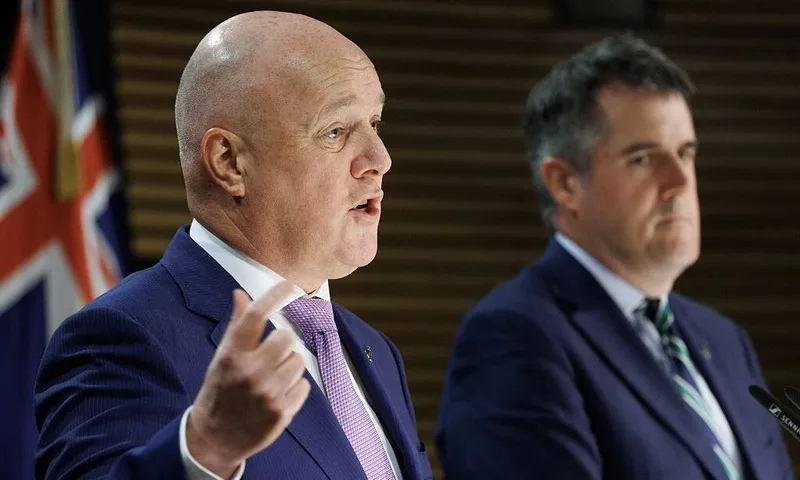
Another metaphor with international roots to gain traction in Aotearoa recently is “cash bazooka”, sometimes altered to “money bazooka”. Traditionally, cash bazooka has been used to describe quantitative easing, when central banks “print money” to buy assets and stimulate economic activity, and last year became shorthand for US president Donald Trump’s spending spree. But the bazooka has found favour in recent months with Willis and prime minister Christopher Luxon as a sly dig at the opposition. While both the magic money tree and the cash bazooka imply the other side is not to be trusted with taxpayer funds, the two phrases aren’t interchangeable: the former paints a picture of a bunch of economically illiterate, almost pitiable fools, while the latter flags a more deliberate, dangerous recklessness.
In announcing a fuel relief package in March, Luxon said there would be no “untargeted, open-slather money bazooka fired around”. During the Covid pandemic, “money was sprayed around in a cash bazooka, untargeted, not timely, not temporary”, he reiterated soon after. The very first parliamentary reference to a cash bazooka was made by Luxon on April 1 this year, and he has since repeated the phrase twice more in the debating chamber. “I’m sorry that I have to explain to the member how economics works,” said the prime minister in a response to a question from Labour leader Chris Hipkins on May 19, “but when you spend more, drive up spending 84% and spray the cash bazooka around the way that it was, inflation goes through the roof to 32-year highs.” Willis, meanwhile, has had a hoon with a single reference to a “money bazooka” and her cabinet colleague Tama Potaka has joined in with a “cash bazooka” of his own.
The precursor to the cash bazooka was the less dramatic but still effective money hose. “The Labour government decided to put the money hose on full blast,” said Willis in parliament in response to the 2022 budget, reiterating the sentiment a few sentences later: “It’s spraying that money hose around and it’s spending more and more.” By 2023 – election year, of course – the money hose was getting a thrashing. The opposition would not be voting for a bill that gave “the minister of finance another go with the money hose, because we’ve seen what he does with that money hose”, Willis said in June. “He sprays it all around without discrimination, without targets, without accountability, without clarity for what will be achieved.” Even faced with an inferno, Willis would not abide hose usage: “Look, the house is burning. Inflation is running at record levels, and yet still you spray that money hose around.”
Speaking of fires and hoses, Willis wasn’t the first in the House to invoke a flexible tube for conveying fluids in order to criticise spending. In September 2020, National’s Paul Goldsmith reckoned the Labour government had “got the firehose out…. It’s spending as much as it possibly can”. The firehose metaphor has been repeated a couple of times since, including by Act MP Simon Court, who in 2023 invoked/invented a hybrid device: a “shotgun firehose” he reckoned was squirting out “$1.3 billion of taxpayers’ funds”.
But Willis stuck with the money hose, uttering the phrase no fewer than six times in parliament over the course of a 12-month period between 2024 and 2025. Chris Bishop joined her once, describing said hose as “spouting” rather than using Willis’s favoured verb of “spraying”. He rolled it out again last week in a retro throwback to 2023. But for Willis, the money hose has been safely retracted into its wall-mounted reel, or perhaps left in a tangled heap on the lawn, since mid 2025, as the bazooka stepped up and blew all other metaphors to smithereens. Except, that is, for the magic money tree, which remains safe at the bottom of the garden.

Alice Neville
Alice Neville is The Spinoff's deputy editor. Her interests include politics, food and data-driven deep dives of all kinds.


