The highs and many lows of Christopher Luxon’s leadership

Christopher Luxon (Photo: Getty Images. Design: The Spinoff)
With a recent run of gaffes, difficulties managing his coalition partners, and two almost-coups, it’s easy to forget that Luxon has also had some significant wins in his time in politics.
After facing the second confidence vote in his leadership in less than four months and surviving, prime minister Christopher Luxon could count today as a high… or a low.
Following a several gaffes, including offending the Rotorua business community and surprising his own caucus by announcing on the fly that he wanted an MMP referendum, the past few weeks has been a series of leadership lows. It can be hard to remember there have been highs too, but there have, from major policy wins to an important free trade agreement.
Is Luxon as bumbling as the past few weeks make him seem, or do the highs even out the lows? Let’s sift through his political past:
- High: Christopher Luxon is elected leader of the National Party in November 2021, just 13 months after becoming an MP. After years of infighting and bitter leadership challenges, the party coalesced around Luxon as a compromise candidate. He was a fresh face without the political baggage of his predecessors, but with leadership experience from his time as CEO of Air New Zealand and as a senior regional manager for Unilever.
- Low: Throughout his first year as leader, Luxon’s inexperience shows with several early gaffes and flubbed interviews. He refers to government welfare policies as “bottom feeding” and says New Zealand businesses were “getting soft and looking to the government for all their answers”.
- High: His first party conference as leader, in August 2022, is hailed as a “triumph” by columnist Matthew Hooton. Reporters at the scene describe higher-than-expected turnout and a galvanised party base.
- High: Jacinda Ardern resigns as prime minister in January 2023. In the following months, several senior Labour ministers, including Stuart Nash, Michael Wood and Kiri Allan, are mired in scandals. With the wheels falling off the incumbent government, Luxon’s chances of becoming prime minister grow stronger.
- Low: The gaffes continue. In June 2023, Luxon is caught on a hot mic describing New Zealand as “a very negative, wet, whiny, inward-looking country”.
- High: In the months leading up to the 2023 election, National announces its core election policies without any major stumbles. Luxon hits the trail for a series of public meetings and photo opportunities where his extroverted nature shines through.
- Low-that-later-becomes-a-high: During a live TV debate in October 2023, Luxon commits to signing a free trade deal with India during his first term. At the time, many commentators treat this as an impossible promise made by a naive new leader. It would later become the crowning achievement of his first term in office.
- High: On election night, 2023, National secures 38.1% of the vote, 11 points ahead of Labour. Labour leader Chris Hipkins concedes. In his victory speech, Luxon promises New Zealanders “a new government and a new direction”.
- High: Six weeks after the election, National completes negotiations with Act and NZ First. Luxon, Winston Peters and David Seymour announce the first three-party coalition in New Zealand history. However, when the details of the coalition agreements are released, some commentators criticise Luxon for giving up too much power to the minor parties.
- High: Drawing on his experience in business management, Luxon institutes a 49-point, 100-day action plan as the government begins ditching the previous Labour government’s work, including fair pay agreements, three waters reform, and the Māori Health Authority Te Aka Whai Ora (to the outcry of many). In March 2024, the government declares it has achieved all 49 actions on the list.
- Low: In February 2024, the government repeals an existing smokefree law despite none of the three coalition parties campaigning on it. The controversy generates international headlines. Associate health minister Casey Costello is later found to have breached the public records act by giving health officials an unattributed, industry-friendly policy document that claimed “nicotine is as harmful as caffeine”.
- Low: In the same month, Newsroom reveals that Luxon has been claiming a $1,000-per-week housing allowance to stay in his own mortgage-free Wellington apartment despite having access to Premier House. Initially, he defends the decision with the now-infamous line “I’m entitled to the entitlements”. Within hours, he changes course, citing feedback from Newstalk ZB callers that made him realise the issue had become a distraction. The ordeal raises further questions about his political instincts.
- High: In April 2024, Luxon leads his first international trade mission, taking a delegation of top New Zealand business leaders through Singapore, Thailand and the Philippines. His performance gets largely positive reviews from businesses and political commentators.
- High: The government’s first budget, in May 2024, delivers small tax cuts and increased funding for health, education and police, though widespread layoffs to public sector staff generate controversy.
- Low: The Treaty Principles Bill inspires mass backlash, which peaks in November 2024 with the largest single protest in New Zealand history and more than 300,000 select committee submissions. Much of the focus is on the Act party and David Seymour, who proposed the bill, though Luxon also cops criticism for agreeing to support the bill through its first reading.

- Low: In May 2025, the government rushes through pay equity changes under urgency with no public consultation. All 33 active claims, covering tens of thousands of workers, are discontinued. It causes widespread outrage. The Act Party claims it as a victory, with Seymour claiming the decision cut $12b in government costs and “saved the budget”. Snap polls find that the changes are deeply unpopular.
- Low: In February this year, US President Donald Trump launches air and missile strikes at Iran, prompting the middle east power to close the strait of Hormuz. The downturn in global trade effectively kills New Zealand’s fledgling green shoots of growth and all but guarantees that economic conditions will not be significantly better by election day.
- Low: National polls poorly for a first-term government through 2026, and rumours of a potential leadership coup start to grow. In an attempt to head off media speculation, Luxon moves a formal motion of confidence. The National Party caucus backs him, Luxon declares the matter closed and decries the speculation as a “media soap opera”.
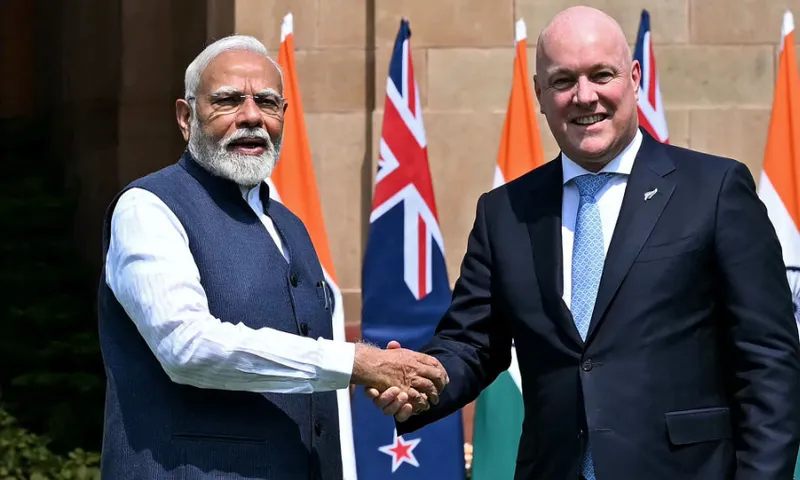
- High: In April, New Zealand signs a free trade agreement with India, fulfilling the bold promise Luxon made during a live TV debate – though some commentators criticise the limited nature of the agreement. The nine-month negotiation period sets a record for the fastest free trade deal ever signed by either country.
- High: The free trade agreement is followed up by an official state visit from Indian prime minister Narendra Modi. Luxon and Modi are greeted by a raucous crowd of 10,000 Indian-New Zealanders at Spark Arena. Luxon takes a victory lap to celebrate his most significant political accomplishment.
- Low: In July, foreign minister Winston Peters causes controversy after telling Chinese-New Zealand MP Lawrence Xu-Nan to “go back to his own country”, prompting strong criticism from the Chinese ambassador. Luxon declines to penalise Peters as doing so would likely bring down the government. It adds to the perception that he has no control over his coalition partners.
- Low: Luxon tells a crowd of small business owners in Rotorua that businesses have a “parent-child mentality” and too often look to the government for help. He later apologises for his comments, conceding that he “got that wrong”.
- Low: During a talkback segment on Newstalk ZB, Luxon indicates his support for a referendum on MMP, saying it would be better to have National ministers at the cabinet table than “some yahoo or numpty from some other party”. It’s widely interpreted as a criticism of coalition partners NZ First and Act. Winston Peters puts out a strongly worded statement criticising it.
- Low: On Monday, after several weeks of bad headlines, discontent again bubbles up within the National Party and rumours of a potential challenger grow louder. Luxon calls an emergency caucus meeting.
- High(?): After three hours, Luxon emerges, surrounded by fellow National MPs. In a 76-second statement, he declares that he has the full support of his caucus. It is a personal victory for him, as he stays on as party leader and prime minister, but there’s no doubt the ordeal leaves him politically damaged.

Joel MacManus
Joel MacManus is a senior writer for The Spinoff. He previously worked at RNZ and Stuff, and began his career at Critic Te Ārohi. His writing explores the political, economic and cultural systems that underpin modern New Zealand. He won the 2025 Voyager Media Award for Best Columnist, Opinion or Critique.


