Introducing Democrasee, the political board game tested by MPs

Democrasee is a newly launched political board game.
A new board game seeks to teach young people the power of politics, without all the boring stuff. And it’s already approved by parliamentarians.
Would you make a good politician? Do you have what it takes to gain influence, pass policies, win seats and form a government? Wait, do you even have the foggiest clue about how our democracy works?
These questions are the aim of the game in Democrasee, which seeks to make understanding politics a little more fun. It’s already been trialled in classrooms by rangatahi, who have, apparently, come away with dreams of actually making it into parliament. A number of MPs have also tried their hand at it, and if you ask defence minister Chris Penk, it’s “almost as fun as the real thing”.
The game is the brainchild of Chris Pongi, a man who’s more of a gaming geek than a political tragic. His past ventures include Taufamana, a collective that incorporates Pasifika storytelling into chess to get youth into the game. With Democrasee, Pongi wants to bring an “innovation in education” to schools and share his passion for helping young people understand difficult topics.
Too many people have a one-size-fits-all approach to education, Pongi says, and some methods of teaching put too much onus on the student for failing to understand a concept. “I believe that the teacher should be the one that should cater the way we divvy out information [to different learners], so it can be met halfway,” Pongi says.
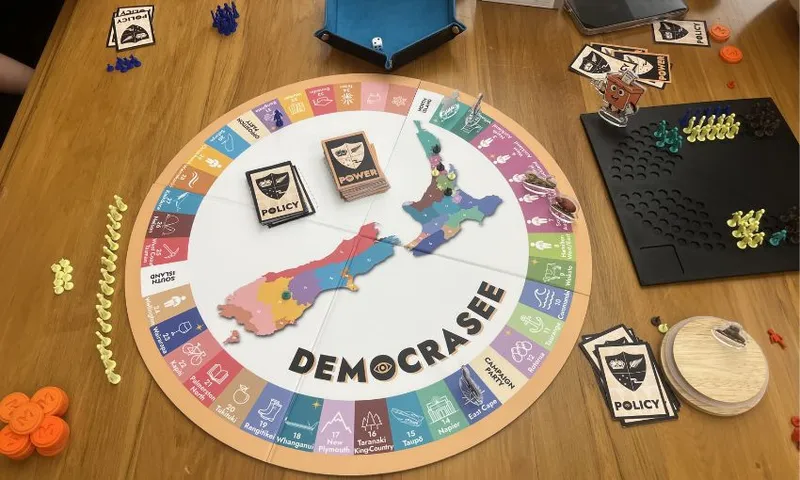
In Democrasee, your end goal is to get as many seats as possible in parliament so you can form a government. It’s like Monopoly in the sense that travellers move along spaces on the board hoping to land on, and own, an electorate seat. Because it would be a bit of a stretch to fit all 71 electorates in Aotearoa on the board, some are lumped together – for example, the South Auckland tile represents six seats. You can also win Māori seats, and negotiate and form coalitions with your fellow players.
To win the game, you’re going to need some winning policies. The policy cards you collect as you travel across the board can range from issues in the justice sector like legalising cannabis, to economic issues like raising paid parental leave. Then you also have your power cards, which can shift alliances and force your and other players’ hands – if you pull the “campaign overspending fine”, you lose one seat.
Pongi has never really been a massive politics guy. He didn’t vote in his first eligible election, but since becoming a father and nurse, he’s realised the long-term effects that policymakers have on society. “I didn’t understand it and didn’t really care too much for it,” Pongi says, “But I’ve got three kids now, and I know that anything that happens in the future is always going to impact them long after I’m not here.” He’s also found inspiration from his community, citing the powers of a close friend who works as a policy analyst to “save thousands of lives with the stroke of a pen”.
The Spinoff sat down for a quick play with Mt Roskill MP Carlos Cheung, Takanini MP Rima Nakhle, youth minister James Meager and defence minister Chris Penk. You would have thought it was poker night in the National Party caucus room – policy debates included some jovial hollering, alliances were formed and broken, and Meager proved himself to be capable of winning a Māori seat.
Players vote on their competitors’ favourite policies and surprisingly – for this crowd at least – my small business fund policy was trumped by Nakhle’s policy to make Matariki a public holiday. Pro tip: you can never really bet on what policy is going to be the biggest crowd pleaser by trying to cater to your fellow players. I never would have predicted I would be out-woked by the National Party.

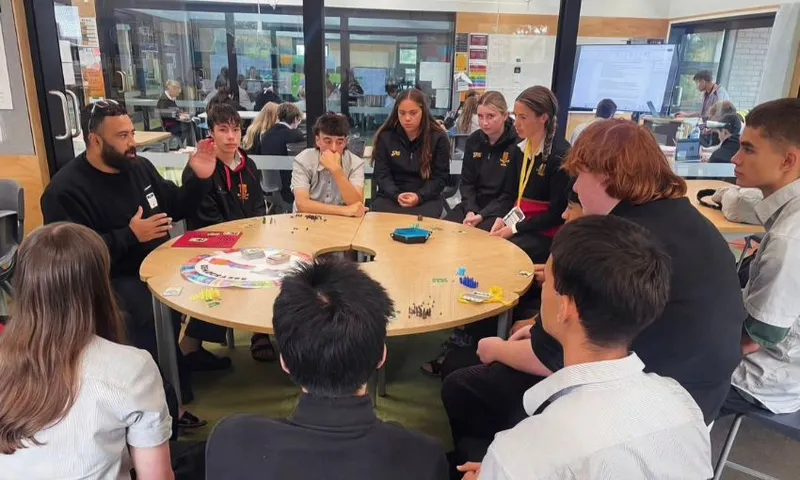
As well as MPs, nearly 200 students across three Auckland schools have play-tested the game. Their feedback has helped developed the final version, which is the third iteration of the game. Pongi and his co-founder, educator Emma Kim, only launched Democrasee’s PledgeMe page this week, with children’s minister Karen Chhour as their first donor. You can order the game (in a family friend or classroom-friendly version) from the page, but you won’t find Democrasee in your local Whitcoulls — Pongi and Kim are hoping to raise $40,000 to roll the game out on a wider scale.
After our match, Penk told The Spinoff he believed the “literal gamifying of politics is a smart move.” He suspected the visual component of the game would make politics more interesting to young person. As for the ever so eloquent Penk, his favourite part of the game was the “passionate and parochial arguments with colleagues about the relative merits of two entirely different policies.”
Trade minister Todd McClay has also tried his hand at the game, and given it a thumbs up. “Our commitment to democracy and protection of the way we elect our parliament is one of the most important principles we must protect,” McClay said. “This game means more New Zealanders, especially our young people, can more easily play their part in how our country is governed.”

Lyric Waiwiri-Smith
Lyric is an award-nominated politics reporter at The Spinoff. She covers parliament from the press gallery, pens the weekly column One MP, One Pint and is endlessly curious about what makes our decision-makers tick. Off the clock, Lyric loves a live gig, a cold brew, and being a Wellingtonian (on a good day).


