The rule-in, rule-out game is ruining one of the best things about MMP

MMP should be allowed to get weird. (Image: Tina Tiller)
Our governments are meant to be decided by elections, not by a process of elimination carried out by politicians months before ballots are cast, writes Hayden Donnell.
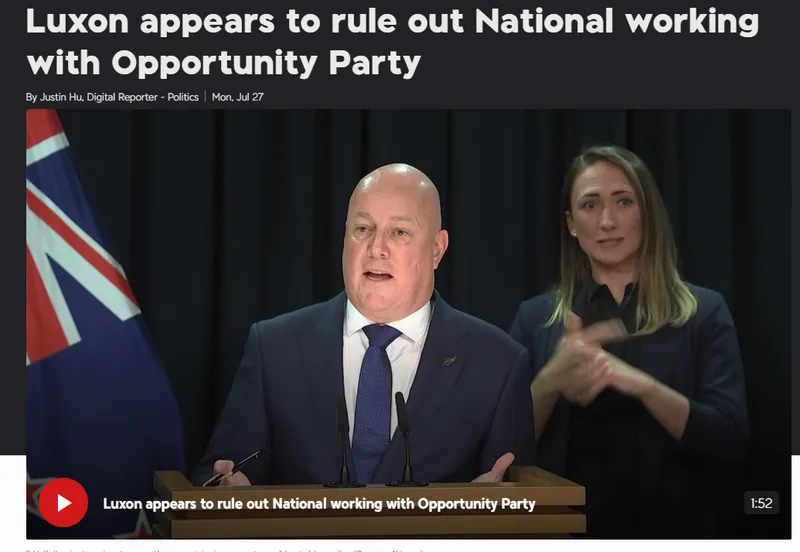
Christopher Luxon didn’t even seem like he meant to rule out working with the Opportunity Party when he did it back in July. The prime minister was just vamping about the evils of the teal party’s tax proposals for the umpteenth time when Sean Plunket pushed him into more strategically definitive territory than expected. “So you won’t coalesce with them?” The Platform owner asked. “I mean, you know, we don’t want to do business with parties that want to increase taxes,” Luxon said before complaining about “hypotheticals” and wandering off stage. His office had to release a statement hours later confirming his comments were an official, proper rule-out.
Perhaps Luxon stumbled into the decision out of force of habit. Rule-ins and outs have become a staple of our general elections. Every three years, politicians are harried into essentially deciding the makeup of the next government via process of elimination about three months before a single ballot has been cast. So far this election, National has ruled out Te Pāti Maōri, Labour, the Greens and Opportunity. Labour has ruled out NZ First and Act. NZ First has ruled out Labour, a lot. Te Pāti Māori appears to be ruling out any of the governing coalition. Other parties are promising more ruling in and out before poll day mercifully arrives on November 7.
The rain of rule-outs is such that only a few viable electoral options are left by the time votes are counted. That has the upside of giving voters certainty when they cast a ballot. It has the downside of kicking the defining and quite possibly best feature of MMP directly in the goolies.
Our voting system is meant to be built on compromise and cross-party cooperation. No longer can National or Labour pootle their way to 40% of the vote and push through their agenda unfettered for three years. Proportional representation is supposed to force them to consider the eclectic views of, if not the whole population, then a more sizable portion of it than before.
The system should allow governments to get a bit weird. It has in the past. In 2008, John Key led a minority government, with confidence and supply support coming from all over the shop, including from worm-wrangling fonts of raw charisma like United Future’s Peter Dunne and buttoned-up statesmen like the Māori Party’s Hone Harawira. Helen Clark cobbled together a government with Jim Anderton’s Progressive as a coalition partner, and United Future and NZ First offering confidence and supply. The Greens tagged along with a bespoke cooperation agreement.
Other countries go further. Right now, Denmark is led by a minority government made up of the centre-left, centre-right and moderates. Ireland, Germany, the Netherlands and Switzerland are regularly governed by politically diverse coalitions. As they delve deeper into ideological cross-pollination, New Zealand seems to be trying to wrench first-past-the-post elections out of an MMP system, with National in particular only opening the door to its social and economic right.
Though that may enable it to promise voters a continuation of the harmonious and stable government relations that have defined the last three years, it comes at a cost. Sometimes a philosophical potpourri can temper the worst bits of a government, with parties taking the edge off their partners’ abrasive instincts. Other times, it can push them in unexpected directions. Key’s administrations are remembered for progress on treaty settlements and Crown-iwi relations after the fractious Clark years, partly thanks to a long partnership with the Māori Party.
The proliferation of rule-outs has distorted our elections. Once an official rule out has been issued by one party, the lack of a rule-out becomes a cudgel with which to beat enemies, sometimes in questionably honest ways. Right now National is running ads accusing Labour of introducing somewhere between seven and 11 new taxes. As it turns out, many of those are actually Green and Opportunity policies they’ve lumped in with Labour’s based on guesswork.
Most importantly, the rule out game strips voters of agency. NZ First leader Winston Peters has been particularly vehement on this point. “Voters will decide this issue, the voter’s our master here. Politicians are the servants,” he said while being questioned on a potential coalition with National in the 2023 election, shortly before repeatedly ruling out a coalition with Labour.
The anti-rule-out version of Peters has a point. MMP is meant to empower voters to demand a governing coalition of their choosing. This time round, Luxon may not want a National-Opportunity government but it increasingly appears the electorate is open to the possibility. Labour may not want to work with National but their top Auckland constituent Wayne Brown wants them to leave the door open. Instead these voters are being railroaded into a traditional two-party battle, only with three or four parties lined up on each side instead of one.
New Zealand voted for MMP in 1993. According to recent polling, a large majority of us still support the system. It’s time we tried implementing it properly by allowing voters to decide our elections instead of politicians. As a wise man once said, they’re meant to be our servants.
Hayden Donnell
Hayden Donnell is a senior writer for The Spinoff. He previously worked at RNZ, TVNZ and the New Zealand Herald, alongside other media companies that have since closed down or been renamed. His primary passions are local politics and the Big Fresh animatronic fruit and veggies.


