


NZ First, Act and even the back-from-the dead Alliance Party are suddenly very interested in West Coast-Tasman. Westport journalist Ellen Curnow explains why.
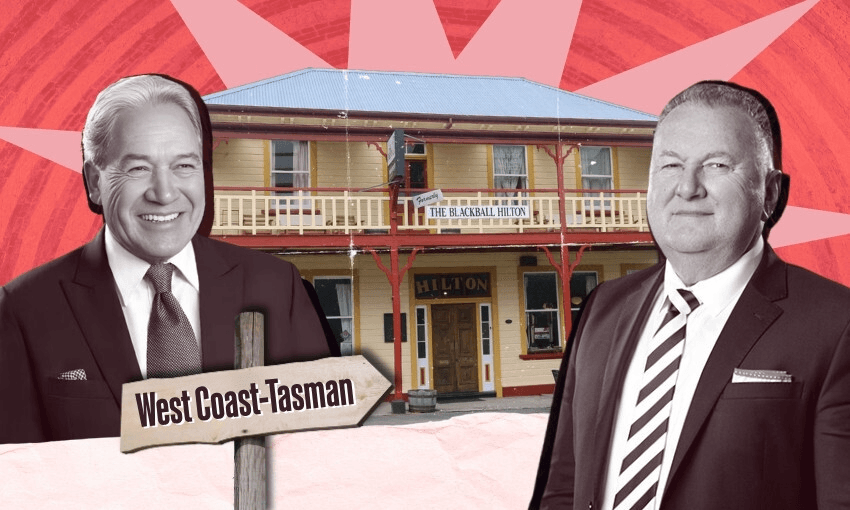
Politicians don’t suddenly turn up on the West Coast for the scenery, but there was Winston Peters, accompanied by Shane Jones, on Saturday, launching NZ First’s 2026 election campaign in the tiny town of Blackball, population about 300.
Peters opened with a familiar refrain: a pitch to hard-working, blue-collar workers who get their hands dirty and work six, sometimes seven days a week. Then came the jab at the left, at urban voters, at anyone not in the room. “Lanyard-wearing, soft-handed, gluten-free, soy boy, virtue-signallers… chardonnay-drinking do-gooders,” he said, who “invariably vote for the Green Party.”
The next day, there were Peters and Jones again, this time in Westport. The NBS Theatre was nearly full – all 360 seats, or close to it, taken.
Act, too, seems to be circling. It’s latched onto the troubles of Blackball’s pub and hotel. The party is apparently very concerned that Formerly The Blackball Hilton has lost its outdoor seating area because its tables and chairs fell outside the licensed boundary. Last month local government spokesperson Cameron Luxton issued a press release about the pub, using it as a case study in what it sees as Wellington strangling small-town businesses with red tape.
Politicians don’t suddenly show up for the scenery: they show up when they think something is up for grabs. What they’re after is the West Coast-Tasman electorate. They see a seat that’s there for the taking.
Once upon a time this would have been unthinkable: the electorate was a Labour stronghold. Hell, the party was famously born over a century ago in Blackball, after a three-month miners’ strike ended in victory. For close to 30 years, Damien O’Connor held the seat for Labour, aside from the 2008 election, when National’s Chris Auchinvole briefly snatched it away.
The Labour era, however, may well be over. National’s Maureen Pugh just beat O’Connor at the last election, as Labour’s historic support from 2020 collapsed. Now, Pugh is retiring after a single term as the electorate’s MP, but O’Connor has moved to Otago and won’t stand. The major parties are yet to announce new candidates.

The seat is wide open, and the minor parties can smell it. Even the back-from-the-dead Alliance Party has announced a candidate, Louis Coup. New Zealand First’s pick is former Buller mayor Jamie Cleine, who may have accidentally revealed the campaign’s blind spot in his opening remarks. “I want to… contest the West Coast seat,” he said.
The problem? The West Coast isn’t an electorate on its own. It has an awkward arranged marriage with Tasman – a political partnership that has never quite agreed on what the future should look like.
Cleine gave Tasman a mention later, but the lag matters, because Tasman supplies roughly two-thirds of the electorate’s voters – even if the Coast has historically supplied the candidates.
What NZ First, and every other party that takes a shot at the electorate, needs to know is that the Coast picks the personalities, but Tasman decides who wins. It’s a political balancing act, and a fragile one.
On the coast, mining, industry and cost-of-living pressures dominate. In Tasman, environmental concerns and lifestyle politics carry more weight. Both places have working-class roots – but they don’t always agree on what that means in practice.
Recent protests have made that divide impossible to ignore. Last year, two protesters spent three weeks occupying an aerial coal wagon to oppose the fast-track approval by Bathurst Resources to extend its Stockton mining operations across the Buller plateaux to Denniston. Local reaction was swift: “They’re not from around here.” There was talk – only half-jokingly – of greeting them with pitchforks when they came down (there was also plenty of speculation about how they were going to the toilet). Buller relies on mining jobs. There’s a lingering resentment that people in big cities get to virtue-signal about places like Denniston but don’t have to live with the consequences.
In Tasman, it’s locals – not outsiders – protesting the Sams Creek goldmine, worried it could poison Te Waikoropupū Springs with arsenic. Same country. Same electorate. Completely different fights.
It’s an interesting line for politicians to walk. New Zealand First says it can unlock mining’s economic potential while protecting the environment. How that balance works in practice remains light on detail.
The other challenge (which is also an opportunity) that candidates face is that the Coast is no longer particularly loyal to anyone. They’re open to pitches and it’s a stark change. In 2020, Act held a public meeting in Westport’s NBS Theatre. One person turned up. Me. I banged out a story about it for the Westport News. The headline practically wrote itself. By the time the 2023 election rolled around, a whole lot more people were showing up to hear from the minor parties.
By then, voters had nine candidates to choose from, including high-profile anti-vaccination campaigner Sue Grey, and independent Patrick Phelps, whose campaign carried the distinct whiff of about $32,000 in Bathurst coal money (a big donation for an independent to bag). That was, of course, the year the red tide went out. O’Connor lost but he still outperformed his party, a reminder that here, the candidate has often mattered more than the colour. With O’Connor moving on, even that safety net is gone for Labour.
Now all of the parties – especially the minor ones – are trying to build a coalition that stretches from Karamea to Collingwood. That’s not easy. Win the Coast and you risk losing Tasman. Win Tasman and you risk looking out of touch on the Coast. Win neither and you’re just another politician passing through. The candidate who can hold both – economically grounded enough for the Coast, environmentally credible enough for Tasman – will win. Everyone else is just visiting.