How one 40-year-old song ended up in seemingly every big NZ movie of 2025

Image by Tina Tiller
Alex Casey investigates the powerful resurgence of a Crowded House hit in cinemas this year.
The most patriotic I have felt in a long time was during one of the occupation scenes in Pike River. Anna Osborne and Sonya Rockhouse, played by Melanie Lynskey and Robyn Malcolm, are leading the protest against concreting trucks coming to seal the mine. Setting up “Camp Pikelet” at the Pike River gates, a montage shows the women perched on camp chairs and wrapped in wool blankets, sharing plates of biscuits and laughing along with the community supporting their fight against corporate greed and negligence.
As if this vision of Aotearoa isn’t moving enough, then comes the hammer. It begins with that unmistakable melancholy strum, then the syncopated backbeat, then the flurry of drums. “There is freedom within, there is freedom without,” Neil Finn starts to croon, as audience members reach to catch their own deluge of tears in the nearest paper cup.
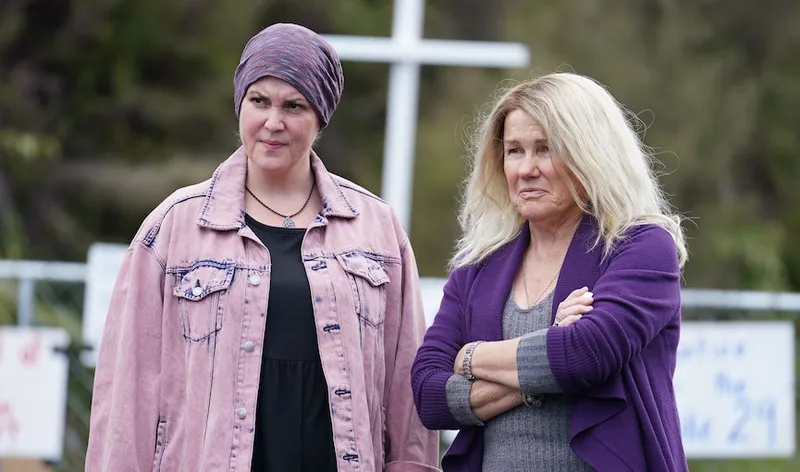
‘Don’t Dream It’s Over’ by Crowded House is having a real moment in local cinemas this year. Beyond Pike River, you might have also heard it played on an outdoor piano in Tinā, as teacher Mareta (Anapela Polataivao) joins her student Sophie (Antonie Robinson) in an impromptu duet. Or perhaps you remember it as the emotional climax of Prime Minister. Jacinda Ardern blinks back tears while talking about her yearning to return home, before Finn comes off the top ropes once more beneath soaring scenic shots of Aotearoa’s mountains, lakes and forests.
Of course, this is far from the first time ‘Don’t Dream It’s Over’ has made a splash in film and television. Just two years after its release in 1986, the song appeared in a climactic scene in Miami Vice, where a permed Caitlin Davies-Crockett (Sheena Easton) makes an emotional goodbye to her mulleted man-friend. Since then it has made dozens of appearances in everything from Love Island to The Leftovers, The Simpsons to The Americans. It’s also been covered by everyone from Ariana Grande to Stan Walker, to the entire cast of Glee.
Despite its ubiquity overseas, ‘Don’t Dream It’s Over’ was a slower burn closer to home. “It is an interesting song because, when it was first released, it became an example of the cultural cringe of the time,” says Gareth Shute, music historian and author of Songs from the Shaky Isles: A Short History of Popular Music in New Zealand. “It even got on the US top 30 before it got in the New Zealand top 30, which shows how we were too shy to embrace it, like we couldn’t believe that a local song could be good enough to sit alongside overseas ones on the radio.”
The song, which Neil Finn wrote in one day on his brother’s piano while “feeling a little bit antisocial”, eventually made it to number one in Aotearoa in April 1987 and has only gained cultural momentum since. In 2001, it was ranked second on APRA’s list of the Top 100 New Zealand songs of all time (behind ‘Nature’ by The Fourmyula). ‘Definitely in the 20 or so years since, there’s no way that ‘Nature’ would be up there anymore,” says Shute. “These days, I think ‘Don’t Dream It’s Over’ would easily win that vote.”
With it’s recognisable “jingajik” or “Māori strum” heard at any sing-a-long in Aotearoa, ‘Don’t Dream It’s Over’ also has deeply emotive lyrics that are just vague enough to resonate with a range of situations. Pike River director Robert Sarkies says the lyrics played a part in selecting the song for the film. “It seemed to speak directly to our story of friendship and an epic battle for accountability – ‘there’s a battle ahead, many battles are lost but you’ll never see the end of the road while you’re travelling with me’,” he tells The Spinoff. “I can’t think of a more relevant lyric.”
Sarkies wasn’t aware of the 2025 ‘Don’t Dream It’s Over’ deluge until he saw Tinā and Prime Minister in cinemas, just like everyone else. “Directors edit films in isolation, sitting in darkened edit suites piecing together our individual jigsaws,” he explains. “Or, in my case, playing a lot of music against images to see what fits.”
Miki Magasiva, director of Tinā, also said he experimented with a few different New Zealand songs for the moment his two main characters meet at the piano for the first time. “It really had to be a strong song that navigated, or could exist in, the lives of both these characters – a young student and an older teacher,” he says. “‘Don’t Dream It’s Over’ is one of those songs that has stood the test of time and continues to resonate with people who were around when it was released, as well as younger people who are discovering it years later.”
The song didn’t just make contextual sense for the characters – the lyrics also connected with the plot, as in Pike River. “The words have always spoken of someone who is struggling to discover themselves and their place in this complex world we live in, but there is always hope in navigating that,” says Magasiva. “Both of our characters are going through hardship; they both feel lost, trying to overcome something massive in their lives. But they’re also both musicians, and this song helps them connect without a word being spoken to each other.”
Rounding out the trifecta is Prime Minister, directed by Michelle Walshe and Lindsay Utz, who explain that the song captures Ardern’s bittersweet journey. “We wanted the final note to hold both the ache of what’s gone and the hope that still endures. For us, the song holds a similar tension – the melancholy of division intertwined with optimism.” And while they experimented with a few options, the choice was clear. “The track is both a reminder and a rallying cry – even when the world feels fractured, we can still dream of a future with humanity and empathy at its core.”
Whatever the motivation behind ‘Don’t Dream It’s Over’ becoming a local film favourite this year, Shute says there is little risk of the song ever feeling overplayed at this point. “You would have thought it would have been killed in the 90s, because 80s popstar Paul Young did quite a cheesy cover of it, and so did Sixpence None the Richer – that’s two pretty good attempts to try and ruin a song,” he says. “But you go back and listen to the original production, it’s just the perfect version that also still sounds current enough to put in a movie.”
And although it has already appeared in the three biggest local films of the year, we’ve still got two months left of 2025. Could there be room for one more spin of the song in cinemas?
“Hey now,” says Shute. “Don’t dream it’s over.”

Alex Casey
Alex Casey is a senior writer at The Spinoff with over a decade of experience writing about popular culture and social issues in Aotearoa. She lives in Ōtautahi and likes watching reality TV and walking the dog, occasionally at the same time.


