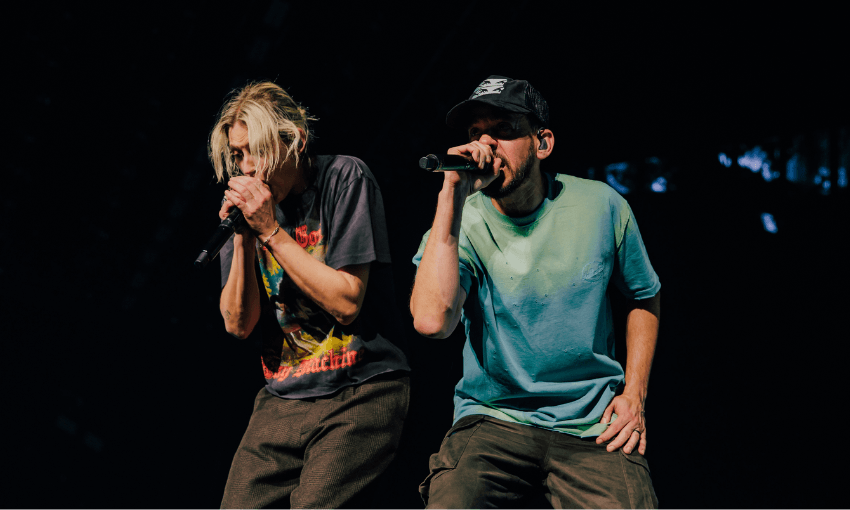



Is the band better or worse with new vocalist Emily Armstrong? In the end, it doesn’t even matter.
The first indication that Linkin Park’s show at Spark Arena was about to begin was a 10-minute countdown timer appearing on an LED wall. It was simple white text on black, with a backing track of groovy, easy-listening jazz. Each time another minute ticked away, the crowd counted the final seconds and cheered. Large men in black singlets waved their arms in the air like they just didn’t care.
The stripped down introduction gave space for everyone to project their own feelings onto what they were about to experience, and there was an atmosphere of happy anticipation. This was a reunion, of sorts, for fans who’ve known the band for almost three decades.
New Zealand has always had a strong connection with Linkin Park; embraced by the die-hard rock fans but with crossover appeal to electronica, pop and hip hop. The band has had seven number one albums here and almost certainly could have packed out a bigger venue. As it was, the show set an attendance record at Spark Arena with 12,736 people – made possible due to a capacity increase at the stadium two years ago and a seating configuration which allowed for more people.
This tour is the first time Linkin Park has performed in New Zealand since 2013, the first since founding lead vocalist Chester Bennington’s death by suicide in 2017, and the first with new vocalist Emily Armstrong, who joined the band in 2024.
Bennington’s death in 2017 hit harder than many celebrity deaths because of how much he wore his anxieties and self-doubt on his sleeve, both lyrically and in his raw, raspy voice where every big note seemed to be an expression of inner pain.
Mike Shinoda, the rapper, guitarist and keyboardist, took on the frontman duties of interacting with the crowd. He was in a good mood, joking about the record attendance (“I don’t know what that means”) and shouting out the fans in the awkwardly-positioned corner blocks (“guests of honour in our most special section”). He shared an emotional hug with a fan who was about to have surgery and gave them his hat for luck. “It’s good to share,” he quipped, as members of the band threw out guitar picks and drumsticks to the pit.
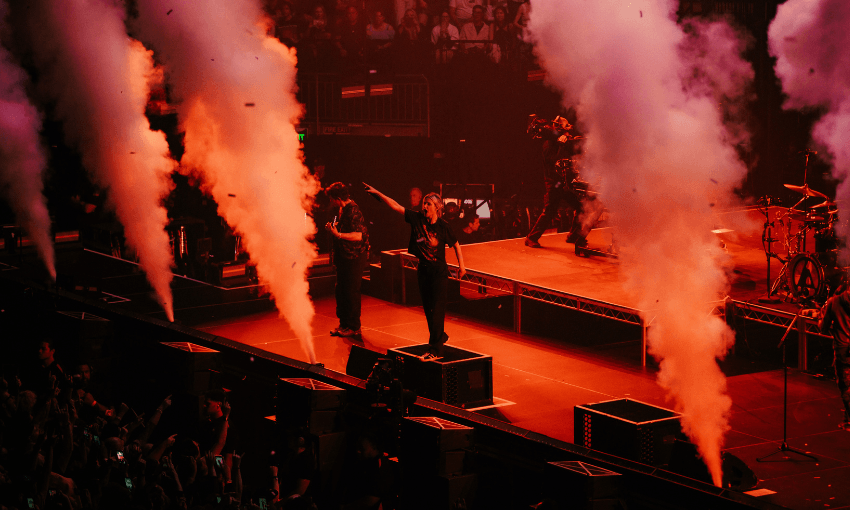
There was no mention of Bennington – clearly, the band has no desire to dwell on a tragedy from nine years ago – and there was no formal introduction of Armstrong as the new vocalist. She just cracked on with it and let the music speak for itself.
The show opened with ‘Somewhere I Belong’, one of Bennington’s most emotionally vulnerable tracks. (“I wanna let go of the pain I’ve felt so long/Erase all the pain ’til it’s gone”). Armstrong performed it earnestly, as if it was a tribute, standing in one spot and cupping the microphone with both hands.
Armstrong is a supremely talented rock vocalist, reminiscent of Amy Lee or Courtney Love, but is inescapably different to Bennington. That difference manifests in a refreshing new layer on some tracks. She can belt ‘From the Inside’ more dramatically than Bennington could, and some lines (“I swear for the last time/I won’t trust myself with you”) take on new meaning coming from a female singer.
She showed her abilities most impressively during ‘Lost’. After 30 seconds of silly riffing with a man in the crowd dressed as a banana, she launched into the first note with a fierce, throat-shredding scream that Bennington wouldn’t have been able to hit.
Other songs, however, gave the impression of watching a high-production cover band. ‘One Step Closer’ wasn’t the same without Bennington’s distinctive yell of “shut up when I’m talking to you”.
‘Leave Out All The Rest’ similarly fell short without Bennington’s voice, but the power of his lyrics carrying from beyond the grave made up for it. (“When my time comes, forget the wrong that I’ve done/Help me leave behind some reasons to be missed.”) The final, haunting refrain felt like Armstrong speaking directly to Bennington – and to sceptical fans. (“I can’t be who you are/I can’t be who you are.”)
At times, Armstrong looked a little uncomfortable on stage. She skipped around, jumped on platforms and did all the things you expect from the lead singer of a rock band, but there was an undeniable air of self-consciousness. Which was perhaps appropriate – a new singer in a legacy band shouldn’t make it all about themselves.
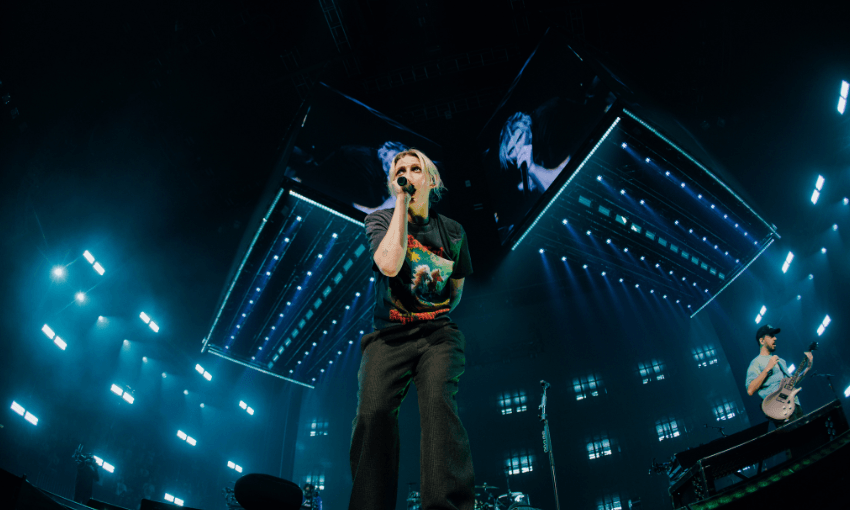
During the show’s conclusion, as the band reached for their hardest-rocking songs (‘Numb’, ‘In the End’, ‘Papercut’, ‘Bleed it Out’), Armstrong proved why she was chosen to take this band forward, delivering a professional, powerful performance that did justice to the band’s biggest hits while adding a fresh sound.
The crowd was on its feet, feeling every word, a sense of collective elation in the room. They were simply grateful that this band, which many fans assumed they would never see live again, was still here putting on a legendary show. Is Linkin Park better or worse with Emily Armstrong in the lineup instead of Chester Bennington? In the end, it doesn’t even matter.