Tokyo’s New Zealand-themed love hotel – that forgot New Zealand

One of only two obvious references to New Zealand. Personally, I’d have traded it for a single Pineapple Lump. (Photo: Ryan Anderson)
After moving from New Zealand to Japan last month, Katie Ham thought she’d found a small slice of home in Tokyo. Turns out it was a love hotel.
I was walking towards central Shinjuku in search of dinner last week when something familiar cut through the sensory overload.
A small gold kiwi icon surrounded by koru-esque motifs. Then, looming above them both, the words “New Zealand”.
I’d heard rumours of Tokyo’s New Zealand-themed love hotel, but assumed it was one of those pieces of expatriate folklore that only sound plausible after a few glasses of sake. Yet here it was: “Hotel Pal”. And beneath the name, the gloriously baffling slogan: “What a Wonderful World Biodiversity of New Zealand.”
For a split second I wondered whether this was simply what early onset homesickness looked like. Three weeks after moving from Wellington to a city of 14 million people, perhaps my brain had started projecting Kiwiana iconography onto random buildings.
But no, the promise of an opportunity to delve into Aotearoa’s biodiversity in the heart of Tokyo was all too real. Colour me intrigued.
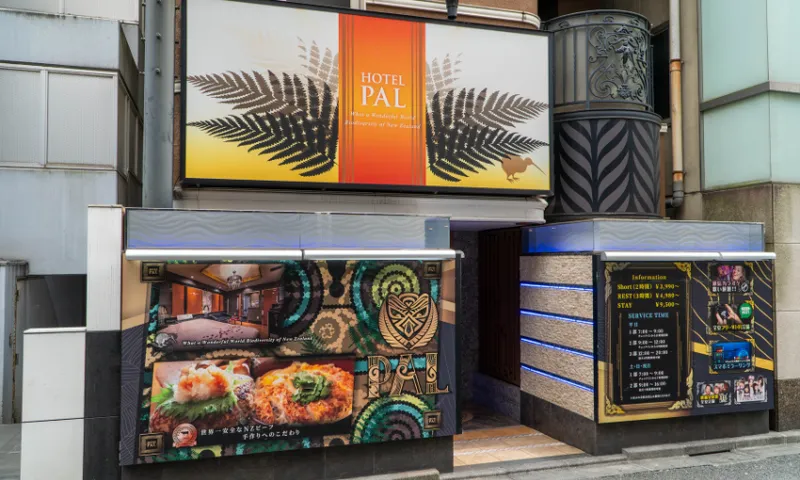
The facade was a curious collision of tourism campaign and romance. It felt less like a hotel and more like someone had fed an Air New Zealand in-flight magazine into an AI image generator.
One sign promised premium farm-fresh steak. Another, translated crudely by Google Translate, extolled the virtues of New Zealand beef as the safest in the world.
Love hotels occupy a curious place in Japanese life. Born partly from a need for privacy in a country where homes have historically been small, thin-walled and multigenerational, they’ve evolved into a peculiar blend of practicality and fantasy.
Usually rented by the hour, they’re used by everyone from couples seeking a little privacy to those conducting extra marital affairs. And they lean into themes. Some promise to make you feel like royalty in your own castle, others offer galactic exploration or a Parisian love affair. The possibilities are near endless.
In Shinjuku, someone has decided New Zealand was an aspirational romantic destination. Fair enough, honestly.
I needed to know more. I followed the zig-zagging entrance away from the street – a design that I can only assume prioritised discretion over directness – stepping over the silver fern adorned welcome mat into a dimly lit entranceway.
A touchscreen displayed every room in the building. Occupied rooms were greyed out while available rooms glowed brightly. A giant arrow directed me to reception. “Two hours?” the receptionist asked. I nodded.
She entered numbers into a calculator about the size of a paving stone and turned it towards me: ¥5,790 or about NZ$65. I nodded again.
The premium type A room, complete with massage chair, was fully booked. After a string of 20,000-step days, I’ve got to admit I was disappointed (whatever had taken place in that chair before me was none of my business).
Nonetheless, key in hand, I headed up to the third floor.
The corridor had a faint Twilight Zone quality. Not necessarily seedy or unpleasant, just slightly detached from reality. Perhaps this was the “Love Shack” The B-52’s warned us about. But inside, the room itself was surprisingly ordinary. There was a vague smell of cigarette smoke and a more persistent smell of drains, though the street outside carried much the same scent, so that might be a neighbourhood issue rather than a hotel one.
What struck me the most, however, was how quickly the New Zealand theme, which had been so arresting from the outside, evaporated inside the room. The first obvious reference to Aotearoa was a silver fern printed on a lighter. The second was another fern in the amenities booklet. And then? Well, nothing. That, it seemed, was the theme done.
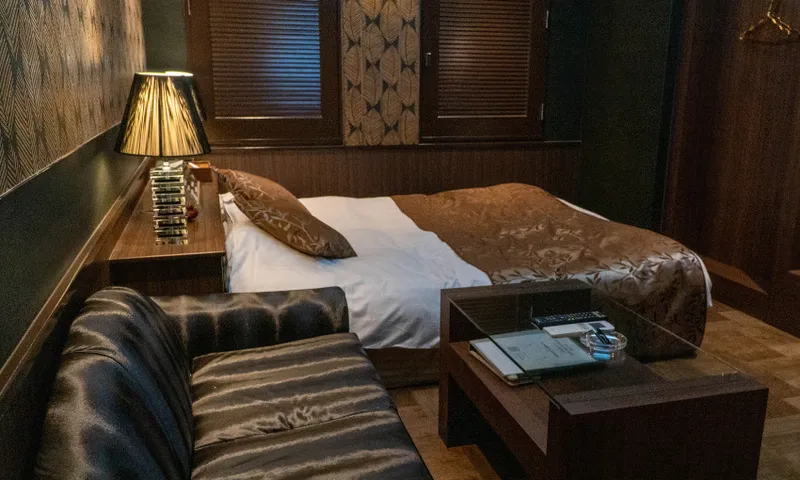
Surely not, I thought, and continued to explore. There was an array of costume rentals, a bewildering number of bed controls and a box of complimentary condoms that I checked over for any sign of New Zealand-ification.
Much to my glee, there was also a karaoke machine (microphones and all) attached to the TV.
Menus offered tempura bowls, sashimi platters and Dominos pizza – but the premium New Zealand steak advertised outside was nowhere to be found.
The wine list proved even more puzzling. Several European wines were available, including bottles sourced from Moldova. It felt like an obvious missed opportunity. If you’re operating a New Zealand-themed hotel in central Tokyo, surely this is where you commit to the bit. A Marlborough sauvignon blanc. A Hawke’s Bay syrah. A Central Otago pinot noir. Some Whittaker’s in the minibar. Maybe even a cheese roll if you’re really leaning in.
After a couple of hours exploring, reading menus and pressing every button I could without accidentally summoning room service, I handed back the key and stepped back out into the suffocating early summer heat.
The whole experience had left me oddly relieved to return to my own apartment. It doesn’t have karaoke or costume rentals, but neither does it promise our beautiful Aotearoa’s biodiversity before quietly forgetting New Zealand even exists.
Maybe that’s why the Moldovan wine bothered me quite so much. Not because I have strong feelings about Moldova (I really don’t), but because it was only when I was flicking through the wine list that I realised I wasn’t really exploring a hotel anymore. I was auditing its New Zealandness and it was coming up painfully short.

Katie Ham
Former senior crime and investigative reporter Katie Ham left New Zealand for Japan earlier this year and is currently adjusting to life in Tokyo, with mixed success.


