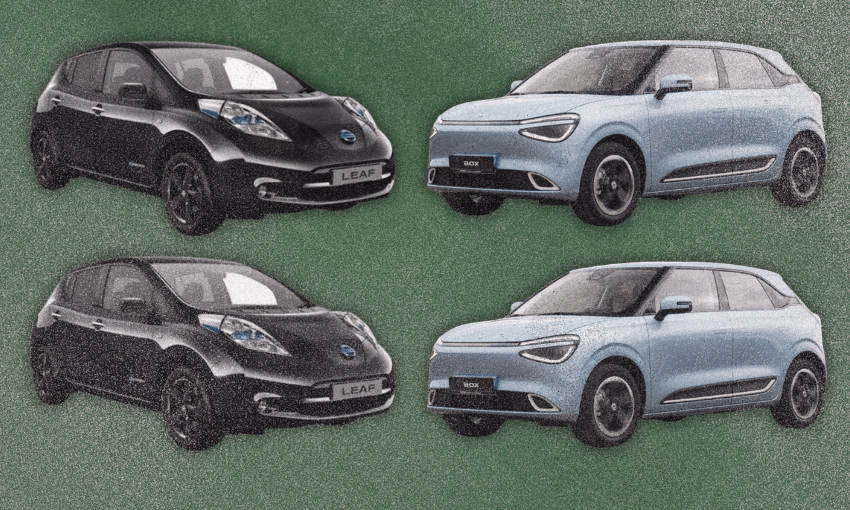

Oil crisis got you thinking about buying an EV? Henry Oliver charts the highs and lows of his seven years driving a Nissan Leaf.
In 2019, I was not in the market for an EV. Our 2003 VW wagon was expensive to run and expensive to fix, but there never seemed to be one specific problem that was big enough to justify getting rid of it. Then a professional perk changed all that.
As part of my job at the time, I was leant an electric VW, in the hopes I’d write about it. I loved it immediately. Driving it felt like a souped-up golf cart. Charging it felt more like plugging in your phone than refuelling at a petrol station. And in 2019, there was almost never a queue for a public charging station, should you need one.
I loved my week with that car so much that a month later we traded in our tired VW for a six-year-old Nissan Leaf (you can imagine how much VW’s PR person loved that detail). The guy gave us $600 for the wagon, mentioning that the warning on the dash I’d been ignoring – the one the manual said meant “see your dealer immediately” – was not good.
For the first five years, the Leaf was close to a perfect car. The inconveniences were minor, the electricity was cheap, there was no road tax, and it never needed a single repair. I loved not going near a petrol station or mechanic for years. The only thing it ever required was a charge and water for the windscreen.
Except when we went on holiday.
Our first long drive – a family Christmas in Kuratau on Lake Taupo – went surprisingly well. We moved from charging station to charging station with never more than a few minutes’ wait. Six months later, heading to Ohakune to show the kids some snow, I was filled with confidence. I had a route planned, all saved to Google Maps. It should have been straightforward, if a little slow.
Everything that could go wrong, did. At our second of four planned stops, the only parking spot near the charger was occupied by a car with a handwritten note saying the driver had gone to lunch and would be back when charged. They did not return for an hour. We had no choice but to wait. At the next station, we arrived to find ourselves third in line without enough charge to make the next town. We crawled into our rented holiday house hours late, driving slowly through the dark to conserve what little battery remained.
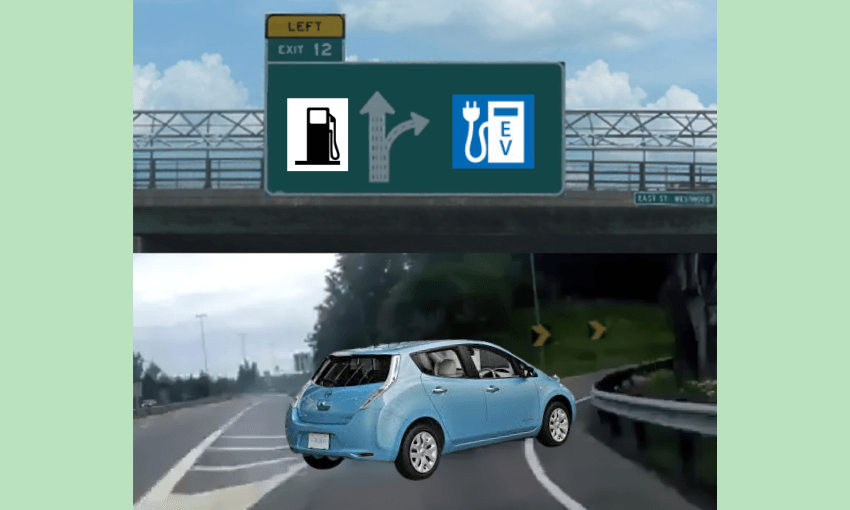
Planning a long drive in an EV is a special kind of psychic labour. You begin with a map of charging stations, like a medieval pilgrim plotting monasteries. You check which ones are actually working – a more optimistic exercise than you might hope. You calculate range against terrain and temperature (cold weather and hills are punishing; a flat motorway in summer, fine) and build in a buffer because the stated range is always slightly aspirational. Then you work out whether the charger at your destination is fast or slow, whether it’ll be free when you arrive, and whether you’ll have enough charge to get to the next one.
Around year five, a new problem emerged. EV batteries, like all batteries, degrade over time – sped up, I now know, by fast charging and always filling up to 100% – and ours had declined to the point where a full charge delivered only around 60km. In the city, we could still manage, but barely. The Leaf’s useful life seemed to be drawing to a close.
There’d long been rumours of various start-ups figuring out ways to revive individual battery cells, so one-by-one you could swap the dead cells for new ones, but the technology was slower to develop than hoped, and incredibly expensive. Then I discovered the secondhand battery market. When an EV gets written off in an accident, its battery often survives intact. You can buy one, have it installed, and for around $4,000 all up, we now have a battery that charges to 145km – more range than our car would have had when brand new.
Not long after, we moved further from the city, and the reality we’d been avoiding became harder to ignore: we were a two-car household. We bought a hybrid. Years ago, in print, I’d dismissed hybrids as timid half-measures – equivalent to going vegetarian but still eating animals that just happen to live in water. But the hybrid doesn’t rely on charging infrastructure or require route planning. It just goes and when it’s about to stop going, you can switch to petrol and get the battery back to 100% in a matter of seconds. But the Leaf remains the default — the first set of keys you reach for, the one that handles everything within its radius, which, it turns out, is most of life.
Over the past few weeks – as petrol prices have crept toward $4 a litre and the global oil market grows harder to read – we’ve leaned on the Leaf more than ever. What once seemed like an inconvenience now feels like a modest form of independence, even if only in increments of 145km.
I am still, for what it’s worth, a believer. Just a wiser, slightly humbler one with one more car than I’d like.