Who are New Zealand’s prolific taggers?

Prolific tagger Pork is in the news this week. (Image: The Spinoff)
Prolific tagger Pork was unmasked this week, but which other well-known taggers are still managing to remain on the down-low?
If you’re looking for a prolific New Zealander, you might want to start with Pork. Examples of the tagger’s work were identified 298 times over 14 months in 2024 and 2025 by Auckland Council. The year prior saw a tally of 989 pork, porke and porkers tags across the city. Sightings have been reported in Wellington and Huntly. Pork-variants have been spied down in the South Island and across the Tasman. In 2023 the tag appeared on the roof of the Pacific Island Presbyterian Church in Newton. You can still see it looming about the Gull petrol station on New North Road.
Pork was the (anonymised) subject of a documentary, Full Time Pork, and has presented work in a Sydney art gallery. You can even buy Pork stickers and skate decks. Pork was everywhere but also a nationwide mystery.
Who is Pork? We have the answer now, thanks to the justice system, which revealed this week he is Karl Truell, a former pro-skateboarder. He was in court not only over graffiti but also fraud, after he switched price tags at a Bunnings store, according to the Herald. Truell was sentenced to 100 hours of community work, 18 months intensive supervision and $2000 in reparations payments. And everyone knows his name.
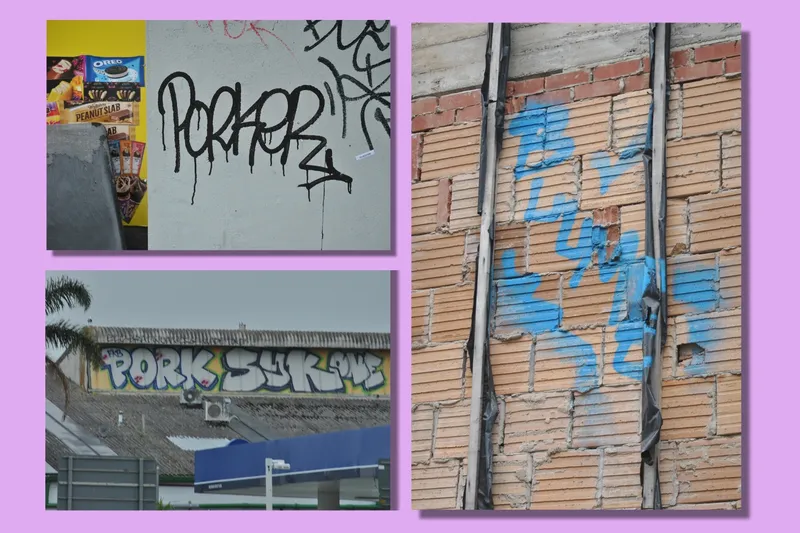
He’s not the first high-profile tagger to lose anonymity after landing in court. Sean Oddy, the landscape gardener behind that bumper crop of Bloom/Blume/Bloomer tags, was arrested in 2022 and jailed in 2025. Unmasked at last, he made headlines due to the scale of property damage he caused, estimated to be north of $1m. It reportedly took Oddy only six months.
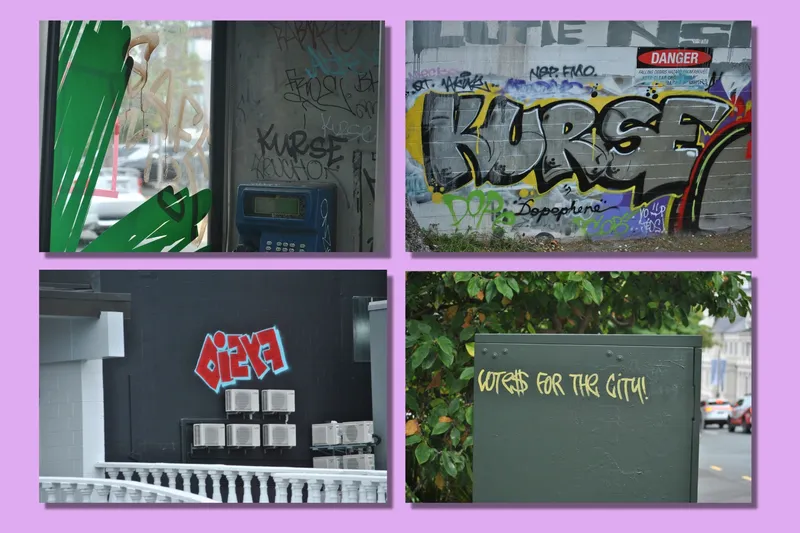
But for every tagger unmasked, there seems to be another pop up and become prolific. Who is managing to be everywhere but also unknown? Throwups by Aches can be seen throughout central Auckland and Fysio tags are nearly as numerous. You might see Skwek/Sqwek, Kurse, Maxbet, Texas, Bats, Love, Nopes, Peril and Rust. Ruins and Prius can usually be found in the same vicinity (taggers often work in crews). Down in Christchurch, residents wonder who the mysterious Kaepe is. Dunedinites will find much of the city’s graffiti is catalogued by the Instagram account @dudsgraff, but they still have a mystery on their hands when it comes to who is tagging as Iron and Bugs.

It doesn’t stop with the cities. All across New Zealand you’ll see tags on bins, power boxes, fences, bus stops and phone booths. Many are small, scrawled in vivid or twink and are a lower-risk way to add a flourish compared to scaling a building or venturing onto the motorway, both of which have been done.
That’s not to say any graffiti is safe or legal. Defacing a property, building, structure, road or tree is punishable with a fine of up to $2000, or community-based sentence under the Summary Offences (Tagging and Graffiti Vandalism) Amendment Act 2008. Even the tools used for tagging are restricted; being found with “graffiti implements” without a reasonable explanation could lead to a fine of up to $500, and sales of spray cans are prohibited to anyone under the age of 18.
Local government is on cleanup duty. Auckland Council budgets $4.5m a year to remove graffiti, and Christchurch City Council facilitates community reporting via its Snap, Send Solve app. Dunedin City Council has turned to local professional Graffiti Doctor, AKA Roger Knauf, to rid its city of tagging.
Auckland-based social enterprise The Manukau Beautification Charitable Trust employs former taggers to help with workshops and clean-ups. It focuses on the reporting, removal and prevention of tagging and graffiti, while also supporting artists creating neighbourhood-enlivening, graffiti-deterring murals.
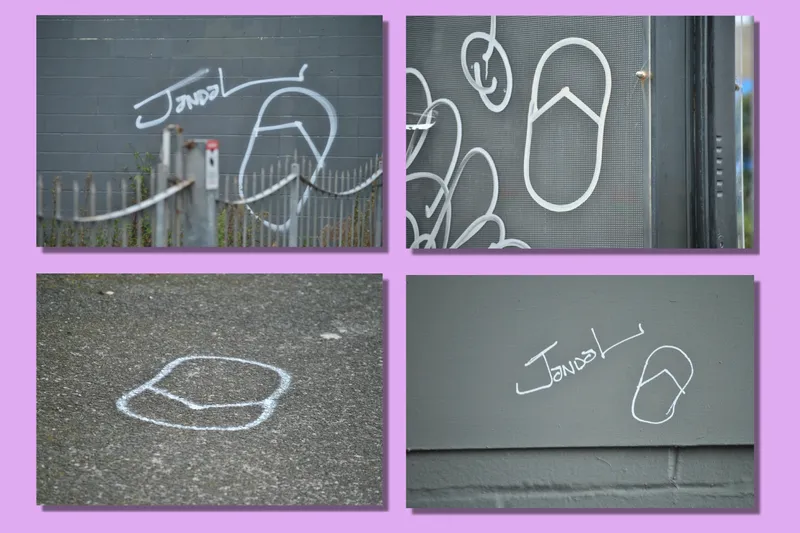
But the cycle of tagging and removing, tagging and removing seems to continue on. The latest tag in Tāmaki Makaurau? Jandal. The tag comes with a distinctive sandal motif and it’s cropping up across the city.

Emma Gleason
Emma Gleason is a staff writer at The Spinoff and an award-winning fashion journalist. But it’s not just clothes that interest her, you’ll find her exploring tasty cheese, influenza outbreaks and more important things right here. She has experience with some of the country’s leading media outlets as well as the toaster in our kitchen.


