We’re anti-war and our son has joined the army

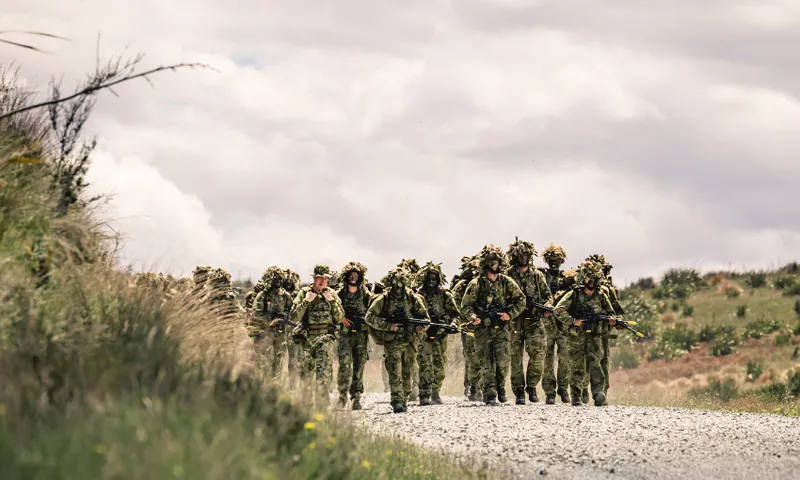
Recruits at Waiouru Army Camp (not the author’s son). Photo: Supplied
We tried to talk our son out of joining the army, but off he went to military camp.
At the end of 2024, our then 19-year-old son sat us down and told us that he wanted to join the army. Our immediate reaction was what the fuck? Quickly followed by a resounding noooo!
My wife and I are peace-loving parents who detest war in all its forms. Of all of the career paths we had envisaged for our son, the army was most definitely not one. The only other person in the household who was genuinely excited by this prospect was his nine-year-old sister, and we strongly suspected this was because she was in the midst of a Teenage Mutant Ninja Turtle phase.
We weren’t the only ones to have a visceral reaction – there were side eyes and gasps from many of the whānau and friends we told. Neither of our families have any recent links to the armed forces, not since our grandfathers fought in the second world war.
Initially, we hoped joining the army was just another grand idea that our son would tire of. It followed a stint at Otago University where he had embarked on year one of a law degree but had instead obtained the first year of a BA in MDMA. His track record for stickability was questionable.
We tried to talk him out of it several times, but he was determined and, after passing aptitude and fitness tests, he was ready to embark on the introductory 16-week basic training at Waiouru Military Camp. For these 16 weeks the 160 recruits had their mobile phones confiscated and our only way of communicating with our son (bar the odd good behaviour phone allowance on a Sunday evening) was through old-fashioned letter writing. At times it felt like we had been thrust back in time to 1940 and he was on the frontline.
As an aside, the difference we noticed in our son after having no phone at his disposal was palpable. The handful of times we were able to speak to him – and the one weekend we were allowed to visit – he was well-slept and more upbeat than we had seen him in some time. It was a real-time case study in how smartphones impact mental wellbeing in young people. Sadly, at the end of the 16 weeks they all got their phones back.
This 16-week training period was intensive, a monumental test of physical and mental fortitude, which about 10% of the recruits found too much (I was amazed it was only 10%). But, it turns out our son loves sleeping outdoors in the Central Plateau in a self-dug trench filled with icy water in the middle of winter. Go figure. He made it to the end and not only did he make it, he by and large loved the experience. And it was an experience he was paid to have.
When he departed for basic training he was still a kid in many respects, but a mere 16 weeks later a fully-formed young man emerged. A young man who had way more respect and tolerance for others, a young man who actually liked to keep his room tidy, a young man who got on and did things rather than having to be reminded of them 10 times, a young man who was incredibly fit, and who was motivated. It seemed to us that these 16 weeks had fast-tracked the reconnection of his frontal lobe and we felt strangely indebted to the NZDF for this unexpected development.
Basic training was the first indication that maybe this was a good career path for our son, maybe we were wrong and maybe there was a good chance we were going to have to eat our words.
Watching him graduate from basic training was a very proud day. We hadn’t known quite what to expect but it turns out that watching a full military review with 150 young, uniformed soldiers performing drills and marching together in jaw-droppingly precise formation is a stunning spectacle to behold. Our boy was no longer a civilian, he was now a soldier.
Since completing basic training, he has been based at Linton Military Camp in Palmerston North, where he’s undertaking specialist training to become a signaller; a communications specialist who is responsible for establishing and maintaining battlefield communications. By and large he is loving this path he has chosen and is showing no signs of wavering. He is now officially employed by the NZDF and is being paid a very decent wage for his age, while learning some highly-valuable skills.
The specialisation he has chosen is a frontline one, which does bring with it some fear for us.
While at the end of 2024 it seemed highly likely the only war he would ever have to fight was the war against climate change, the mood of the world has since shifted significantly. When we have conversations about international conflict now it is very different knowing that he could one day be part of it.
We have learned so much about the NZDF through our son’s journey. We had no idea just how many career options are on offer (pretty much any career you can think of), or how many careers have zero potential to be anywhere near any action – like carpentry, or dentistry, or Military Police Officer.
With so many young people graduating from university and unable to find employment – a good portion with a sizeable student loan around their necks – it feels increasingly like a viable career path that our son has chosen, and even a sensible one. And, while still remaining firmly anti-war in our beliefs we have most certainly had to endure the uncomfortable indigestion that comes from eating our words.


