What new population data reveals about why some cities are growing and others aren’t

The Pacifica apartments in Auckland are an example of houses that people live in.
Detailed data analysis by The Spinoff reveals an incredible true fact: people live in houses.
In journalism, it’s important to hook your audience with a strong, compelling opening line. So here goes: last week, Stats NZ released a new dataset titled “Subnational population estimates: At June 2025 (provisional)”.
This annual data compilation tracks the population changes within each council and Auckland local board area, and attributes those changes to one of three reasons: internal migration (people moving within New Zealand), international migration (people moving to or from New Zealand) and natural increases (births and deaths). It’s a useful insight into which regions and local government philosophies are the most successful. In other words, which councils can claim bragging rights?
Ever since Covid, New Zealand’s population numbers have been pretty screwy. Long-standing, predictable demographic patterns were upturned by border closures, then a migration wave, a house price bubble, a subsequent crash, and rising unemployment. So with all that, what does the new data tell us about where people want to live?
Well, it’s a bit unclear. The five fastest-growing council areas by total population are Auckland, Christchurch, Hamilton, Selwyn and Waikato. But the way that growth is happening is completely inconsistent. Auckland and Hamilton have negative internal migration, meaning people are leaving those cities for other parts of the country; their growth is driven by international migration and a high birth rate. Meanwhile, Selwyn and Waikato have negligible international migrants and are booming due to internal shifts: people are moving there from other regions of New Zealand. Christchurch is a rare example of a city that is succeeding at all three forms of growth.
Wellington City had the largest population decline, both in total terms and per capita. That trend seems to have spread across the wider region, because Porirua and Upper Hutt also rank in the bottom six.

While Auckland is one of the fastest-growing cities, when you split it out into local board areas, you get a more complex story. Howick, Papakura, Henderson-Massey, Maungakiekie and Whau are all in the 10 fastest-growing council areas nationally, but Waitematā, which covers the city centre and inner-city suburbs like Ponsonby and Parnell, and Ōrākei, which covers inner eastern suburbs like Remuera and Saint Heliers, are the second and third worst-performing areas in the country, behind only Wellington City.
Waitematā and Wellington City are the two most urban council areas in the country, so you might expect some demographic similarities. But again, it isn’t so simple. Waitematā’s population loss comes from people leaving for other parts of New Zealand; its international migration is still positive. Wellington City is the exact opposite. Since 2024, it has reversed several years of negative internal migration and now has 210 more people arriving from other parts of the country than leaving. The capital’s decline comes from a net -1,700 people leaving the country. The Ōrākei local board area shows a similar pattern to Wellington; an area with a lot of wealthy, highly educated residents who have fled for international shores, but expensive housing that is out of reach for many new immigrants.
As a general trend, international migration is highest in the outer suburbs of major cities, especially Auckland and Hamilton. Natural increases are also highest in these regions; they’re generally areas that appeal to young families and first-home buyers. Aucklanders and Hamiltonians are moving south for Christchurch and Central Otago, while people in the lower North Island and the top of the South Island are leaving the country entirely.
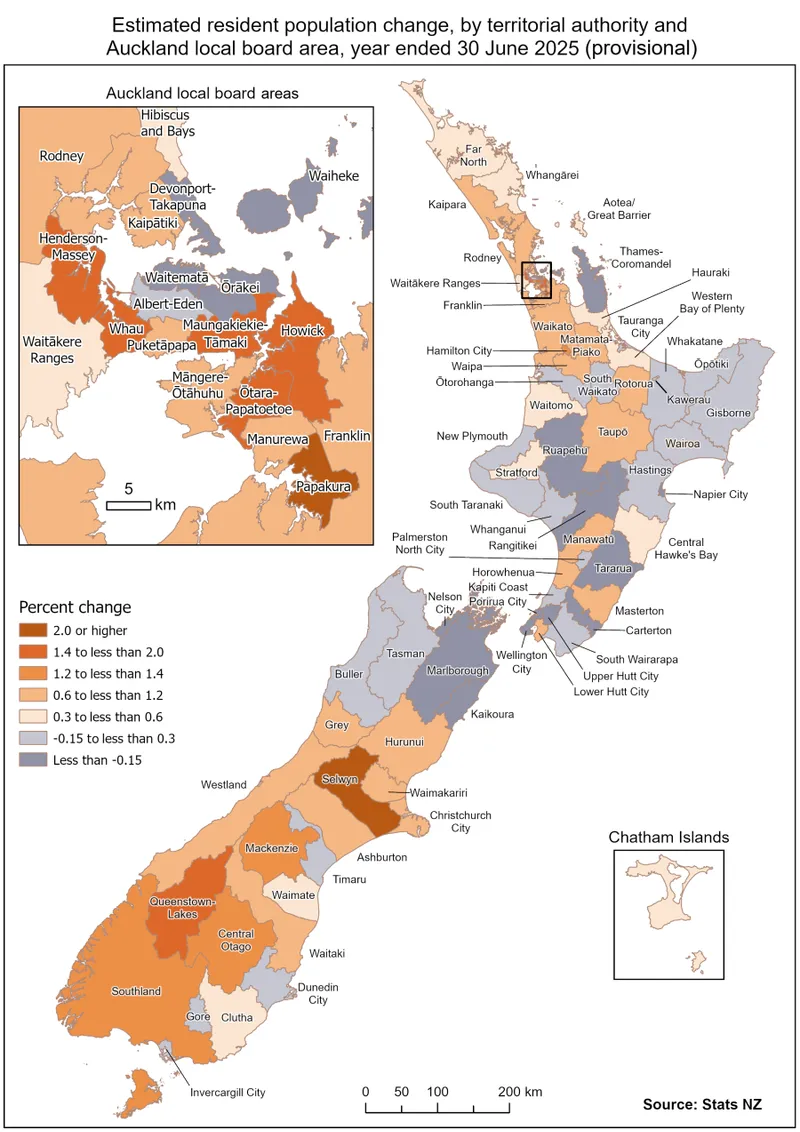
But even those broader trends contain multiplicities. Lower Hutt has a positive total migration, while other Wellington councils are in the negatives. In Auckland, Devonport-Takapuna is shrinking, while its neighbour Kaipātiki (Beach Haven, Birkenhead, Glenfield etc) is growing. Is there any single statistic that explains why some areas are succeeding and others aren’t? Well, maybe.
Stats NZ recently released another dataset showing which councils had the highest rate of new building consents per capita. When you compare it against the council areas with the fastest population growth, there is a clear correlation. Here are the numbers for 2025:
And when you look at the data averaged out over the past 20 years, the trend becomes even clearer.
Let’s remove the two outlier councils, Selwyn and Queenstown-Lakes, to get a better view.
And just in case there could be some city-specific factors at play, here are the numbers for each of the Auckland local boards since the creation of the Supercity in 2010.
Obviously, there is a bit of a chicken-and-egg situation here; regions that build more houses tend to grow in population, and property developers are more attracted to fast-growing areas. But it’s a good reminder of a simple fact: people live in houses.
If council areas want to attract more residents, they need to build houses for those residents to live in. That might sound like an oversimplification – what if no one wants to live in those houses? In theory, an unpopular council area might build too many houses and be unable to fill them. The good news is, there’s no evidence of that in the recent data. Oversupply of housing has historically not been New Zealand’s problem. There is generally a price at which most houses will sell or rent.
Population changes tend to be framed as a demand-side problem. Councils worry about job numbers, cultural vibrancy or street safety, all of which can affect residential demand. But the evidence shows that the bigger problem is on the supply side. People will move to where they can afford a home that fits their needs – and if they can’t afford one, they’ll leave. If councils want to grow, they need to build.

Joel MacManus
Joel MacManus is a senior writer for The Spinoff. He previously worked at RNZ and Stuff, and began his career at Critic Te Ārohi. His writing explores the political, economic and cultural systems that underpin modern New Zealand. He won the 2025 Voyager Media Award for Best Columnist, Opinion or Critique.


