‘Tunnel, tunnel, tunnel’: on board the first train through the City Rail Link

Passengers cramming into the first CRL train. (Photo: Joel MacManus/The Spinoff)
More than 400 people queued in the dark at Ōtāhuhu for the first passenger service through the City Rail Link. Joel MacManus was one of them.
Aucklanders packed in front of the gates at Ōtāhuhu station on Sunday morning, waiting to catch the first train service through the new underground City Rail Link stations. Several enthusiasts arrived as early as 3am to catch the 4:57am service, though no one seemed to mind queueing for a couple of hours. They’d been waiting for this moment for 10 years. Or, depending how you count it, for more than a century.
The crowd was a peculiar coalition. Aside from the usual gaggle of politicians and journalists, there were dozens people who worked on the project: staff of Auckland Council, Auckland Transport, NZTA, CRL Ltd, Auckland One Rail and more. And many people involved in advocacy campaigns and public submissions. Greater Auckland supporters were out in force, many wearing Beatles-inspired T-shirts featuring the names of the four new stations.
The mood was celebratory and self-congratulatory. Everyone there had played some role in bringing this project to life – even the regular ol’ members of the public lining up to ride the train, whose enthusiasm helped to justify the $5.5bn cost and the years of construction disruption in the Auckland city centre.
Some VIPs I didn’t recognise briefly addressed the crowd with the usual kind of opening day waffle but cut it short because the train was due to arrive any minute. With that, the crowd surged through the payment gates and down the stairs to the platform.
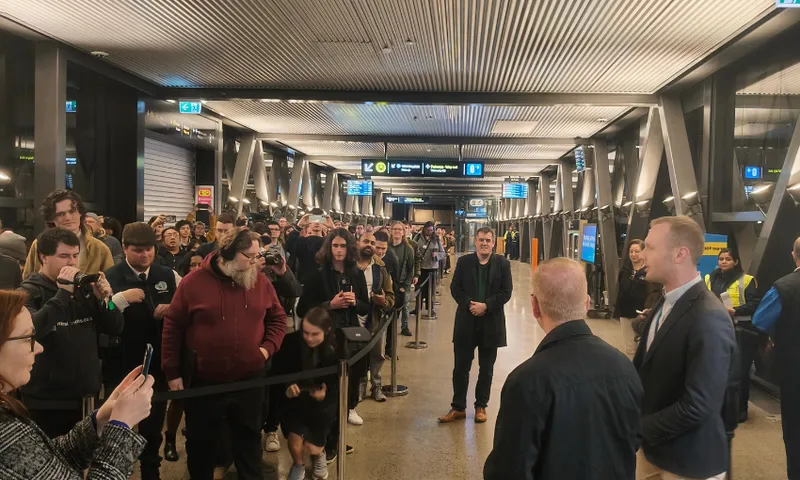
Near the front of the mass, I absentmindedly wandered across the yellow raised bumps that mark the edge of the platform. This prompted the loudspeakers to blare out a warning to please not cross the yellow line. You heard it here first: on top of holding the self-proclaimed record for the fastest traverse of New Zealand’s public transport network (Stewart Island to Kaitaia in six days, seven hours and one minute), I am also the first person in history to get told off by the CRL.
After a few minutes of nothingness, a bright white light emerged from the inky black. I heard gasps, as if the Hogwarts Express was appearing out of the mist. There was nothing inherently magical about this train – the carriages themselves are exactly the same as before, though there was something surreal about seeing the scrolling text on the front read “S-C South City Line”. It was a reminder that, yes, this is real, New Zealand actually has a subway system.
The crowd crushed into the first few carriages – everyone wanted to be at the front of the first CRL train, creating the bizarre situation where a few carriages were overcrowded while the back half of the train was virtually empty. With a jolt, the train set off and the passengers cheered.
Journalists scrambled to get generic quotes from Chris Bishop, who held an impromptu press conference in the middle of the aisle. Auckland Transport CEO Stacey van der Putten unsuccessfully tried to peel an outdated sticker from the side of the carriage showing the old Auckland train route. A group of urbanists mocked National MP Simeon Brown’s attempts to claim credit for the CRL after cutting funding for public transport and spending years crying about a “war on cars”. As the train passed through Penrose, it overtook a Mainland cheese truck emblazoned with the words “good things come to those who wait”, which felt like it could have been a slogan for the CRL itself.
A few more people hopped on at Newmarket. The front carriages got even louder and hotter. Behind me, two aunties from Hamilton narrated every inane thought from their inner monologues at approximately one million decibels. Thankfully, everyone lost their train of thought as we approached the first section of underground tracks. “Tunnel, tunnel, tunnel,” the passengers chanted,
The tunnelled section was the best-lit part of the entire pre-dawn journey. And, thankfully, the aircon kicked into higher gear. People stared out the windows, audibly gasping at the idea of a train running below the surface of the earth.
As we pulled into the first underground stop, Karanga-a-Hape station, the passengers burst into applause. On the platform, dozens of people were waiting with their phones out to film the arrival of the first train. As we departed, they waved us goodbye like civilians farewelling a ship of soldiers off the war.
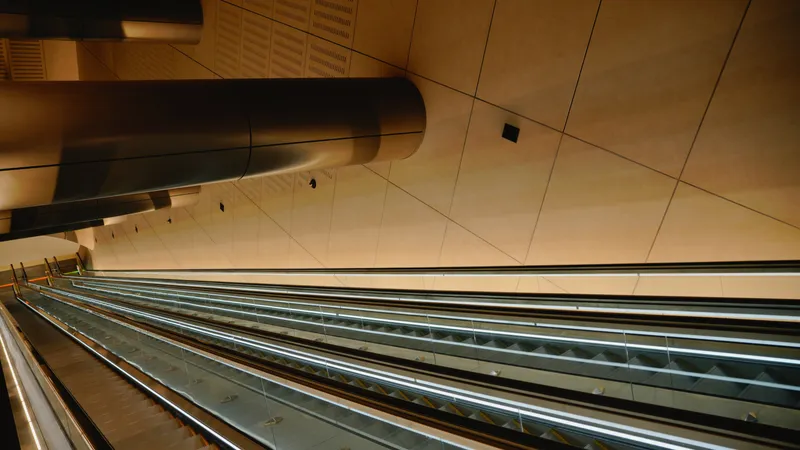
A couple of minutes later, we arrived at Te Waihorotiu. Chris Bishop was the first to depart, turning back to the train and holding his arms to the side, like Maximus asking “are you not entertained?”. Some passengers ventured off to explore the station that is predicted to soon become the busiest in New Zealand. The Hamilton aunties admired the spotless rubbish bins and speculated about how long it would take for someone to tag them.
The final section to Waitematā station was uneventful but for the hyperventilating monologue of a Francis Bourgeois-esque train nerd excitedly livestreaming his thoughts and feelings to whoever is watching public transport content at 5.30am.
As the crowd spilled out of the carriages and onto the street of a dimly-lit downtown Auckland, the excitement dissipated. All of a sudden, the world felt very ordinary. A group of intoxicated youths on the back end of a big night in town sat on some stairs in Te Komititanga Square, unaware of and completely disinterested in why such a large professionally dressed crowd had emerged from underneath them.
And that, perhaps, is the best possible symbol for the City Rail Link. This particular train, on this particular day, was filled with excitement and hype. But the true sign of success will be when it is just another train boringly following its schedule, a part of Aucklanders’ lives so widely accepted that no one thinks about it at all.
Joel MacManus
Joel MacManus is a senior writer for The Spinoff. He previously worked at RNZ and Stuff, and began his career at Critic Te Ārohi. His writing explores the political, economic and cultural systems that underpin modern New Zealand. He won the 2025 Voyager Media Award for Best Columnist, Opinion or Critique.


