
With one in three Jobseeker beneficiaries now over the age of 50, there are calls for the government to scrap ‘ageist’ student loan policies, reports Alex Casey.
At 57 years old, Leah* jokes that she has finally figured out what she wanted to do with her life. But after recently being accepted into her dream counselling course, she was “devastated” to discover that her age prohibits her from accessing the same financial support from Studylink provided to younger students. In a challenging job market where people over 50 are struggling to find work and many are looking to retrain, seniors advocates believe the student loan policies are ageist, and are calling on the government to scrap the criteria altogether.
Leah* spent her 20s and 30s working in the hospitality industry, during which time she battled substance addiction and experienced multiple stints in recovery. Getting sober in her 40s, she embarked upon a degree in drug and alcohol counselling to help people like her, but found she wasn’t ready for the in-depth one on one sessions. She then transferred to a bachelor of arts in sociology, studying part-time while receiving a student allowance, still working in restaurants until the tendonitis in her legs and the ever-changing shifts made hospitality untenable.
Towards the end of her undergraduate degree, Leah’s student allowance had run out (not only is there a strict eligibility criteria but, if you are over 40 years old, you can only access it for 120 weeks in total). She swapped hospitality for part-time sex work and continued to devote herself to her studies, receiving straight A’s and eventually a scholarship to continue into honours. But when the university cut the courses she wanted to take in 2020, so she decided not to continue with her studies and instead focused on earning a full-time wage through sex work.

In more recent years, with the cost of living going up and people’s disposable income going down, Leah’s income through sex work has reduced dramatically. “It’s gone really, really quiet,” she says. “I got really sick of the insecure money situation, but I’m also sick of always having to watch your back if you’re in accommodation, because landlords will kick you out. You just get so fed up with all the stigma stuff.” She started to see a therapist through the New Zealand Sex Workers Collective about her options, and was encouraged to look into studying counselling again.
Leah is far from alone in seeking out a new career later in life. According to the Office for Seniors, people over the age of 50 years old now make up a third of the workforce, while people aged 50-64 also make up 30% of those receiving the Jobseeker benefit in Aotearoa. Seniors at Work, an online network for those over 50 looking for work opportunities, experienced a 50% uptick in sign-ups last year. It is now estimated there are over 150,000 people over the age of 50 currently looking for work, while over 17,500 university students are aged over 55.
After doing a bit of research, Leah discovered her “dream job” in creative therapies. “I finally found something where I could use my creativity, alongside my lived experience of addiction, to help people,” she says. “Also, because of all my time in sex work and hospitality, I have so much experience dealing with people from all walks of life.” She gathered her references together and applied for Whitecliffe’s coveted Creative Arts Therapies course. After an agonising months-long wait, she found out in December she was one of 25 students accepted into the course.
“It felt like I was in a dream,” she recalls. “I was so excited.”

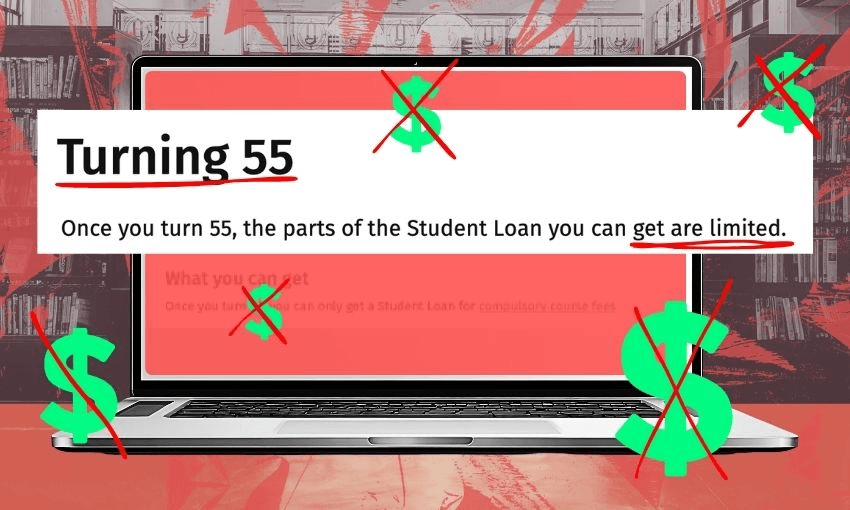
But when she rang Studylink to add living costs to her student loan, she was told she couldn’t access the additional financial support due to her age. As per the Studlink website, once you turn 55 you cannot add living costs or course-related costs to your loan. Leah was left “beside myself” with the news and had to give up her place on the Whitecliffe course as there was no way she could earn enough money to survive and pay rent while also studying full time. “It’s really cut me off at the knees,” she says. “I feel like I have no future any more, which is really scary.”
Having the door closed on her new career has contributed “massively” to her mental health distress, including anxiety and depression, Leah says. “I know I can’t do sex work forever and I can’t work in hospitality anymore because of my legs, and the job market is just absolutely crazy when you’ve got thousands of people applying for the same customer service role.” She characterises the Studylink policy as age-based discrimination. “You basically have to be rich, or have a rich partner, or have property, or have a trust fund to support you through it,” she says.

David Marshall is the vice-president of Grey Power, an advocacy group for New Zealanders over the age of 50, and agrees that the Studylink policy is a form of age-based discrimination. “Grey Power is very concerned that such an ageist policy remains in place, especially at a time when many older people are being made redundant in their 50s and 60s, and need to be upskilled to secure meaningful employment,” he says. “Denying financial support to this cohort is clearly an ageist policy that needs to be revoked as soon as possible.”
Since 2021, the Human Rights Commission has received 23 age-related complaints connected to “education or student support such as StudyLink, student allowances and loans, tertiary providers, and other education or training settings.” On the question of age discrimination, Katrina Sutich, general manager of tertiary policy at the Ministry of Education, tells The Spinoff that the ineligibility of over 55s to receive living costs and course-related costs is “because of the higher risk of non-repayment,” in comparison with other borrowers.
“The Ministry of Education’s non-discrimination obligations under human rights legislation were carefully considered prior to the introduction of aged-based limits on student loans and allowances in 2013 and are viewed as consistent with these obligations,” she adds.
While Marshall at Grey Power believes that the age limit on Studylink financial support should be abolished, and that allowing access to education at all ages should be a “critical component” in the government’s commitment to increasing productivity, Sutich says there are currently no plans to change the eligibility criteria for students aged 55 and over. “Any future changes to student support eligibility and entitlements would need to be considered alongside wider funding priorities within tertiary education and across portfolios,” she says.
In the meantime, Leah is continuing to assess her avenues for retraining as a counsellor at 57. “My only other option is to go through a rehab and start out as a peer support worker, but that will take me years and years,” she says. Further frustrating matters are the constant headlines about counsellor shortages across the country. “I know people waiting for sexual abuse claims for ACC counsellors who’ve waited eight months, and they still don’t have a therapist,” she says. “And here’s me trying to get into the industry, but there’s these huge barriers.”
“I could work well into my 70s doing that job,” she adds. “I’ve still got so much to give.”
*Name has been changed for privacy reasons