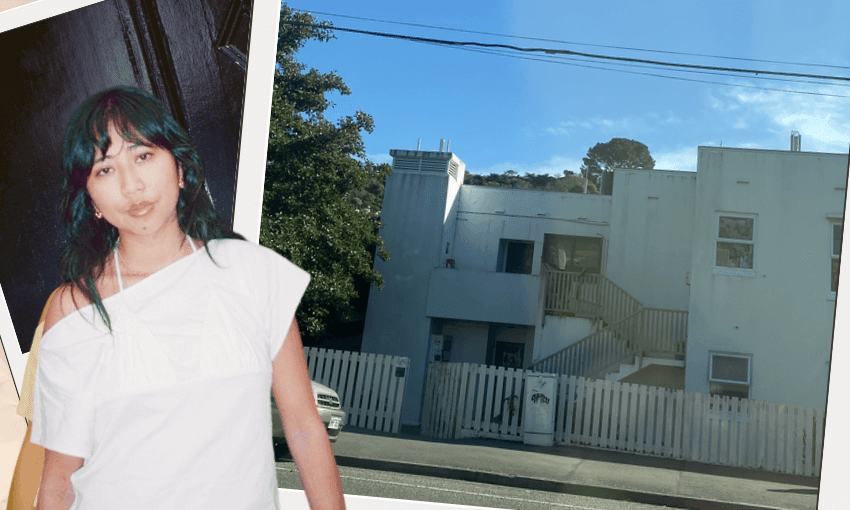

Love made Yawynne Yem self-conscious about living in a Wellington council house. But years on, she wishes she could take her partner to see where she once covered black mould with One Direction posters.
“I’m surprised you have wifi in there,” pinged a message from Stefan. It was 2012, iPod Touches had just arrived onto the primary school scene, and after receiving mine as a gift, I’d finally joined our cohort’s group chat.
In messaging me, Stefan had broken so many unspoken rules. He was Year 7 and I was Year 8. While he was taller and, quite frankly, much more popular than me on the primary school social ladder, my age should have trumped this. But I was poor. And somewhere, at a dinner table, he’d picked up that my housing situation meant I was less than him.
Our council house was grey, ce(de-)mented and kind of looked like a prison, a stark contrast to the quaint cottages that dotted us on Karori Rd. I loved it though. And there was potential. It could become chic one day, in that way that could only be afforded by Green Party-voting architecture students writing theses about the contrast of the square block against its environment. They’d, of course, forget to interview the actual residents.
My father had moved us in in 2010. He was laying the foundation to leave our family. I don’t know where we would have been without the subsidised rent. A fresh immigrant to Aotearoa, my mum found herself alone with two daughters. Six years apart, my sister and I would complete 1.5 primary school cycles and 2 high school educations within those walls. Our house was cramped and damp but we learned to make our own colour. The faces of One Direction members, ripped out of centre-folds, made DIY wallpaper that covered black mould. When the heyday of those tween magazines passed, my little sister covered those same walls with Sid and Nancy posters bought from Cuba St.
Fifteen years have passed and my incredible mum moved out earlier this year – a privilege afforded by finding love again at 53. I now live in London, within a country where class manifests as clearly as an office full of homogenous accents and lunchtime complaints about inheritance tax.
I’m preparing to fly home for Christmas. I’ll be introducing my partner to my family this summer, in an experience that will be mirrored across many homes over the holiday period. Returning without going home to the council flat keeps playing on my mind. My boyfriend will never see it, nor exist temporarily with us in the state system. The place which brought me so much shame over the years, now feels like a lost, floating piece of my identity.
It’s commonly known, but is rarely acknowledged, that Karori, our country’s biggest suburb, acts almost as a Richter scale of rich to poor. In an essay written in defence of the suburb by Leah McFall, she notes a common truth: “Spoken about with a sigh, or a shrug in the voice; often, by those who live here, with a bristle of defence. Sometimes qualified with “We’re city end” — a niche phrase, meaning “almost Kelburn”. Sullen Stefan of course, lived on this end.
Like clockwork, this scale continues to play out every afternoon for passengers on the Number 2 (formerly Number 3 bus) to Karori. The location of our state house allowed me to attend a Decile 10 school. I fit in, and I would cry in the bathroom if I received a merit grade instead of an excellence. My friends and I would all take the 3 bus home everyday, getting on at Lambton Quay to return to Karori. The wealthier of our group would get off at Marsden Village. Their parents typically worked in high-level government or law. I was always last to get off. Sometimes I felt an odd satisfaction. Our flat was not the last stop, it was bang-smack in the middle of the route.
I knew we had less. But I was also a teenage girl. It was never going to be the classist 11-year-old Stefan who would trigger an inferiority complex. It was love. Bus Stop Boy was blond, a year older, and used to ride a cool scooter down the hills of Karori. On my first day of high school, I noticed his beauty (the misogyny-laden design of the Wellington College uniform) at the bus stop. Something was unlocked.
One day that year, my friend Matahana texted asking to hang. She said she’d come meet me at my house – a rarity, as I always offered to meet my friends at their dishwater-equipt homes. There’s a skill: when you’re poor, you learn to quickly pinpoint the kids whose parents have taught them to be comfortable with class differences. ‘I’m outside,’ Mathana texted. I opened the door to find her and Bus Stop Boy. They were somehow friends. He was at my gate, staring up at the concrete block that we called home. My heart sank. The chances of him getting to know me on even terms were gone.

University was the true equaliser. It’s a universal experience for the gift of freedom to arrive with it. My present to unwrap, however, was liberty from my class identity, although I’d learnt how to become comfortable around those with more (we just never talked about it). No longer did I have to worry about being unable to host pres, or underage-drinking-disguised-as-sleepovers. University also introduced a new breed. I found myself at parties, where stoners bragged about receiving the student allowance, thanks to parents who shuffled money around in offshore Bali bank accounts. This free money was to be spent on weed and repeating papers. They couldn’t see my class, creating an open invite for them to brag to me. Little did they know, the student allowance allowed for me to be at those parties. But better yet, I could host my own parties! In a house!
I met my first boyfriend at our first-year flatwarming. A kiss snuck outside Grey Lynn Park turned into a whisper from friends that his parents were rich. I felt comfort when he told me that his mum’s parents came from nothing. That relationship ended when I accidentally fell in love with a uni mate. My second boyfriend lived just off Ponsonby Rd in his family home. He was liberal, but was once confused as to why I couldn’t afford to go to the doctors. I have a memory of him mentioning council flats on his street. I don’t remember us ever talking about it again.
Somehow, I’d accidentally fallen into the trend of dating rich. My class dictionary was, however, never thick enough for comfort at family dinners. We were young though, so people weren’t breaking up with people because they didn’t earn enough yet. It’s funny, because now I’ve built a career in a field typically destined for the ideal guest at those dinners — one in fashion and beauty PR. The archetypal PR is often a white woman, blonde, who was private-school educated in Auckland. She loves a slicked-backed bun and her boyfriend who votes for National.
Do I now hold the vocab to comment on the challenges of a second home? Or the correct commentary for an expensive rock gifted? By the time I started in the fashion industry, I’d become so accustomed to being in these spaces, I never felt that out of place. The only memorable time of class inadequacy was when I was at a fancy steak house in Herne Bay for a perfume launch. An influencer, notorious for her parents’ deep wallets, looked at me, and asked if I was going to eat my soup. I thought it was aioli.
When I began writing this, I wanted to create a smart piece of advice for parents meeting their children’s new partners this Christmas. Partners from the same background as me, or ones who simply felt queasy discovering the RV of their potential in-laws’ houses. But I just don’t have that advice. I embarked on a search for it. Bus Stop Boy is now in London too, he flats with one of my close friends. I texted him:
“Did you ever look down on me because I lived in a council house”
“Lol i didnt even know you lived in council housing until very recently im pretty sure. But no ofc not.”
Perhaps my now middle-class identity is not cemented in my salary, conversation contributions, or even the seriousness by which I Google “double-chin surgery recovery time”. It’s in the privilege of being able to leave, to shut the page, to ask a former crush for their true opinion.
The existence of this piece is deep privilege. The first time I ever felt like I had true power was the first time I had an article published. There is fear of speaking out if your family lives within the council housing system – you fear eviction. It’s why council housing and the experiences of its tenants are so deeply under-reported.
Boyfriend 3.5 is from Dorset, on the Jurassic Coast of England. He’s 6’4″, works in film and is middle-class-ish. He would have been the most accepting of our house and the class it defined us as, even though his ex-girlfriend lived in a really nice part of Dublin. I wonder if my exes relay tales about my council flat and of sleeping on a mattress on the floor? If we broke up, 3.5 would never mention it to anyone, let alone a new lover. It’s complete and utter middle-class suburbia to be forgotten, and quite honestly, never to be written about.
The first time I met his parents though, they asked me what it was like to grow up in state housing. Maybe that’s the answer to everything – to simply ask.