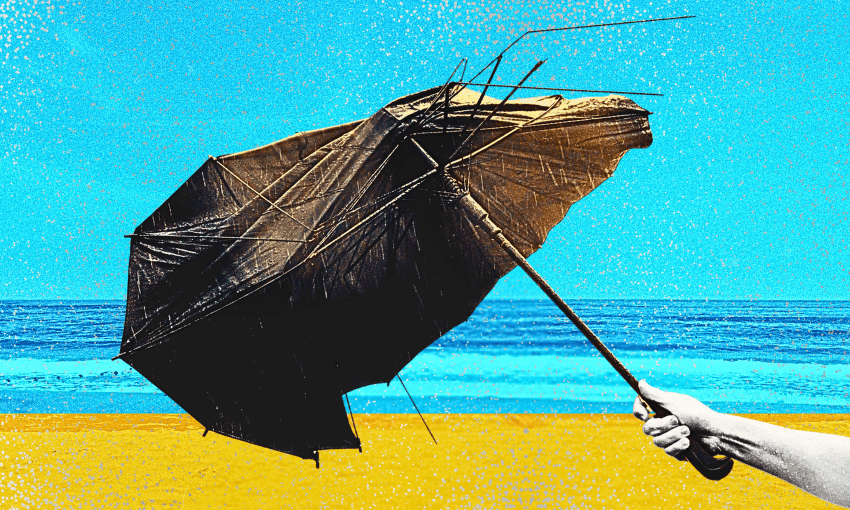

The good news is we’re still going to have long dry summers. The bad news is why.
If you’re reading this, congratulations, you haven’t been struck by lightning or drowned in the poo backwash spraying off the Cook Strait. This summer has been a parade of weather disasters, some of them tragic, some of them destructive and filled with turds. The catastrophes have somehow been both random and regular. Tornadoes in Manawatū. Landslides in the Bay of Plenty. Flooding in Warkworth. They bring to mind the days of yore, 2023, when summer brought us Auckland’s worst ever floods and one of the worst cyclones in living history. That in turn conjured memories of the ancient summer of 2020, which Stuff described as “not a summer at all” in Wellington due to its winter-coded oscillation between downpours and severe winds.
The regularity of these meteorological meltdowns is almost enough to make you pronounce the death of a foundational part of our national myth. This is meant to be the nation of unbroken sun-soaked weeks in January; of baches, fishing, backyard cricket and sandwiches on the beach. But there’s diminishing recent evidence of those conditions existing. Climate change, the scientists say, will increase the frequency of severe weather events. It’s bringing more storms and cyclones. Is it also bringing an end to the classic long, hot, dry New Zealand summer?
According to Dr Luke Harrington, the answer is absolutely not, you drongo. “No, no, no. I cannot stress this enough – climate change is not just heavy rainfall becoming more intense,” the Waikato University senior lecturer in climate change tells The Spinoff’s resident dumbass. “This feels a bit like five or six years ago, when my colleagues and I were having to persuade people that climate change is more than just sea-level rise.”
If that sounds encouraging, don’t worry it’s definitely not. Harrington says climate change will make our weather more extreme in both directions. The wettest days will be wetter and the dry spells will be drier. The good news is that means we’ll still end up with lengthy stretches of hot weather which will tempt people to gulp down Tip-Top ice-cream on the nearest stretch of sand. The bad news is that means we’ll still end up with lengthy stretches of hot weather which will cause droughts and kill old people. Auckland, for instance, is projected to have 21 more dry days and four times as many days above 25 degrees celsius per year by 2110, which would be nice if it wasn’t expected to cause water shortages. “I think [there will be] fewer medium summers and more shit summers, but for different reasons depending on whether you’re a farmer, a homeowner or someone who’s vulnerable to extreme heat (like those living in aged residential care),” Harrington says.
Daniel Kingston, an associate professor in geography at Otago University, delivers a similar eulogy for the averagely nice summer season. Though our climate will continue to be affected by a range of factors including the naturally occurring La Niña cycle, climate change is making severe weather more likely by heating the oceans, he says. That leads to more evaporation, which in turn leads to more water vapour in the air, which in turn leads to it absolutely pissing down. “Changes are happening in terms of more severe extreme events, but when and where they affect us is still largely down to a complex mix of how different large features of the oceans and atmosphere combine. So, I’m sure at least some of us will experience a good summer again in the future, but our climate is changing and becoming more extreme,” says Kingston.
Sam Dean, principal climate scientist at Earth Sciences New Zealand, says climate change accelerates the hydrological cycle, “squashing” the distribution of rainfall. “While the long-term average summer rainfall over 20 years might be very similar to what it was in the past, it will be made up of fewer summers with average rainfall and more that are either wetter or drier than average.” But he sounds a note of caution on equating those stretches of drier weather with warmth, reminding us that it can be sunny while also being windy, cold and generally miserable. “I can’t quite agree that oscillating between extra hot and extra rainy nails it,” he says.
James Renwick, professor of physical geography Victoria University, has confirmed his fellow scientists’ forecast for our future summers in a devastating email exchange with The Spinoff.

If there’s an overarching message, it’s that while summer isn’t dead, it’s definitely being transformed into an erratic, moody version of its former chilled out self. The culprit, by contrast, is completely predictable. Climate change, the slow-moving crisis that’s encroaching into every part of our lives is coming for our jandals and Top 10 Holiday Park camping spots. The only way to limit the damage is to invest in resilience and low-emissions transport while upping housing density and limiting our exposure to expensive, non-renewable, emissions-producing energy.

Ah well, nevertheless. At least it’s warm out at the moment. Time for an ice-cream. Make it rum and raisin. Go heavy on the rum.