
Bob Kerr remembers his trip to Ukraine in 2004.
“Do not travel to Ukraine due to Russia’s invasion and ongoing military aggression. There is a real risk to life.” – the New Zealand Safe Travel website, 2025.
It wasn’t always like this. Our 2004 copy of Lonely Planet told us that it was “possible to travel across the Black Sea from Istanbul to Odessa by ferry, but don’t bother, it’s too difficult”. It gave the phone number of one travel agent in Odessa.
We rang.
“Yes, I can make a booking for you,” said Galina. “I will fax you the details.”
The fax said we should pick up our tickets from the shipping office in Istanbul then report to the vessel, the MV Gloriya, an hour before departure. It seemed simple enough.
Two months later in Istanbul we climbed three flights of stairs to the shipping company’s office. The floor was dusty, walls unpainted. A man in a blue shirt glanced at the faxes Galina had sent us. “I’ll ring the captain,” he said. Indicating two wooden chairs, he disappeared into the next office. Thirty minutes later Hazel knocked on the office door.
“I haven’t heard back from the captain,” said the man in the blue shirt.
“The ship will be leaving in an hour,” said Hazel. The man shrugged.
There was a phone number on the bottom of Galina’s fax. Hazel rang, Galina answered. “Let me speak to him,” Galina said.
“Eminonu Pier,” sighed the man in the blue shirt as he handed the phone back. “You’ll have to run.”
As we arrived at Eminonu Pier, five taxis pulled up and women in black high heels and tight pink miniskirts spilled out. The officer at the bottom of the gangplank smiled and removed the rope, the women walked up the gangway towing huge plastic suitcases.
A group of men in vinyl jackets arrived. One handed the officer a magazine. The officer opened the magazine, took out some notes and handed the magazine back. The rope was removed; the men walked up on to the ship. The rope was hooked back.
We followed. The officer glanced at our tickets and looked out over the Bosphorus. The rope remained in place. Mooring lines were untied. We waved our tickets and pointed at the ship. The officer waited, two sailors arrived to remove the gangplank, reluctantly he unhooked the rope. As we walked up the gangplank an older woman in black tights pushed past, she had an armful of toasters in boxes and was carrying a huge bag of electric kettles.
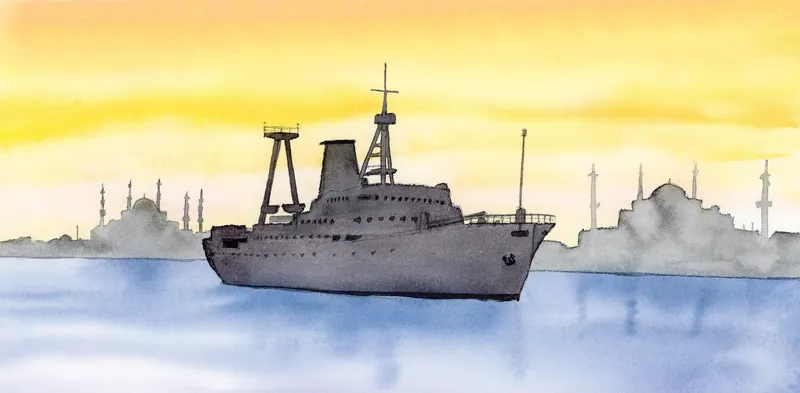
There was a toot on the ship’s hooter as it swung out into the straits. Dinner was served in the Gloriya’s dining room. Every diner was poured a glass of vodka. One of the men at our table jumped up to help the waiters carry the empty plates back to the kitchen. As he collected the plates he drained the last drops of vodka from every diner’s glass.
Outside the dining room a staircase with gold painted handrails led down to a bar. In the stairwell were black and white photographs of the Gloriya in its glory days in the 1960s when it was the research vessel Akademik Vernadskiy. In the bar the businessmen sat smoking, their vinyl jackets on the back of their chairs. The older woman who had pushed past us up the gangplank sat at the bar watching over women dancing in their tight pink miniskirts. We retreated back up the stairs to our cabin.
On our way to breakfast the next morning we passed the voluntary waiter from dinner stumbling along the corridor dressed only in his underpants. None of the businessmen turned up for breakfast.
We lay on deck in the sun, the sea was flat, the Ukrainian women smoked. One of them asked for a light.
“Have you done this trip before?” I asked.
“Many times,” she said. “To work in Istanbul, I have to return every two months to renew my visa.”
“What do you work at in Istanbul?” I asked. She didn’t answer.
On the morning of the third day, the Gloriya berthed at the bottom of the Odessa Steps. The grand stone stairs that lead from the port up to the city.
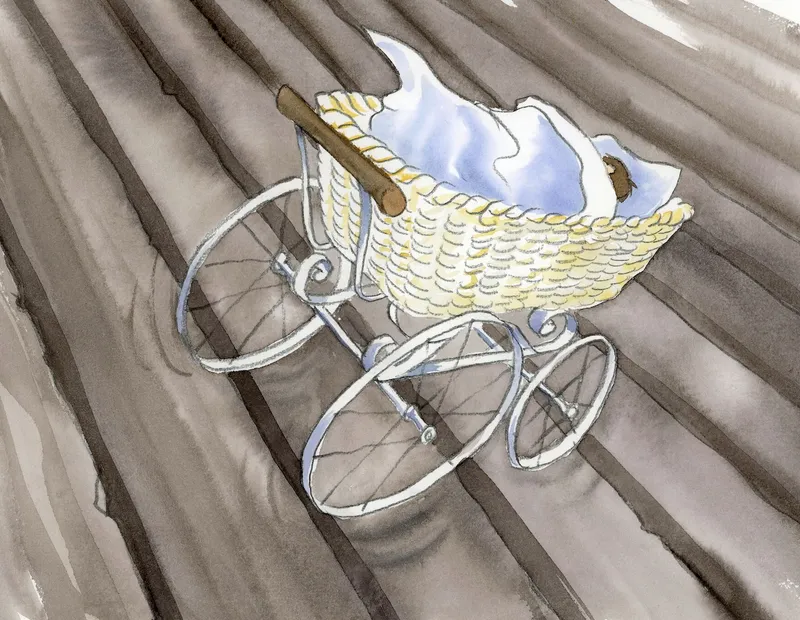
Sergey Eisenstein’s 1925 film The Battleship Potemkin is regarded as a masterpiece of world cinema. Its most famous scene takes place on the Odessa steps. Czarist troops march down the steps firing on the citizens of Odessa who have come to greet the sailors who have mutinied and taken over the battleship. A mother pushing a baby in a pram is shot, she lets go of the pram, it bounces to the bottom of the steps.
We walked up the steps, students sat in the morning sun. Tourists took photographs, Hazel took out her phone, “I’ll ring Galina and tell her we’ve arrived.”
“Where are you?” asked Galina.
“At the top of the steps,” said Hazel.
“I’m two blocks away in Katerynyns’ka Street, you must come for a cup of tea.”
In Galina’s office, fine china teacups were set out on a gold and red tablecloth.
“Welcome to Odessa,” Galina said. She explained how she used to work for Intourist, the Soviet travel agency, and how in the new market economy she had set up her own travel agency.
“When I was a young tourist guide,” she told us, “I met an old man who had been a sailor on the battleship Potemkin. I shook his hand.”
“So, if we shake your hand,” said Hazel, “we will have shaken the hand that shook the hand of one of the revolutionary sailors.”
“Yes,” said Galina, she held her hand out across the teacups. “I have booked a hotel for you to stay in, it’s an old Soviet hotel, you will like it.” And then she added, “to understand Odessa you need a guide, I have arranged Yulia. You meet her tomorrow at nine o’clock at the top of the steps.”
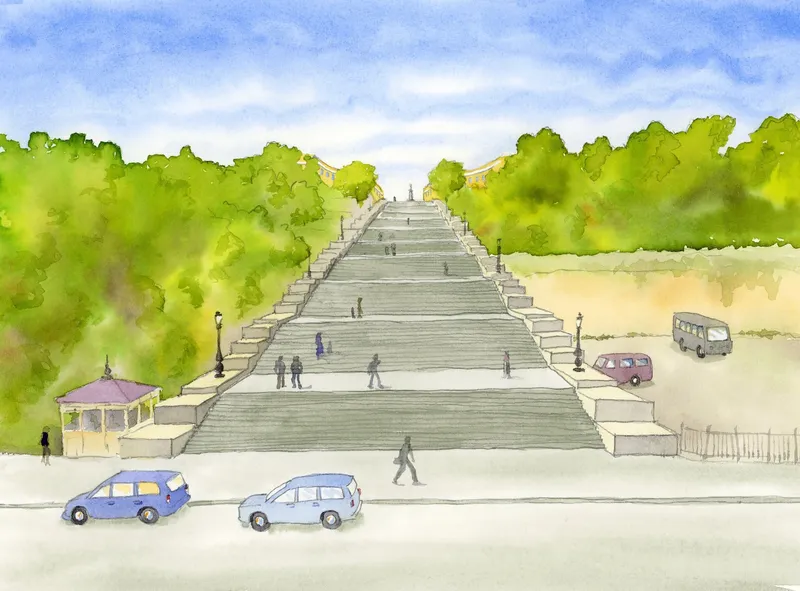
Yulia was waiting by the Richelieu statue on Primorsky Boulevard at the top of the steps, she was wearing a long red coat. She spoke English, Ukrainian, Russian and French.
“I learnt when I worked for Intourist,” she said.
She began by telling us about Duke of Richelieu, the Frenchman appointed governor of Odessa in 1803. She took us to the Opera House and then to the Odessa Fine Arts Museum to see the Kandinsky paintings. Wassily Kandinsky grew up in Odessa. He invented the word abstractionism to describe how his painting was moving away from landscape towards painting sound and feeling.
In the afternoon she showed us the city underneath the city, the vast network of tunnels in the limestone beneath Odessa where partisans lived during the Nazi occupation.
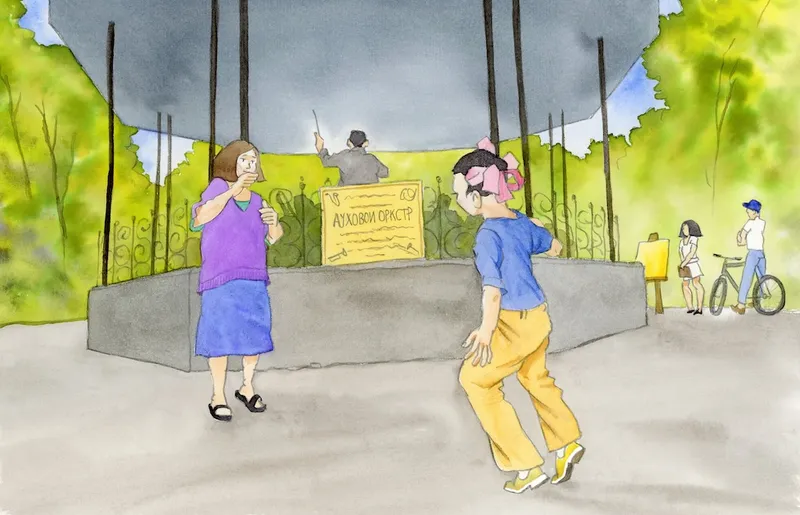
We ended the day in the afternoon sun in a leafy park. Families picnicked on the grass. A band played. I got out my sketchbook and drew the conductor.
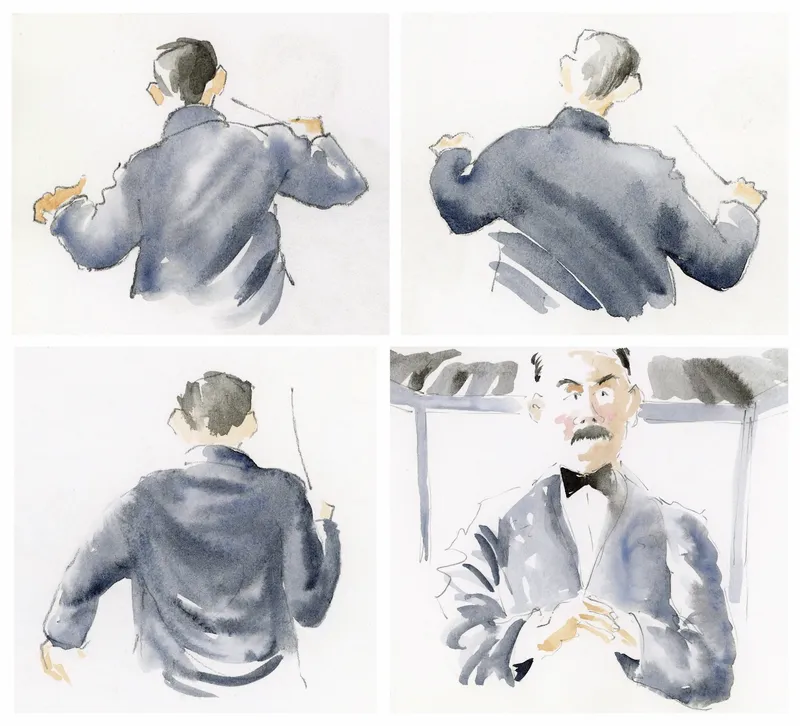
A mother and daughter danced in front of the bandstand. Wassily Kandinsky would have drawn the soundscape. I was happy to be scribbling down the park scape and the dancing child.

Bob Kerr
Bob Kerr is a Wellington author, illustrator and artist. He is the co-creator of Terry Teo, one of New Zealand’s most beloved children's characters, and his painting work often focuses on historical events and characters. His best-known artwork appears on the cover of Michael King's book The Penguin History of New Zealand (2003).


