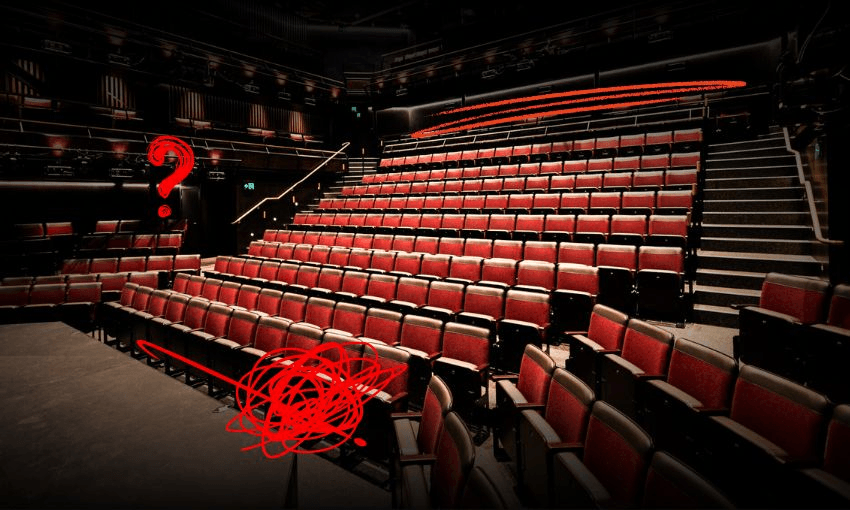

Court Theatre audience members as well as people working on shows say in some seats you can’t see parts of the stage, while in others you can peer behind the scenes. And then there are the sore backs, necks and knees…
When a theatre enthusiast recently took his grandparents to the Court Theatre’s production of 9 to 5 in Christchurch, he quickly realised they would struggle to experience everything the splashy Dolly Parton musical had to offer. “Everyone was having to lean forward in the side seats to see, but my grandma couldn’t do that,” he explained. “She could only see about a third of the stage.” Curiously, at the very same show but in different seats, a mother and her six-year-old daughter faced the exact opposite problem: they could see too much.
“We had a view into backstage, which was kind of interesting, but also distracting, as well as a view down onto the actors’ heads,” she said. “We also had a great view of a screen which faced the actors, showing the director.”
Check the Google reviews, and you’ll find more of the same. “Had to lean on the rail to see the whole show, but when others are leaning forward as well you can’t see what is happening,” wrote one patron. “Show was great, what we could see of it, the seating layout in the theatre is absolutely awful” wrote another. Other reviews lament both the “cramped” seats and “uncomfortable” stools, which left feet “dangling” and even saw one patron offered an upturned bucket to use as a foot rest. Several mentioned being left with sore necks, backs and knees.
It’s not the kind of feedback you’d expect from a brand new, state of the art, purpose-built theatre. Opening in May 2025, the $61 million council-owned building was billed as the anchor of the performing arts precinct in Christchurch and a much-anticipated return to the CBD for New Zealand’s longest-running professional theatre company. Having operated in the historic Arts Centre until the 2011 earthquakes, The Court sought refuge in a temporary industrial space in Addington, affectionately known as The Shed, where it would stay for over a decade.

A representative from the Court told The Spinoff that the vision for the new theatre was “to create contemporary, intimate venues that place audiences close to the action.” Their planning process took place over several years (and over 2500 meetings) and involved specialist theatre designers, architects, technical consultants and accessibility advisers, alongside extensive consultation with the theatre sector. “As with any purpose-built performance space, the design required balancing sightlines, acoustics, comfort, accessibility, flexibility and capacity.”
When the new Court finally opened last year with two theatre spaces (the Stewart Family Theatre and the Wakefield Family Front Room), along with flexible rehearsal and education rooms, onsite production offices and set-building and costume workshops, there was much anticipation in the air. But as audiences took their seats for the opening night of The End of The Golden Weather, something felt amiss. “I remember thinking ‘woah, this is friendly, this is quite tight’,” said Erin Harrington, arts critic and Flat City Field Notes editor.
Another opening night patron, who has been attending Court Theatre productions since the early 1990s, noticed immediately that the “claustrophobic” seats were “jammed in very close together” while observing elderly audience members struggling down the steep steps to get to their seats. “Given that a large percentage of the audience is older people, it was surprising that access to seats possibly wasn’t taken into account when the theatre was designed,” they said. “Not even the ushers were prepared for how many people needed assistance.”

Since that cosy opening night, Harrington has seen almost every Court Theatre production in her capacity as a theatre reviewer, and has encountered a litany of “wild” problems with the seats. “I have been uncomfortable because of proximity to other people and the fact that you might have somebody’s elbow up in your nose for the better part of two hours,” she said. “I’ve had problems getting in and out of my seat, including navigating some of those stairwells, and that’s been as both an able-bodied person and an injured person.”
Another common complaint from audiences and practitioners alike is how the seating impacts sightlines in both spaces. One patron didn’t even realise there was an umbrella onstage for the entirety of Twelfth Night in the Stewart Family Theatre, because they couldn’t see the full set. Actors unintentionally disappeared during Black Faggot for those in the upper level. One mum said the bench style seating for Kitchen Chaos left her kids unable to see past the people in front of them. “They were craning their necks the whole time, which was a real shame.”
In other cases, the sightlines have revealed key elements too soon, such as the pivotal wooden puppet in Wolf Play. “It’s a really beautiful theatrical conceit, and there’s supposed to be a reveal moment when you meet him,” recounted Harrington. “But I had already seen it, and I know that anyone who would have been sitting near me had already seen it too.” Other patrons reported seeing crew backstage, and actors waiting in the wings. As one longtime Court attendee put it: “it’s like you’re seeing how the sausage is made, when all you really want is the sausage.”

The Spinoff also spoke to several theatremakers who have been equally impacted by the bad sightlines. “There would be times where we were standing in the tiny wings backstage and, even with masking put in, the audience could see us,” said one actor. “Psychologically, you’re always on guard because you’re never truly offstage,” added another. “Backstage, you’re often fussing about with props or costumes, and you really want to be able to do that out of sight. Not just for your own privacy, but because you don’t want to spoil the illusion for the audience.”
It is that disruption of illusion which many mentioned as the most disappointing factor of the new Court space, with one theatremaker describing it as “unfair to the people performing, and unfair to the audience”. Harrington agreed. “The fundamental reason for the theatre is the interface between the audience and the performer, this moment that should be total immersive alchemy,” she said. “At the end of the day, it’s only about the audience and the performer, and everything else should be about supporting that. But at some point, something’s been lost in translation.”
A spokesperson from the Court Theatre told The Spinoff that while they have received a broad range of positive feedback around “the intimacy of the spaces, the acoustics, and the connection between audiences and performers,” they are also aware of “comments relating to seating comfort, navigation, and sightlines” in both theatres. “We take all audience feedback seriously and see this period as a normal post-opening evaluation phase for new venues,” they said. “Real-world use inevitably reveals nuances that cannot always be fully anticipated.”

The Court also acknowledged that “there are areas where refinements may be possible.” In response to the feedback, they are now reviewing seat classifications, improving booking advice and signage, and working with creative teams to ensure staging choices maximise sightlines and minimise unintended backstage visibility. “We are actively exploring practical adjustments where feasible, within the constraints of a fully operational venue, and will continue to prioritise accessibility, audience comfort, and transparency in how we communicate about the spaces.”
“We are immensely proud to have helped create new spaces for the arts in Ōtautahi Christchurch and see these conversations as part of being responsible custodians of them,” they added. “Our focus remains on listening to our audiences, responding thoughtfully, and ensuring the best possible experience for all who come to the theatre.”
In the meantime, Court attendees and practitioners continue to negotiate their feelings of frustration with the new $61 million space. “It’s great that the theatre is back in the city, but it just feels like a purpose-built building that is not fit for purpose,” said one theatremaker. Other performers feel awkward corralling friends and family to come to their shows. “I just want it to be better. It’s humiliating to invite people and know that they might not be comfortable, especially if it’s an elderly person, or someone with mobility issues, or someone who is tall or larger.”
It’s a sentiment echoed by Harrington. “It’s really hard to recommend shows, even ones that have felt really good in the space, if you can’t see everything,” she said, adding that the price of tickets, as well as transport, parking, dinner and a babysitter can be “quite the investment” in the current economic climate. “Contrary to popular belief, reviewers don’t want to go see something and then go, ‘oh, that sucked’ and luxuriate in telling people that it sucked. You want to go see something, be really moved, and to be a cheerleader for it,” she said.
“We all want to believe in it, but they are making it really hard.”