Why Sam Ruthe runs so fast

16-year-old running phenom Sam Ruthe.
Sam Ruthe may be the greatest prodigy in the history of running. The teenager’s talent is built on formidable genetics, careful parenting, a preternaturally mature mindset and the good fortune of having a man living in his Tauranga neighbourhood who knew how to pull it all together.
When 16-year-old Sam Ruthe lined up earlier this month for the one mile race at the John Thomas Terrier Classic at Boston University, Massachusetts, it was his first time running against a top-tier professional field. The race featured three Olympians, a world champion, a junior world champion, a US champion and a two-time US college champion. And yet all eyes were on Ruthe.
He first grabbed the running world’s attention in March 2025 when he became the youngest person ever to run a four-minute mile, aged 15 years, 11 months, and 7 days old. Since then, he’s broken age group records nearly every time he’s raced. He now holds the New Zealand under-20 record in every middle distance event from the 800m to the 5000m. On YouTube, hundreds of thousands of people have watched grainy footage of him competing in local meets and secondary school races.
Boston University’s track has a reputation as one of the fastest indoor tracks in the world. With a top-quality field of runners to drive him along, he had the ideal conditions for a new personal best time. Before the race, he told his dad, Ben Ruthe, that he thought he could run the mile in 3:48. Ben tried to temper his son’s expectations: “I don’t think you’re respecting how hard 3:50 is”. Since New Zealand’s John Walker first broke the 3:50 barrier in 1975, only 63 men have managed it. None were under the age of 18.
From the start of the race, Ruthe’s plan was to tuck in behind training partner Sam Tanner, a two-time New Zealand Olympian. But barely 400m in, Tanner tweaked his achilles and pulled out of the race, limping. The youngster was left out there alone. Ruthe didn’t look bothered. He never does. His notably smooth stride makes every movement seem comparatively effortless.
With 600m to go, the Belgian Olympian Peter Sisk started to separate from the front of the pack. Ruthe sprang to chase him down, making it a two-man race. On the final lap he found another gear, overtaking Sisk so aggressively that the Belgian didn’t even try to match him. Gritting his teeth, Ruthe powered down the home straight, gesturing to the crowd as he crossed the line in first place. The clock read 3:48.88.
That time was:
- Five seconds faster than the US high school record.
- Ten seconds faster than his personal best from 10 months earlier.
- The 11th fastest mile ever run on an indoor track.
- The 116th fastest mile ever run by anyone, anywhere.
- The fastest mile ever run by a New Zealander, surpassing legends like John Walker, Nick Willis and Peter Snell.
- Run before he started year 12.
Exactly 47 seconds after Ruthe crossed the line, there was a TV camera and microphone in his face. “I didn’t feel like I was going that fast to be honest,” he told the interviewer. “I can probably even go a bit faster”.
To say that Sam comes from running pedigree would be an understatement. His father Ben Ruthe won the Auckland Marathon in 2008 and won New Zealand titles in the 1500m and 5000m. His mother Jess Ruthe won the Auckland Marathon in 2009 and won New Zealand titles in the 1500m, 3000m, 5000m and the 10,000m (twice).

His Poppa Trevor Wright (Jess’s father) set the world record for the fastest debut marathon in 1971 with 2:13:27, and achieved podium finishes at the European championships, the New York City Marathon and the London Marathon. His best marathon time would have been enough to finish in the top 40 at the 2024 Paris Olympics.
His Nan Rosemary Wright (née Stirling, Jess’s mother) won the 800m gold at the 1970 Commonwealth Games, competing for Scotland. She also reached the finals in the 1972 Munich Olympics, won three European championship medals, including gold in the 4x400m relay, and set the British national 800m record with a time of 2:00.15.
Sam’s younger sister Daisy is already showing signs that she is in the same tier. Earlier this month, she won the New Zealand under-20 3000m championship. She’s 14 and it was her first time racing the 3000m. In a post-race interview with the Bay of Plenty Times, she put a target on her brothers’ back. “One day, I would like to be better than him,” she said.
The siblings’ personality differences show in the way they train and race. Daisy is a firebrand, Sam is a technician.
“Daisy just absolutely loves racing. There’s nothing in the world she likes more than competing and she can’t get enough of it,” Ben says. “Daisy’s approach is really, really competitive, so to some degree I feel like we have to hold her back more.”
By comparison, Sam is more cool-headed. “Sam enjoys the process and enjoys doing the hard work and likes getting the systems right and the process right,” Ben says. “He’s just built for this – and I don’t mean physically. I mean, psychologically. He has a rare, mature approach to racing that I’ve never seen.”

It was always obvious that Sam was a good runner. He won his primary school cross country every year. It was never even close. Despite the natural talent, Ben and Jess didn’t want their kids to train specifically for running until they reached high school. Instead, Sam played rugby and swam competitively. “We wouldn’t let him run. He was asking to go for training runs and we were saying ‘no, you’re not allowed to,’” Ben says.
“It can be quite hard for kids when they’re young, if they’re doing really well, to get overtaken. They can struggle with that if they’re not mentally prepared. We didn’t want to put them in that position. By 13, they started to get a level of emotional and mental maturity to understand and accept that part of the journey,” Ben says.
A recent analysis shows that only a third of top teenage middle-distance runners (defined by the 10 fastest times by u18 athletes since 2005 in each event) went on to achieve elite senior performance. The rest had decent but unexceptional careers or flamed out early, never surpassing their teenage peak.
“It’s quite tempting for parents that see their kids doing well at something to want to maximise that potential early. Jess and I are lucky that we have some experience in the sport and we’ve seen how that goes,” Ben says.
By fate or fortune, Sam was born into the perfect laboratory for a runner: the right genetics, and parents who understood how to nurture them. It also just so happened that the best running coach in the country lived in the neighbourhood.
Craig Kirkwood’s junior running squad in Tauranga has produced Olympian Sam Tanner, two-time Olympic medalist triathlete Hayden Wilde, and 20 other athletes who earned full-ride scholarships at US colleges. In 2025 alone, his athletes won 19 national championships (16 in athletics and three in triathlon) and six of them qualified for the world cross country championships.
How did Sam first come across his radar? Kirkwood laughs: “Well, I’ve known him since he was born.” He has been close friends with Ben and Jess Ruthe for 30 years and was a top runner himself, competing in the marathon at the 2002 Commonwealth Games.
Ben compares Sam and Daisy’s natural talent to a block of marble; you need a great coach to sculpt it into a work of art. In that metaphor, he says, “Craig is Michelangelo”.
“He’s created a culture and an environment that’s unparalleled in New Zealand,” Ben says. “We’re talking to coaches over here that recruit to universities and they simply cannot believe the amount of talent coming out of a few schools in Tauranga. It’s unheard of.”
“The nature of Craig’s coaching is he allows the children to have autonomy over how they approach training sessions. It’s their choice whether they turn up. He doesn’t reprimand them if they don’t. They get given the session and they get to choose the effort that they apply. He’s created an environment where everybody encourages each other and they all apply significant effort. They all support each other and because of that you get all these kids that are doing better and better.”
Kirkwood says there’s no secret to his system: “It’s just a sensible training approach and caring for the people you’re working with. Making sure that they’re doing the things that are going to make them the best athlete that they can be without being crazy about it.”

With Sam, Kirkwood is applying a conservative training protocol focused on incremental gains. He doesn’t want to employ advanced training methods until they’re necessary to break through plateaus. Sam has never done any weight training. He’s never done altitude work to improve his oxygen efficiency. His training volume is relatively low. In a typical week he runs 80-90km, while many professionals run 150km or more. He’s still training like a 16 year old, which means he should have a lot more room to grow.
This year, Sam is targeting the Commonwealth Games and World Junior Championships in July and August. He’s had to turn down other opportunities. He qualified for the senior World Indoor Championships in Toruń, Poland, but his parents think it would disrupt his education too much. “We’re saying no, you have to go to school,” Ben says.
As for Sam’s longer term future, his coach is already speculating about whether he can break the world mile record of 3:43.13, set in 1999 by Morocco’s Hicham El Guerrouj. “That’s only five seconds,” Kirkwood says. “That’s not ridiculously far. It’s only 40 metres on the track or so. Who knows what’s going to happen.”
His father has his sights even higher. “This is the complicated thing: if you think about what the world records are, then immediately you start limiting yourself.”
Since Sam’s 3:48:88 mile in Boston, the US athletics world has broken out in full-blown Ruthemania. “There wouldn’t be a collegiate or high school athlete in the country who doesn’t know who he is,” Kirkwood says.
When he arrived at his next race in Winston-Salem, North Carolina, he was mobbed by fans wanting photos and needed a security escort to get to the changing room. Dozens of people waited around for him to finish his warm down so they could get autographs and selfies.
“I don’t think he was ready for that,” Ben says. “You just don’t experience anything like that in New Zealand. It’s a lot for him to wrap his head around.” As a result, he decided to limit Sam’s media appearances so he could focus on upcoming races.
The race in Winston-Salem had even more hype around it because Sam was taking on one of the biggest names in the sport: Cole Hocker, the reigning Olympic gold medalist and Olympic record holder in the 1500m.
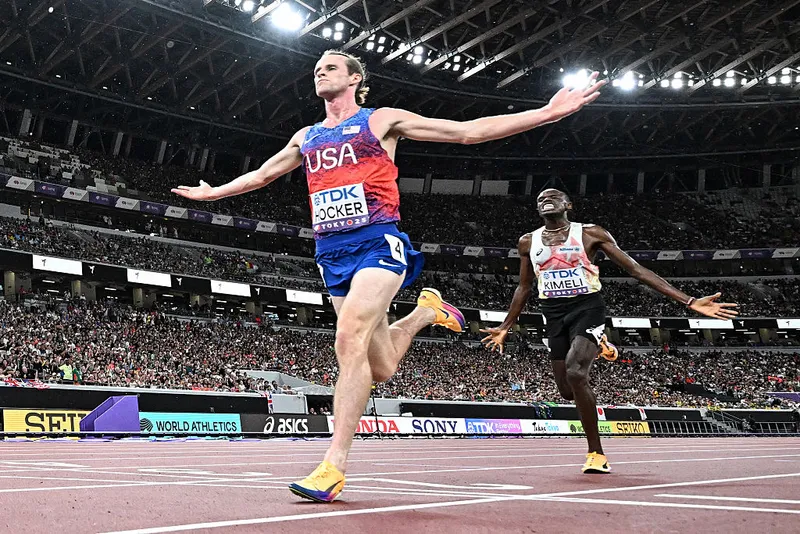
It was a controversial move among some observers who worried that it was too much too soon for a young runner – or that it was a cash grab to benefit from his name, image and likeness endorsement deal with Nike.
Ben says several “mostly well-meaning people” have questioned whether he is pushing Sam too hard, overtraining him, or giving him performance enhancing drugs. “I’ve received a variety of advice from random members of the public saying ‘oh, you shouldn’t put pressure on your kids’. But we’re not putting any pressure on him at all. I’m happy for him to quit the sport whenever he wants and I’ll still love him as my son.”
Ben insists racing in the US wasn’t about the spotlight or the money. “Sam doesn’t have a great desire to be famous, he just wants to run faster,” he says. “The reality is he needs to race against people who are faster than him and there are very few people whose names are on that list… All Sam is doing is trying to get into a running race where he is challenged. That is no different to any other child in the world that wants to run. It’s just unfortunate for Sam that his races have to be international.”
The race against Cole Hocker didn’t go to plan. Sam was jostled out of position by older and more experienced athletes, forced to run wide, and blew up on the last lap. He finished 7th in a time of 3:52.26. Hocker won in 3:45.94, a new US record.
It was exactly what many feared might happen. Ruthe was chewed up and spat out. He looked out of his depth, like a boy among men. But Ben and Craig were thrilled. Not at the result, but the way Sam had raced.
On paper, Sam didn’t have a chance against Cole Hocker. No one did. Hocker was targeting the record time and had brought two pacers along to help his attempt. Every runner in the field knew this. Most of them wanted to settle smoothly into the pack and hope that the pace would propel them to a new personal best.
Sam could have done that too, but he didn’t. He raced to win. Maneuvering around veteran runners, he fought his way up to third place, staying within striking distance of the Olympic champion. He matched Hocker’s pace as long as possible until he physically couldn’t hold on anymore. “He put himself in a position to be as close as he could, but he blew up and it didn’t succeed,” Ben says. “But man, I’d way rather see him have a crack.”
“It shows that he’s a racer, it shows bravery, and with that comes fast times,” Kirkwood adds.
The Ruthes have a sort of family mantra, which originally comes from Sam’s Nan: “It’s just running”. It’s a reminder not to take things too seriously. It shows in the way Sam competes. He doesn’t get particularly nervous before races, and he isn’t intimidated by big name opponents. Another kid might be crushed by the weight of his own potential, but Sam is protected by a strong support system that gives him the security to take impossible risks.
The reason Sam Ruthe tried to chase down Cole Hocker wasn’t that he was under pressure. It’s that he had nothing to fear. Why not have a crack? After all, it’s just running.

Joel MacManus
Joel MacManus is a senior writer for The Spinoff. He previously worked at RNZ and Stuff, and began his career at Critic Te Ārohi. His writing explores the political, economic and cultural systems that underpin modern New Zealand. He won the 2025 Voyager Media Award for Best Columnist, Opinion or Critique.


