
With talks under way between Wellington and Washington, the jargon of ‘critical minerals’ is everywhere – so what are they, and why does the US care so much, asks Catherine McGregor in today’s excerpt from The Bulletin.
To receive The Bulletin in full each weekday, sign up here.
A framework, not a deal
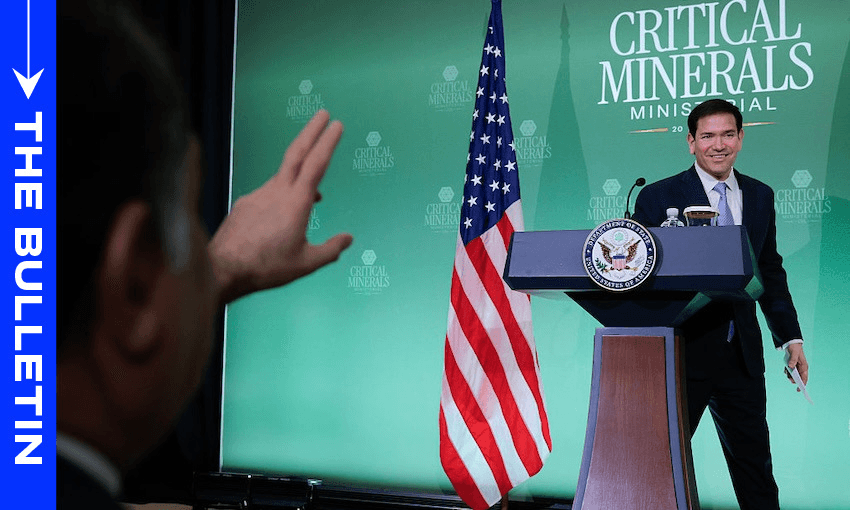
From electric vehicles to artificial intelligence, the race for the raw materials behind modern technology is intensifying – and New Zealand is now part of it. Last week it emerged that NZ is in discussions with the US on a non-binding critical minerals framework, as the Trump administration intensifies its efforts to secure supply chains that do not run through China. The talks became public a fortnight after Auckland University law professor Jane Kelsey first raised the issue in a Newsroom column. Last week NZ joined around 50 nations at the Critical Minerals Ministerial, where the US unveiled plans for a preferential trade bloc for critical minerals.
The US has described its heavy reliance on imported processed critical minerals as a “significant national security vulnerability”. According to the International Energy Agency, China is the leading refiner of 19 out of 20 important strategic minerals, with an average market share of 70%; the concentration has only intensified in recent years. “Reliance on a small number of suppliers increases vulnerability to shocks and disruptions, be it from extreme weather, technical failure or trade disruptions,” the agency notes. Washington wants to address this imbalance through a network of trusted international partners, including New Zealand.
What are critical minerals?
Critical minerals are the raw ingredients behind nearly every modern technology: the elements used in batteries, electric vehicles, wind turbines, semiconductors, data centres and advanced defence systems. MBIE last year issued a list of 37 minerals considered essential to NZ’s economy and technological needs, many of which are exposed to supply risk. Some are already produced here, including aggregate and sand, aluminium, gold, metallurgical coal, silicon, titanium, vanadium, zirconium and rare earth elements. Others, such as antimony, copper, cobalt and tungsten, have potential to be developed.
Yet as Newsroom’s Fox Meyer reported this week, the fast-track panel’s draft rejection of a proposed Taranaki seabed mine – a potential source of vanadium – has highlighted a basic constraint: NZ may want in, but it does not yet have many advanced projects that match US strategic priorities.
The domestic politics
Domestically, the issue has reopened the long-running mining debate that is far from settled. Opposition MPs have criticised the lack of transparency around the talks, and questions have been raised about whether Māori and the wider public will have meaningful input before any framework is agreed. Speaking to the Herald’s Jamie Ensor this week (paywalled), Christopher Luxon stressed there is no “fait accompli”, but has also argued NZ needs a critical minerals sector because “the future of the world is all about semiconductors and AI”.
Writing in BusinessDesk (paywalled), Dileepa Fonseka says the government has good reason to join the global effort to diversify supply chains, but its messaging has been abysmal. “The real political problem is that the electorate is not really sure what it thinks about mining, and our political leaders have not made the case for it in a way that speaks to anything beyond cash.” Hardly surprising, then, that the immediate assumption among many was that the minerals framework was primarily about currying favour with Donald Trump.
A minerals club built on security
At the heart of the US push is Forge – the Forum on Resource Geostrategic Engagement – the new trading bloc’s platform for critical mineral coordination On paper, it is about stabilising supply, creating price floors and encouraging investment. But Christopher Vandome of Chatham House argues it is also a geopolitical strategy: critical minerals are being “slotted directly into the architecture of US security alliances and defence industrial cooperation”. Countries with the closest security ties and highest political trust – such as Australia, Japan and South Korea – are likely to receive the most substantial investment and preferential access.
For New Zealand, that means any decision about digging up vanadium, antimony or other critical minerals will be shaped not only by public opinion and environmental law, but by how closely it chooses to stand with the US.