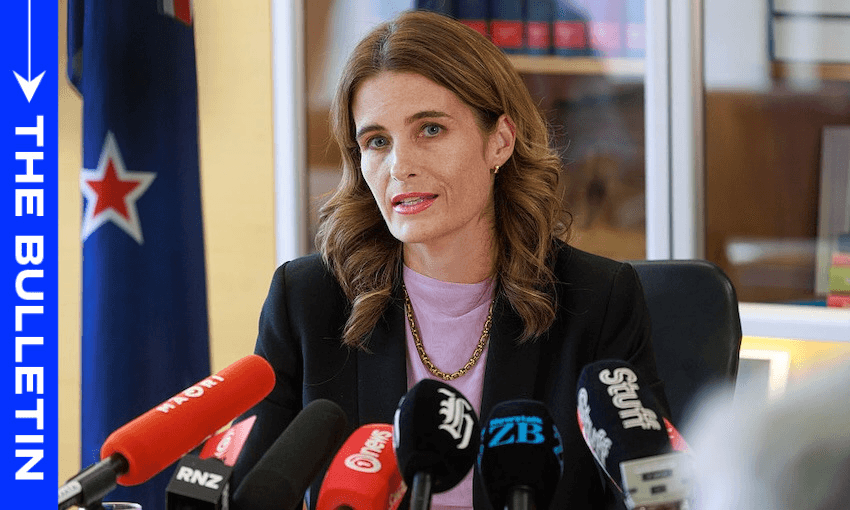

Jacinda Ardern’s handling of a crisis led to a landslide win for Labour. Could a little of that magic wear off on Nicola Willis, asks Catherine McGregor in today’s excerpt from The Bulletin.
To receive The Bulletin in full each weekday, sign up here.
The 1pm update is back
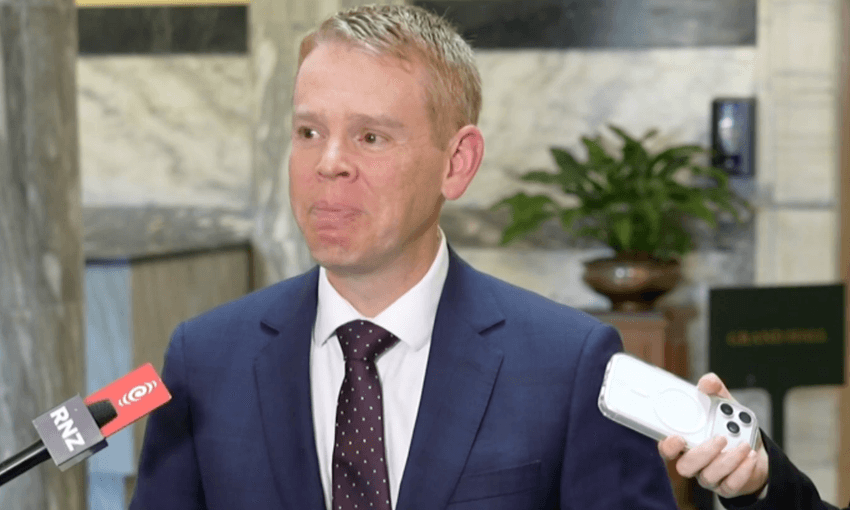
On Monday, Nicola Willis held a 1pm press conference on a national emergency and urged New Zealanders not to panic buy – a message familiar to anyone who lived through 2020. The briefing was about the Fuel Supply Emergency Level System and the government’s response to the sudden fuel crisis. Toby Manhire in The Spinoff, was unable to resist a satirical reimagining: Willis warning of “one new cluster of stranded vehicles after a super-spreader event on Transmission Gully” and urging New Zealanders to flatten the fuel curve as “a fleet of 4.7 million”.
Willis is no Ardern in her prime, but the crisis may be working in her favour anyway, according to BusinessDesk’s Dileepa Fonseka (paywalled). Watching Willis across multiple media appearances, Fonseka sees “a finance minister who is comfortable in a crisis, who isn’t panicking, and who knows that not panicking is itself a political asset”. The Post’s Luke Malpass (paywalled) agrees, observing that, for governments, a crisis response “needs only to be moderately competent to confer a large advantage on the incumbent”. He goes on: “As it happens, the Government’s response to the oil price shock so far has been more than competent – it has been good. Willis especially.”
The Iran war is unambiguously bad for the world; whether it’s bad for this government is, Fonseka notes, “an entirely separate question”.
A very long way from the Persian Gulf
Writing this morning in The Spinoff, Joel MacManus explains why New Zealand’s fuel supply is quite so exposed. The petrol in your tank traces a supply chain from tanker truck to pipeline to oil tanker, with more than 70% of NZ’s refined fuel sourced from Singapore, South Korea and China – which in turn relies on crude oil from the Persian Gulf, almost all of which passes through the Strait of Hormuz.
With the strait now effectively under Iranian military control, that chain has become a single point of failure. New Zealand’s options are limited, but the most durable long-term solution, MacManus argues, is rapid electrification of the economy – “a sort of green economic nationalism”, as he puts it.
A series of questionable decisions
Hayden Donnell, writing in The Spinoff (them again) is eager to salute “our government’s farsighted decision making, which has lessened the country’s reliance on fossil fuels and opened up non-oil-dependent transport options.” Oh wait – they didn’t do that at all. Among the moves Donnell catalogues: a 2024 government policy statement severely curtailing NZTA’s ability to invest in walking and cycling; $56 billion committed to 17 four-lane highways; the scrapping of the $50 million fund helping councils electrify their bus fleets; and the cancellation of the iRex ferries – at a cost of $500 million – in favour of smaller vessels that are already running over budget. The clean car standard, at least, should keep the fleet trending toward electrification over time. “Hopefully there are no plans afoot to scrap it entirely.”
The cost of scrapping the clean car discount
There are. The government is reportedly considering getting rid of the clean car standard altogether – which, as Ed Harvey writes in The Press, would make New Zealand one of only two OECD nations without a vehicle emissions standard, the other being Russia. But the decision drawing most anger this week is the earlier one: the removal of the clean car discount in 2023, which Harvey says sent EV sales from 26,000 that year to around 9,000 in 2025. Willis stands by the move, telling media that “giving subsidies to millionaires in Remuera” was not the right way to help those hit by high petrol prices.
Stuff’s Verity Johnson is unpersuaded: “My God, this would be the week to drive an EV,” she writes, before assessing the government as having spent “the last two years systemically punching NZ’s car electrification movement in the face. Then, when it was out cold on the pavement, kicking it in the head.” Harvey, a prominent EV industry player, is almost as blunt: had EV sales maintained their 2023 trajectory, “tens of thousands of additional households would today be immune to this week’s price shock.”