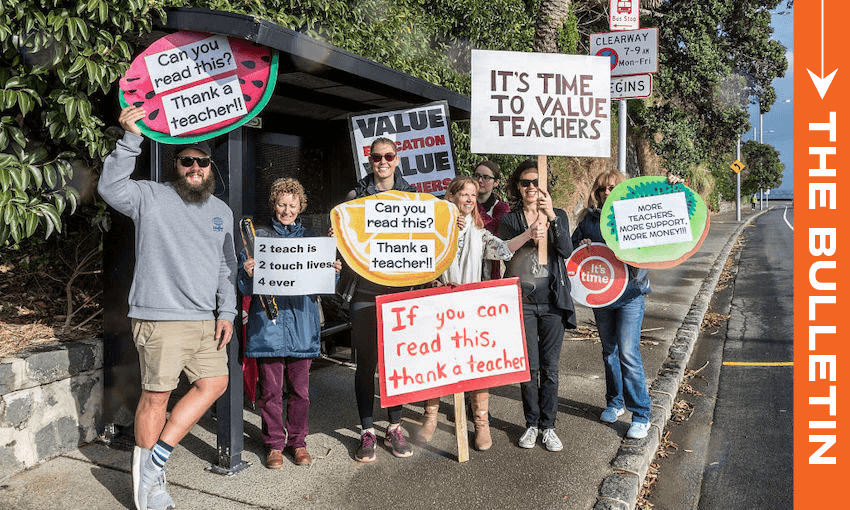

Teachers say an offer of 1% a year is an insult. Ministers say they should be at the negotiating table, not on the picket line, writes Catherine McGregor in today’s extract from The Bulletin.
To receive The Bulletin in full each weekday, sign up here.
A full-day walkout
Secondary teachers are off the job today, with classes around the country cancelled as members of the Post Primary Teachers’ Association stage a one-day strike. As Lyric Waiwiri-Smith explains in The Spinoff this morning, the action follows teachers’ rejection of the government’s offer of a 1% annual pay rise over three years – an increase the union described as “the lowest in a generation”. Teachers had sought a 4% yearly rise to cover inflation and stem the loss of staff overseas. Today’s walkout is just the beginning: rolling strikes are scheduled for mid-September, when teachers will refuse to teach particular year levels on successive days. Meanwhile, primary teachers are holding paid union meetings this week to consider their next steps, after also voting to reject the 1% offer.
Teachers say they’re worth more
For many teachers, the issue is about more than headline figures. In a widely shared essay for The Spinoff, Auckland teacher Connor Murphy describes the government’s offer as “an insult disguised as an offer”, pointing out that “teachers entered into these negotiations with a set of very reasonable demands. Instead of making a reasonable counteroffer, the government ignored our requests and crafted an offer seemingly purpose-built to make things worse.” Teachers argue their pay has fallen far behind comparable professions, with Australian starting salaries now up to $31,000 higher than New Zealand’s. Murphy says that while prime minister Christopher Luxon has talked about keeping New Zealanders at home with good, well-paying jobs, the government hasn’t followed the rhetoric with action, and teachers are instead eyeing better pay across the Tasman.
Ministers dig in
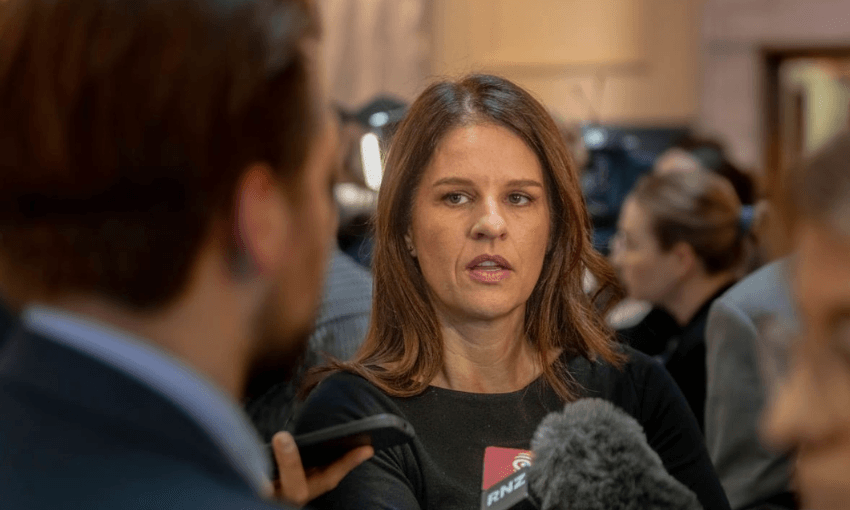
Education minister Erica Stanford has urged the union to return to negotiations, calling today’s strike “premeditated” and “deeply unfair” for parents and students. Public service minister Judith Collins went further, labelling the walkout a “political stunt” and accusing unions of having “little tantrums” and using children “like their shuttle boards” [sic]. The government has tried to highlight what it says is a strong deal: public service commissioner Sir Brian Roche said the latest offer came “on top of a further 3.9% to 7.7% in pay increases already built-in for each of the next three years” and that the package would deliver pay rises of between $2,500 and $7,000 a year, when annual progression is included.
But Collins herself was forced into a rare backtrack yesterday after she wrongly claimed that teachers with 10 years’ experience earned $147,000 a year. As Stuff’s Bridie Witton and Glenn McConnell report, she later admitted she had “mixed up [her] messages”, clarifying that only a small number of senior deputy principals in large schools would reach that figure. The gaffe further inflamed teachers already sceptical about the government’s grasp of their pay and conditions.
What teachers actually earn
So what do teachers really take home? As Nik Dirga writes in a comprehensive explainer for RNZ, the base salary for a newly qualified teacher begins at just over $61,000, rising step by step each year to $103,000 at the top of the scale. The Ministry of Education puts the average secondary teacher salary at around $101,000. Extra responsibilities – such as running a subject department or serving as deputy principal – attract management units and allowances, which can boost pay into the $110,000–$140,000 range. But only a handful of teachers reach the $147,000 Collins cited, and most are in senior leadership rather than classroom roles. For new teachers, the current offer of 1% a year translates to an increase of less than $12 a week. That, say striking teachers, is why they’re on the picket lines today, and why more disruption is on the way unless the government comes back with an offer they can live with.