
The bill would reduce health and safety requirements for small business, which critics say will increase workplace harm, writes Madeleine Chapman in today’s excerpt from The Bulletin.
To receive The Bulletin in full each weekday, sign up here.
The bill that keeps on rolling
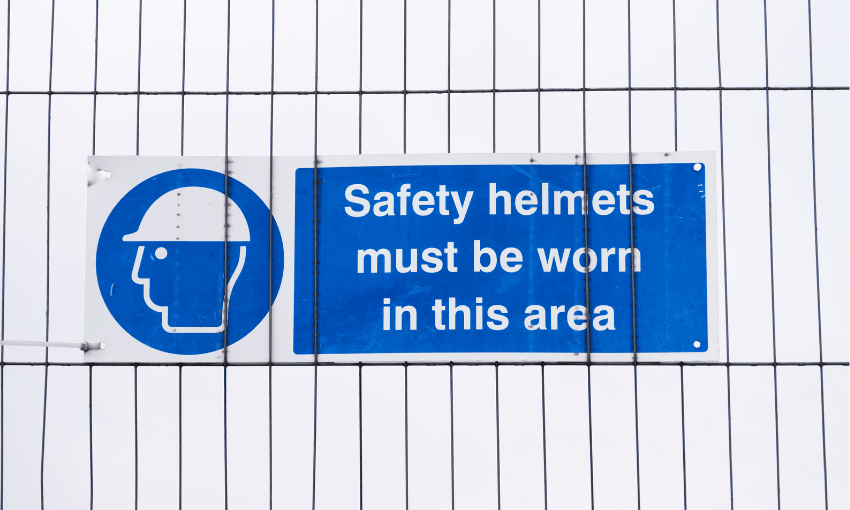
Like a steamroller at the office of a workplace with fewer than 20 employees, only a critical injury will halt the progress of Brooke van Velden’s Health and Safety at Work Amendment Bill. Introduced last year, the bill’s aim, as written, is to “improve the work health and safety system by reducing unnecessary compliance costs and clearly stating what businesses and organisations need to do”. It also aims to reduce workplace injuries at the same time.
Those aims would be achieved, in large part, by reducing the compliance requirements – AKA regulatory red tape – of small businesses (defined as businesses with fewer than 20 employees) to only “critical risk”.
The bill passed its first reading in February and the Education and Workforce Select Committee returned its report last week with the majority of members recommending that the bill pass with only minor amendments. It is expected to have its second reading today.
Workplace injury claims steadily falling
The bill would amend the Health and Safety at Work Act 2015, which was established in direct response to the Pike River tragedy, where 29 men were killed while at work in 2010. Pike River campaigners Anna Osborne and Sonya Rockhouse, who lost a husband and son respectively in the mine, are staunchly against this bill, and planned to meet Winston Peters last week to ask his party to vote against it at second reading.
The pair met with van Velden herself last November to voice their concerns, but considered the meeting “a complete waste of time”, reported Anneke Smith for RNZ. “She seemed to be focusing all the time on the employers and I sat and listened to it for a little while and then I just couldn’t stand it,” Rockhouse said of the meeting.
Since the HSWA was implemented, workplace injury claims to ACC have been steadily falling, with the exception of 2019, the year of the Whakaari White Island eruption. In 2025, 169,259 claims were lodged with ACC, 40,000 fewer than in 2018.
Reducing or exacerbating workplace harm?
Van Velden has defended the decision not to invite ACC to consult on the details of the bill, saying it had been consulted with regarding the “overarching cabinet paper”, reported Tom Pullar-Strecker yesterday for The Post (paywalled). And turns out the agency had plenty of concerns to share. Documents obtained under the Official Information Act reveal that ACC advised MBIE last year the bill could drive up insurance costs, and further documents show the agency warning of “a real and material risk of increasing deaths, injuries, claims and costs”.
Institute of Safety Management board chair Mike Cosman told RNZ’s Checkpoint that if small business owners considered the current regulations confusing, this bill would simply be confusing in a new, different way. “Working out what is a critical risk is complicated. Working out what is a small firm is complicated. So none of these changes actually will make it easier for business,” he said.
A union of opposition
At the start of June, Rebecca Macfie wrote a comprehensive feature for The Listener (paywalled) canvassing industry opinions and laying out the surprising opposition for a bill tasked with supporting businesses. “Critics as diverse as Ports of Auckland Ltd (whose former CEO was successfully prosecuted for fatal health and safety failures), hospitality workers, the civil contracting sector, the bus and coach industry, engineers, unions and bereaved families of the Pike River Mine disaster have raised concerns and called for deep changes or the scrapping of the bill altogether.” Swimming against the tide is Katherine Rich, CEO of Business NZ and former National MP, who voiced her support to select committee.
Writing on The Spinoff this morning, Max Rashbrooke doesn’t mince words: “As with much Act policy, [the bill’s intention] seems superficially plausible: small businesses are stretched, so why not let them concentrate on the biggest risks? But as with much Act policy it is evident, the moment one peers into the engine room, that this is an absolute trainwreck of a bill.”