Waitangi remembers. Politics moves on


Tell me lies, tell me sweet little lies. (Image: The Spinoff).
Every Waitangi, politicians promise transformation. Looking back 12 months on, the gap between what was said and what was done is harder to ignore.
Waitangi has a long memory.
Every year, the Treaty grounds become a kind of national mirror. Politicians arrive keen to see themselves reflected as principled, pragmatic, courageous – or at the very least, misunderstood. Māori arrive carrying history, expectation, frustration and hope, all compressed into a few hot, humid days in February. The rest of the country watches from a distance, dipping in when controversy breaks through the summer haze.
It is ironically fitting that Waitangi is where political promises are both made and unmade. The speeches are big. The language is earnest. The follow-through is usually slow, partial, or quietly abandoned. But still we return, year after year, because Waitangi is where intent is tested – and where the gap between rhetoric and reality is hardest to hide.
Last year’s commemorations landed in the middle of an unusually charged political moment. The Treaty principles bill loomed large. Talk of a Ngāpuhi settlement once again resurfaced. The prime minister’s decision not to attend strained already frayed nerves. Against that backdrop, political parties used Waitangi to sketch out their priorities on Māori issues, some cautiously, others confrontationally.
Act
No moment captured that tension more clearly than the February 5 speech by Act leader and deputy prime minister David Seymour, which saw his microphone being removed twice by Ngāti Wai leader Aperahama Edwards. The image travelled quickly. A government minister cut off at the nation’s symbolic centre, insisting he was there to talk “facts” while some in the crowd rejected both his framing and his authority to define the kaupapa.
Seymour’s message was consistent with Act’s broader project. He spoke about Māori home ownership, school attendance, crime victimisation, unemployment, income and life expectancy. These were presented not as outcomes shaped by colonisation or Crown policy, but as indicators of system failure in the present – failures his government claimed it could fix through “practical solutions”. Fewer people on welfare. Faster health treatment. More people in work. Less emphasis on the Treaty, more on uniform rules.
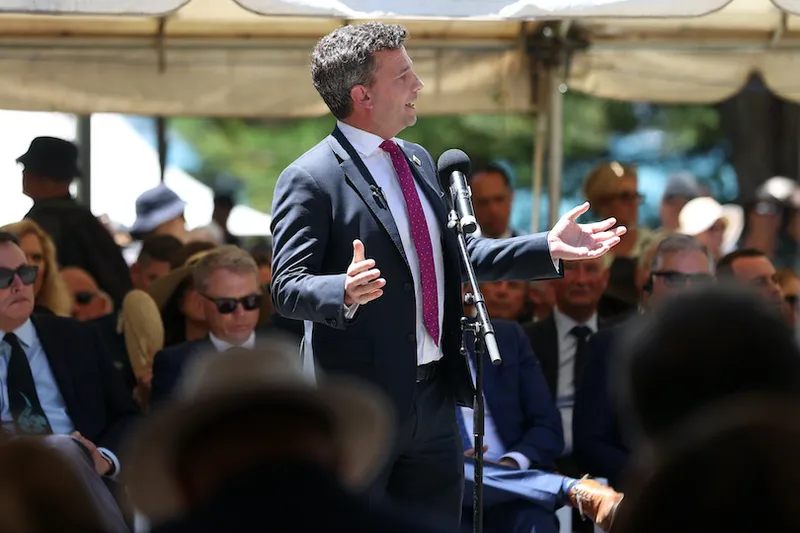
A year on, it is difficult to argue that those promises have translated into measurable change. Māori school attendance has not improved – in fact, it has slipped slightly, with barely a third of Māori students attending regularly. Reported reductions in Māori victimisation have been challenged by analysts who point to changes in reporting and categorisation rather than lived safety. Income gaps remain stubborn, with Māori still earning significantly less on average than non-Māori. Health wait times, by the government’s own measures, have worsened.
There are longer-term trends that resist easy political ownership. Māori life expectancy has increased over the past two decades, including a notable jump in recent data. But that progress predates the current government and reflects decades of cumulative change.
Te Pāti Māori
If Act framed Waitangi as a place to restate its scepticism of Treaty-based policy, Te Pāti Māori used it to argue the opposite – that symbolism without power is meaningless. Last year, the party talked openly about the need for a Treaty commissioner or authority – an independent body with teeth, capable of monitoring and enforcing the Crown’s obligations rather than just advising on them.
That idea has not advanced legislatively, but politically it has gathered weight. The past year has seen the disestablishment of Te Aka Whai Ora, the stripping back of Māori policy infrastructure, and a steady narrowing of how the Treaty is recognised in law and practice. With that, the argument of Te Pāti Māori has sharpened. If Māori wellbeing is always dependent on who holds office, then Māori control must be structural, not rhetorical.
Waitangi, for Te Pāti Māori, is less about persuading the Crown than about speaking directly to Māori – highlighting the limits of engagement and the costs of relying on goodwill alone.
Labour
Labour, by contrast, arrived at Waitangi last year offering something more intangible – presence. Opposition leader Chris Hipkins framed his visit as an exercise in listening rather than leadership, promising to return every year he remained in politics and to keep his “taringa open”. In the wake of Labour’s election loss, it was a deliberate repositioning – humility over certainty, engagement over confrontation.
That approach has largely held. Hipkins has been careful to distance Labour from more radical constitutional proposals, ruling out support for a Treaty commissioner with veto powers, while later signalling openness to a parliamentary commissioner model that would sit within existing frameworks. It is a position that acknowledges Māori frustration without committing to structural change – a line Labour continues to walk cautiously.
Hipkins’ speech at the political pōwhiri was widely praised by haukāinga as constructive and unifying, offering a contrast to the tension surrounding government speakers. But the underlying question whether listening alone is enough remains unanswered. A year on, Labour has regained relevance at Waitangi – but it has still to articulate what, beyond tone and trust, it would do differently if returned to power.
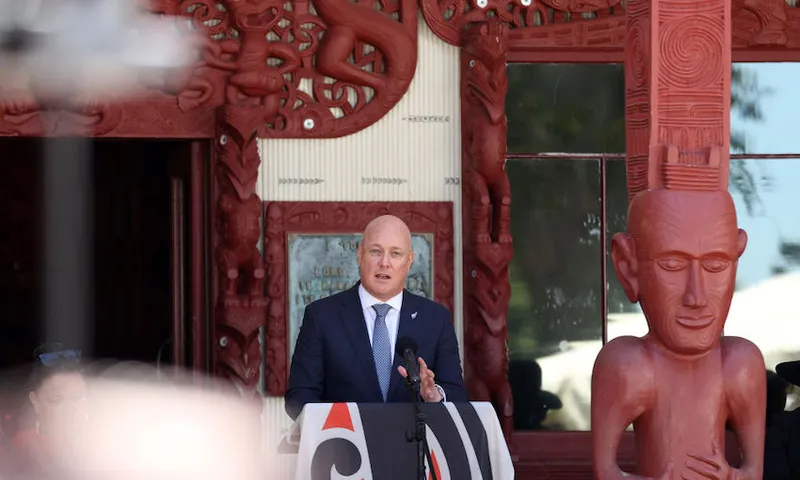
National
For the National Party, last year’s messaging was more restrained. The party emphasised economic repair, social cohesion and a desire to move beyond what it characterised as divisive debates. However, one issue it repeatedly returned to was the unresolved Ngāpuhi settlement – the largest and most complex Treaty claim still on the table. Minister for Treaty of Waitangi negotiations Paul Goldsmith pointed to a recent settlement as illustrative of the government’s willingness to settle a Ngāpuhi claim, but that such a deal would be on the government’s terms as much as those of Ngāpuhi.
Twelve months later, Ngāpuhi is once again front of mind. Progress remains slow, tangled in questions of mandate and representation that resist tidy resolution. National has framed renewed settlement momentum as both an economic imperative for Te Tai Tokerau and a matter of unfinished business for the Crown. But the underlying tension remains unchanged – Ngāpuhi does not organise itself for the Crown’s convenience, and every attempt to force closure risks reopening old wounds.
Waitangi continues to be the place where that discomfort surfaces – where the desire for a “final” settlement collides with the reality of hapū autonomy and historical grievances.
New Zealand First
If National has leaned into pragmatism, New Zealand First has leaned into leverage. Over the past year, its influence has been felt most clearly through funding threats, including proposals to cut the budget of the Waitangi National Trust. Even floated, those threats carried weight – especially when coming from the party’s top brass, both of whom are respected sons of the North. They signalled that Treaty institutions – even the most symbolic – are vulnerable when their value is treated as optional rather than foundational.
The cuts have not landed, but the message has. At a place where history is supposed to anchor the nation, the idea that commemoration itself must justify its cost is illustrative of where this government stands.
Green Party
Meanwhile, the Green Party arrived at last year’s Waitangi with a quieter but no less significant focus on the return of co-leader Marama Davidson. Her re-emergence was framed as a recommitment to kaupapa Māori, climate justice and Treaty-based politics at a time when all three have been pushed to the margins.
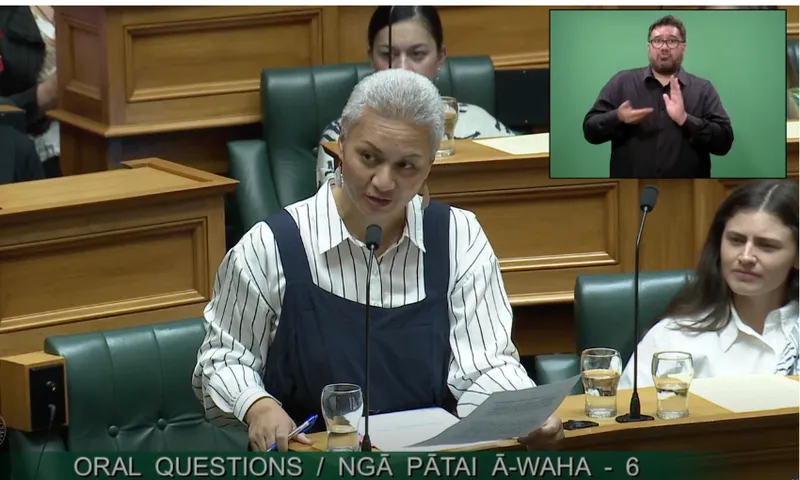
Over the past year, the Greens have struggled to cut through a political environment dominated by fiscal restraint and culture-war framing. But their presence at Waitangi was a reminder that, for some parties, the Treaty is not a side issue or a technicality – it is a forum where social, environmental and economic justice must be discussed and understood.
So what has changed in the year since last Waitangi? Less than the speeches suggested, and more than the headlines admit. The Treaty principles bill that once loomed large has faded from view – and while prime minister Chris Luxon swears that he will not concede to Act’s wish for a second run at it if they’re negotiating after November 7 – the ideological project behind it continues in quieter forms. There are ongoing institutional rollbacks, narrowed definitions, and funding pressure. Talk of partnership persists, but the substance is increasingly contested.
Waitangi remains pivotal because it exposes these contradictions. It is where politicians say what they mean – or at least what they want to be heard saying. It is where Māori remind the Crown that memory is not optional, and that promises do not dissolve just because the calendar turns.
A year on, the lesson is familiar but no less urgent. Waitangi is not where the work is done. It is where the work is measured. And the ledger, as ever, remains uneven.


