

Nearly three centuries ago, a massive greenstone gong belonging to a powerful chief was hidden near Maungawhau. Where is it now? Joel MacManus investigates.
Down a long garden path, behind some suburban houses, there is a hole in the ground. Go down the hole and you’ll find yourself in a muddy pit, surrounded by jagged rocks. Crawl along a low passageway, then cling to a rope as you lower yourself down a perilous drop. There, you’ll find something special: an expansive, airy chamber, with bioluminescent bacteria sparkling on the walls and pōhutukawa roots dangling from the surface like delicate stalactites.
This is Stewart’s Cave in Mt Eden. Underneath Auckland’s streets there are hundreds of caves like this formed by ancient lava flows from the city’s volcanic cones. In one of them, some say, there is buried treasure.
A massive pahū pounamu, a greenstone gong, is said to have been hidden around 1740 before a battle to prevent it falling into enemy hands. Nearly three centuries later, it is still lost. If it could be found, it would be one of New Zealand’s most important archaeological discoveries; a symbol of Auckland’s first great civilisation.

The pahū pounamu belonged to Kiwi Tāmaki, the most significant chief in the history of Tāmaki Makaurau. At the peak of his power, about 20,000 people lived in pā complexes across the Auckland isthmus, enjoying a sustained and prosperous peace within their strongly defended borders.
When Kiwi Tāmaki wanted to summon a war council or call the people to shelter in their pā, he would beat the pahū pounamu, which was said to have made a noise that carried for several kilometres.
Its name was whakarewa-tāhuna. Whakarewa means to float or launch, while tāhuna refers to a beach or shore (or possibly a specific location: Queenstown, which was used seasonally to gather pounamu). Transporting a notably large, heavy slab all the way from Te Wai Pounamu to Tāmaki Makaurau by waka must have been a significant feat worthy of being remembered.
The pahū pounamu disappeared around the same time Kiwi Tāmaki was defeated and his iwi, Te Waiohua, lost their military control of the region.
Kiwi Tāmaki’s downfall began when he received false information, possibly fed to him by an enemy, that Te Taoū, a hapū of Ngāti Whātua based around Kaipara, was planning to attack. In reality, Ngāti Whātua were preoccupied by holding a tangi for a senior chief. Without waiting for clarification, Kiwi Tāmaki attacked, killing dozens of Ngāti Whātua.
It was a grave insult that demanded utu. Ngāti Whātua gathered a large army and invaded south, killing Kiwi Tāmaki in a battle at Paruroa, on the edge of the Waitākere Ranges and going on to conquer all of Tāmaki Makaurau.
Te Waiohua fled south to Waikato and wouldn’t return for several generations. Before they left, a woman put the pahū pounamu in a secret hiding place which has since been forgotten. Some people say it was dropped in the harbour. Some say it was hidden in a cave. Others are unsure it ever existed.

Kelvin Tapuke (Ngāi Tai kī Tāmaki), a senior research fellow at Massey University who serves as a cultural advisor on work related to Auckland’s caves, is a pahū pounamu sceptic. “I think it’s an absolute myth,” he says.
“There were lots of stories in the 19th century about lost treasures. Indiana Jones-type mysteries that justified people exploring our burial caves,” he says. Museums across Europe still hold vast collections of weapons, jewellery, and kōiwi (human skeletal remains) raided from urupā (burial sites).
Tapuke doubts that it’s possible to make a gong out of pounamu that could be heard for kilometres around – and even if it is, why not use it for tools or weapons? “It seems like a bit of a waste of a resource, especially when you have those big massive trees you can hit with a big stick.”

Karen Wilson, the great-great-great-great-great-great granddaughter of Kiwi Tāmaki and the current chair of Te Ākitai Waiohua Settlement Trust, believes the pahū pounamu is real.
“It’s not a story to us,” she says. “It is true, from our perspective.” The pahū pounamu is mentioned in the iwi’s statement of claims, part of the treaty settlement process that shows their ancestral connections to Maungakiekie and Maungawhau.
“We wish we could put more investigation into it,” she says. “Long story short, we are aware of it, it’s well known. But no action has been taken at this stage.”
The internet is frustratingly light on information about the pahū pounamu, but there are a handful of clues buried in old legal documents and academic texts.
It’s mentioned by Justice Francis Fenton in an 1868 Native Land Court case brought by a chief named Hetaraka Takapuna.
“Much was made of a greenstone slab called Wakarewhatahuna, which it was alleged carried with it the mana of Tamaki, and possession of it was evidence of the ownership of the land,” Fenton wrote in his judgement.
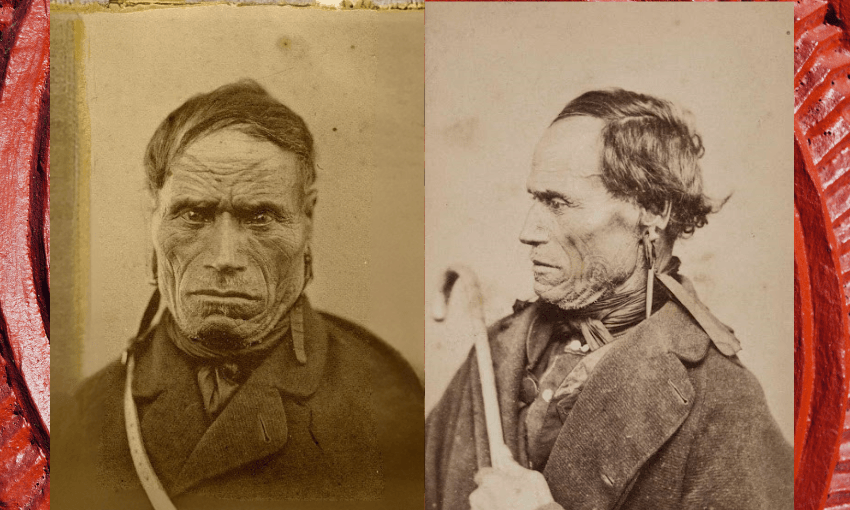
“It belonged, Hetaraka tells us, to Teke, a wife of Te Hehewa. She was the last person seen with it, and she hid it – Hetaraka does not know where.”
Fenton was wary of suggesting that the person who eventually found it would own all of Auckland. “It was buried last century, and with it must be taken to be buried whatever mana it possessed. Nor do we hold that the title to Tamaki will be revived for the benefit of the person who may happen hereafter to find it.”
The pahū pounamu appears several times in The Ancient History of the Māori, a six-volume collection of oral histories by government historian John White, published in 1891.
There is a description of the slab having had sections chipped out. “Whakarewa-tahuna, this block of greenstone, is of very ancient days, because it had been in the possession of many generations of our ancestors, and many meres and many kurukuru and heitiki had been cut from it by our ancestors.”
Two accounts mention a woman named Peke (not Teke) who was the wife of Te Hehewa, while a third names one of Te Hehewa’s other wives, Rangi-ika-ketu. That means there are multiple sources telling roughly the same story.
One informant told White the pahū pounamu “was hidden by Peke, and she hid it for fear it should become the property of our enemies, as it was a keepsake of our ancestors.”
A second source gave more details: “Peke had it till it was lost, and she hid it, and it was lost near Maunga-whau on the west side of that Pa, it was in the days when a war party attacked the Pa, and a charge was made by the enemy on the Pa, Peke took the block of greenstone and hid it a little below the ditches of the Pa in a cave of the scoria on the west side toward the south of the Pa, and it is lost still.”
That’s an incredibly specific description. So, what caves are there on the south-western edge of Maungawhau?

Professor Jan Lindsay from Massey University’s school of environment isn’t aware of any caves that fit the description. Neither is Kate Lewis, a natural features specialist at Auckland Council.
Many of Auckland’s caves have been destroyed by property development or covered up to prevent people falling in and hurting themselves. Some property owners hide their caves because they don’t want the hassle of dealing with the council’s heritage rules.
Peter Crossley has been caving since 1968 and has been inside “about 250″ of Auckland’s caves. “There’s not many that I haven’t been in. Or at least not that you can still get into,” he says.

Crossley suggests it could be in Rangi’s Cave or Nga Ana Peka Rau (“the cave of many bats”) located around Windmill Rd, Mt Eden. These caves were near the old Epsom Mill, a site with some dark history. Opened in 1844, and initially used to grind corn, it was later used to grind animal bones for fertiliser. The Mt Eden Borough Council’s history of the area notes that when animal bones were scarce, owner Robert Robertson would raid the nearby Māori burial caves for bones. “Thousands of skeletons apparently went through but it’s difficult to know the truth,” Crossley says.
It’s a good theory, but it still doesn’t quite fit. Rangi’s Cave and Nga Ana Peka Raudue are about a kilometre from the edge of Maungawhau, due south. Not on the south-western edge.
Crossley’s second theory is more disappointing: that the pahū pounamu could have been hidden in a hole in the ground surrounded by scoria; not a literal cave, but something that could have been described as one. If that were the case, it’s almost certainly lost.
But what if we’re looking at the wrong maunga? The sources which mention the pahū pounamu have conflicting details: some say it was kept at Maungawhau, others say Maungakiekie. Perhaps the same mixup could apply to its hiding place?
Crossley immediately recalls a cave on the south-western side of Maungwhau, right where the edges of the pā would have been. But it’s one of the few he’s never been inside. In fact, he’s never been able to find it. He only knows about it from a 1907 story in the Auckland Times, and a photo which shows men climbing into it down a ladder. “I’ve tried standing on the slopes with the photo in hand to work out where it was, but no such luck. I haven’t got a clue where that one is,” he says.

According to the newspaper report, the cave is shaped like a vertical shaft; a sudden descent of 15 feet, which opens up into a large chamber. From there, there is a second descent into another chamber, where there is “a veritable catacomb” of human bones. “One thing was quite evident, namely, that tons upon tons of bones must have been thrown down to consolidate into a heap, at one point four feet in depth, of fairly solid composed human debris.”
The group explored several chutes coming off the main chamber but found nothing of interest except for the skeleton of a rabbit which had apparently fallen in. There is no mention of a large, smooth chunk of pounamu amid all the coarse scoria.
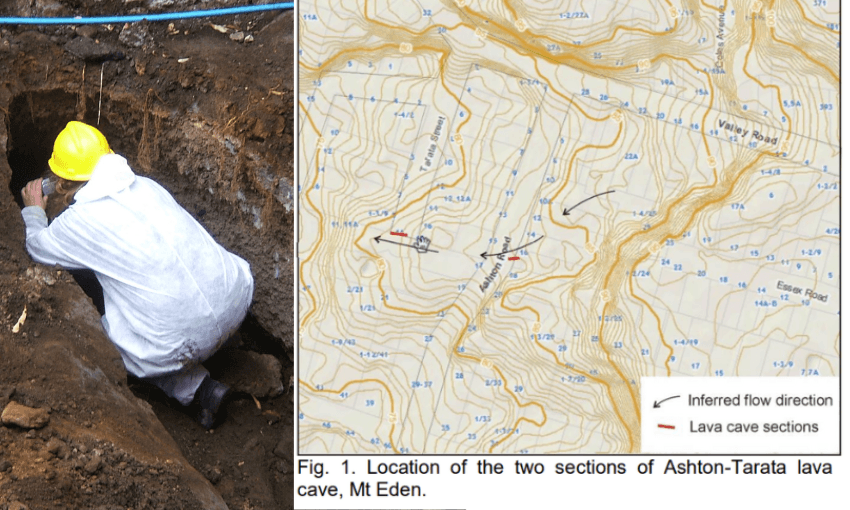
The search for the pahū pounamu seems to be at a dead end. Then, Jan Lindsay sends through a PhD thesis by Jaxon Ingold, who used geospatial analysis to predict the sites of lava caves. On the 20th page is a map with red dots showing some of the known lava caves around Auckland. One of the dots was nestled right on the south-western edge of Maungawhau.

The original creator of the map, geologist Bruce Hayward, says the dot represents two narrow tubes that were discovered during footpath works in 2007. “Those entrances were covered up again and there is no known access at the present time. They have no special significance.”
In a short academic article he wrote about it for the Auckland Geology Club, Hayward describes the two sections of cave: a 12m-long tube on Tarata St and a 6m-long segment on adjacent Ashton Rd. They were too small for an adult to crawl through.
From the positioning of the two sections of cave, Hayward was able to infer the direction of the lava flow. These two sections of cave are part of a longer lava tube, probably collapsed in parts, that runs from the south-western side of the maunga.
If you do a little bush bashing near the Batger Rd entrance of Maungawhau, you can find signs of where the cave begins. About 20m from the path, near the fence line, there is an outcrop of volcanic rock. Most of it has been commandeered by neighbours to build garden walls. Some older formations have been covered with moss and reclaimed by nature.
If the stories about the pahū pounamu are true, this is roughly where Peke hid it.

Unearthing the pahū pounamu would probably require a full archaeological excavation – a difficult proposition given the cave runs underneath private property. Te Ākitai Waiohua have no plans to start digging anytime soon. If and when it happens, the search would likely be overseen by the Ministry of Culture and Heritage, with the iwi playing an advisory role.
“We would certainly believe that we would play a part in deciding where it was held,” Karen Wilson says. “It’s Kiwi Tāmaki’s, there is nobody else that can make a claim to it. There is only one iwi with a direct line to him.”
There are political considerations at play, especially since Te Ākitai Waiohua have yet to sign a treaty settlement, which could create a complicated case of disputed ownership. So for now, Wilson says, Te Ākitai Waiohua is happy to leave the pahū pounamu underground.
“It’s been there for some time now, there’s no harm in it staying there until we get better certainty.”