

Ātea editor Liam Rātana ponders exclusion, access, and the uncomfortable reality of flashing a media pass and being waved through into the roped-off area at Waitangi.
Here I am, sitting on the edge of Te Ana o Maikuku – also known as Hobson Beach – at Waitangi. Small waves lap the golden sand as a constant stream of people walk up and down the hill behind me.
Just three hours earlier, I stood here in the darkness of the dawn, rubbing my eyes along with a small crowd of people gathered for a dawn ceremony. Karakia, takutaku, and karanga ushered the sunrise. I felt privileged to understand what was happening – to be able to bask in the wairua of the moment.
The people leading the kaupapa are descendants of some of the signatories of te Tiriti o Waitangi. They are versed in the knowledge of our tūpuna. Many of them have grown up travelling to Waitangi every year. As children, they watched their grandparents and then parents lead these ceremonies. Now, they are privileged to take the reins.
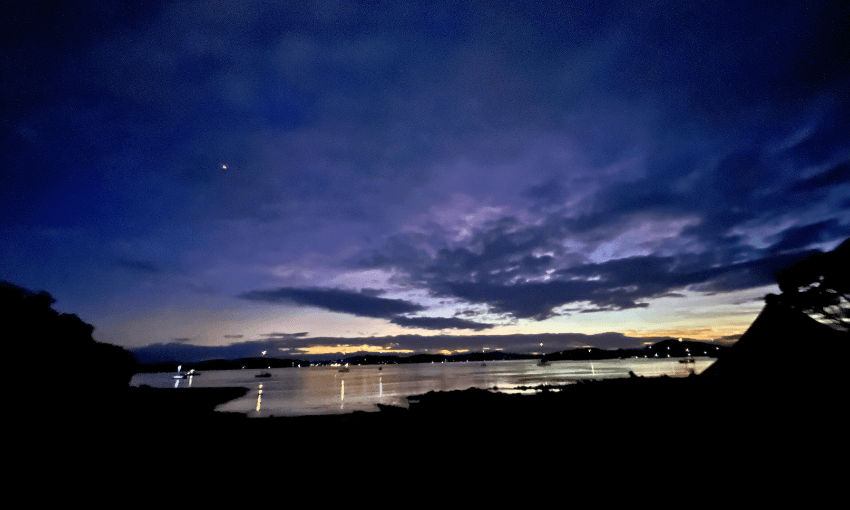
This beach is where William Hobson arrived 186 years ago aboard the HMS Herald. He got off his boat, walked up the same path still in use behind me, and signed te Tiriti o Waitangi under the authority of Queen Victoria. I imagine the early morning sky would’ve looked quite similar back then to what it looks like now: anchor lights swaying atop the ship masts and moon light reflecting off the shimmering water. There wouldn’t have been any street lights in the backdrop though, or drones flying around doing surveillance. I’m privileged enough to remember a time when the skies here only had stars in them.
I remember, because I’m fortunate enough to have been to more Waitangi commemorations than I can count. My father would bring me here as a child. Back then, most of our time at Waitangi was spent around Te Tii Marae, Te Pou Rangatira, and all the whānau camping in tents or sleeping in their cars. That is what I think of when I hear “Tent City”. These were the sovereigntists – the whānau that weren’t here for the official services, but for the wānanga. They were the whakaminenga, the grassroots whānau, the ones who knew more about constitutional law than some lawyers.
A lot of what I learnt from just being in this environment was through osmosis. Discussions would often go into the early hours of the morning, with topics including He Whakaputanga, the language differences between the two treaty documents, treaty settlements and iwi elitism (though that wasn’t a term I remember hearing much back then). The mātauranga and worldviews I was exposed to helped to inform my views and shape my identity today. A lot of what I am now involved in – the things I write about, roles I hold and views I have – come from those times and people.
I often wonder if my dad would be rolling in his grave watching me now, rubbing shoulders with the politicians, iwi leaders and elitists he used to despise. Part of me likes to think he’d be proud. I know for certain he’d be making sure I was repping our hapū, working towards its advancement in some way. In a strange way, I am.
Often through the guise of my job, I talk to iwi leaders in control of hundreds of millions, attempting to glean an understanding of the inner workings of their entities. I watch politicians mix with the top brass of te ao Māori, learning how these relationships work in practical terms. I start to think I am learning how the world operates, but as the saying goes: “The more you know, the less you know.”
On Thursday, I stood at the flagstaff as a group of activists gathered in the rain. At first, I was the only journalist there. I had been keenly following their build-up to Thursday’s protest on social media. I knew they planned on disrupting the official proceedings, wanting to send a message to not only the government, but also their relations welcoming them on to the treaty grounds and Te Whare Rūnanga Marae.
The group was upset at how the government had been treating Māori and they were upset their whānau was “rolling out the red carpet” for these people. The speeches from the group’s leaders were akin to calls to battle, questioning how their own whanaunga could welcome what they claimed was “one of the most overtly racist governments of recent years” to Waitangi.
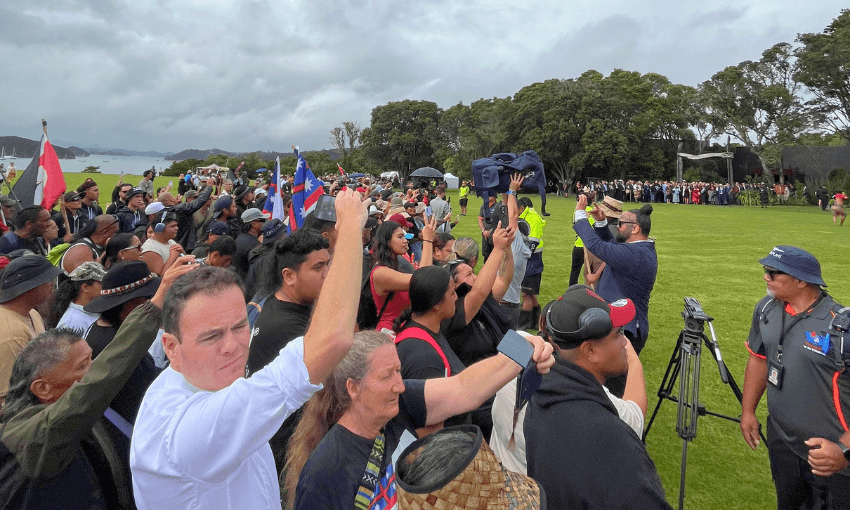
As the pōwhiri began, the group made its way from the flagstaff towards the roped-off section where the dignitaries – including leaders of all the major political parties and government ministers – stood awaiting the wero from the hau kainga. Leaders of the protest group asked onlookers to move out of the way, but they didn’t and instead forced the protesters to squeeze their way to the front. A few protesters attempted to breach the line, despite being asked by the haukainga and Waitangi National Trust not to. The police and other security guards were acutely aware of the planned protest. They formed a barricade on the dignitaries’ side, preventing the protesters from being able to cause any disruption beyond their chants and waiata.

Initially, I was standing to the side of the group, watching the events unfold. I saw members of the media on the dignitaries’ side of the rope, taking photos and videoing the protesters from the front. Security desperately tried to get the media back behind the rope, but their requests fell on deaf ears. I jumped over to get a better view myself and was quickly approached by the nearest guard, who told me to get back. “I’m just like her,” I said, pointing at another journalist standing on the same side of the rope.
The protesters again tried to breach the line, but were held back by their own whānau, some of whom were wielding weapons. I stood there watching it all unfold from the other side of the rope. Once upon a time, I was just like them. The only difference now was that I had a red lanyard around my neck and a green bit of paper that said “Media Pass”.
Later in the day, I spoke with one of the senior leaders of the Treaty grounds. He was once a protester. I asked him if it felt strange being on this side of the rope now. Without batting an eyelid, he told me it didn’t. “They have the opportunity to participate. We never had that,” he says.
I wonder how accurate that statement is. The protesters weren’t invited to the Iwi Chairs Forum. They weren’t a part of the intimate meetings between politicians and iwi leaders in the backrooms of the Copthorne. They weren’t invited to Shane Jones’s party the night before. Instead, they held their own wānanga, created their own kaupapa, rode their own wave.
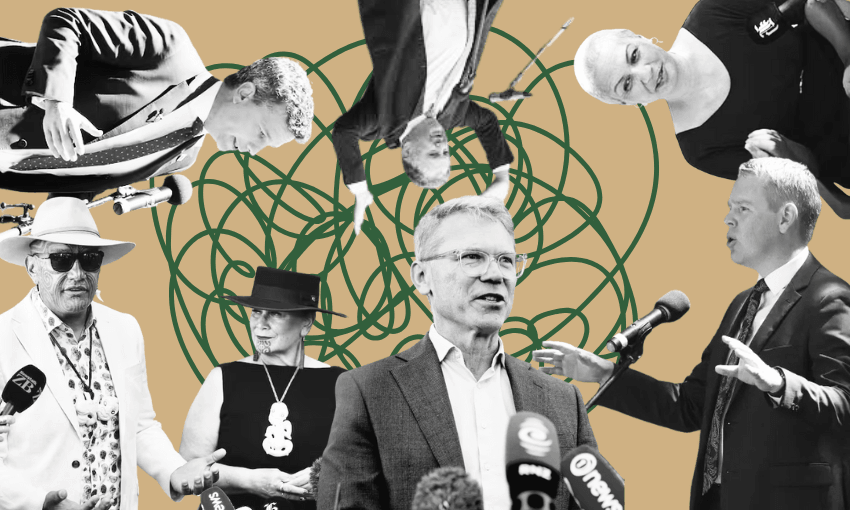
At the end of the pōwhiri, the politicians make their way to another fenced off area where they answer questions from the mob of media lying in wait. There I am again, flashing that green bit of paper and getting within arm’s reach of some of the country’s most influential people. The protestors are nowhere near us now, unable to voice their concerns or ask the questions they would like to put to. These days, that’s my job.