The dialects that shaped us: listening to our ancestors in every reo Māori voice

Design: The Spinoff.
Ngā Taonga Sound & Vision’s new platform offers a rare chance to hear how our tīpuna spoke, how dialects formed, and how te reo Māori continues to evolve across generations.
Ngā Taonga Sound & Vision launched Our Ancestors’ Voices last month. It’s an online platform featuring a selection of recordings from across the motu, each showcasing a different dialect of te reo Māori.
On the platform, you can listen to the words of beautiful speakers, some still with us and others who passed away a long time ago, or that we’ve not long been without. With a wide age spread across the speakers and recordings from as far back as 1900, the collection illustrates as much how language changes over generations, or between first and second language speakers, as it does dialectal differences.
Lots of speakers don’t know they have a dialect. Many won’t call the way they speak a dialect – it’s just the language of home. However, they may intrinsically know the language of everyone else’s home too, and know where other speakers are from as they listen. This knowledge creates humorous conversation, with jibes about why someone talks a particular way – and plenty of ribbing about where they come from.
Other times, you’ll hear speakers talking about their dialect as one that comes from the mountains, the forest or the sea. They’ll paint beautiful descriptions of language origins that relate back to weather patterns in the area or geographical traits of the region. It can be tempting to pass these off as romanticisms or myths, but it’s important not to.
Dialects of a language stem from a combination of isolation and connection. For te reo Māori, where there is isolation, there is language divergence – we stop talking others. Where there is connection, language converges – we start emulating each other. The locations we are in matter greatly.
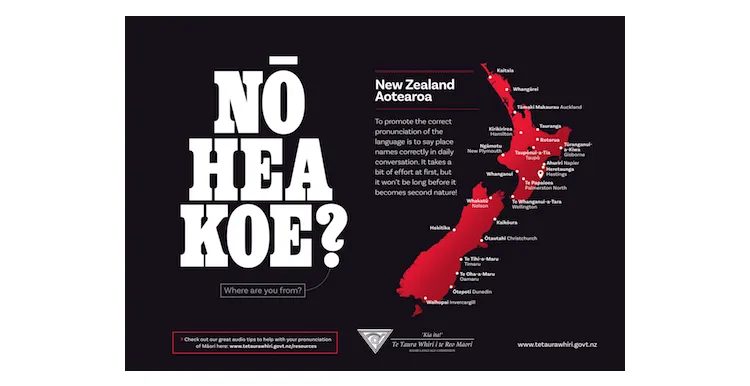
Our ancestors travelled by waka and on foot, so there are similarities in dialect around lakes and on shores that formed key trade routes. Rafts of mountain ranges though, such as those that form the spine of the North Island fish, create a barrier for difference. People are much less likely to climb a mountain than they are to avoid it, so those on either side of a mountain range will speak differently – that’s dialect. For example, my Nan told me it’s pōwhiri to the east, pōhiri to the west.
As a Māori person, I talk about dialect representing a waka or iwi group: of Tainui, Te Arawa, or Ngāpuhi. But as a linguist, I also know dialects are formed more by region – by people who live closely to each other, talk to each other often, and, importantly, like each other. People who live close by but don’t get along, will diverge away from each other.
Dialects are made up of letter distinctions, pronunciation differences, and unique words, regional proverbs and adages.
One of the most easily recognised dialects is that of Kāi Tahu. In terms of letters, the use of k in Kāi Tahu stands in place of the North Island ng – leading to words like Aoraki and Wānaka, for Aorangi and Wānanga.
There’s a particularly large amount of variation in the wh letter – so much so that the original use of the letter f was dropped to cater to the sheer number of pronunciations. Sometimes the w element is dropped in the far North (leaving a word sounding like hakarongo instead of whakarongo). In other areas of the North Island the h is dropped, leaving wakarongo. In the Taranaki region, there can be a glottal stop present, leaving the word sounding like ‘wakarongo. Beautiful variation.
Phrases can be different also – the classic is the “kei te aha koe” of the East Coast. If asked by a speaker of that region, one should reply with how they are. Others would ask, “kei te pēhea koe?”.
Dialect has become an important feature for many Māori speakers today, especially second language learners like myself. Many of us are happy just to be able to speak Māori. The standard variations of the language, which don’t really carry a regional identity, are enough. For others, there is little point in venturing down the difficult road of identity reconstruction if the dialect identity doesn’t go along with it. I understand both perspectives. I can speak everyday Māori to a reasonably high degree, but I don’t have a dialect people would pick as being from my iwi of Tauranga Moana or Te Arawa. I do feel a certain sense of loss about that, but I don’t let that stop me from using the language.
Nothing replaces feeling comfortable in your skin. If that’s dialect for you, then I encourage you to go for it. If you’re like me and just stick to the standard, that’s kei te pai too. Just know that dialects can be switched on later, so don’t let not knowing yours get in the way of learning te reo Māori.
A word of caution: we need to exercise care when asking our elders about dialect. When I was younger, I’d often ask my Nan questions like “what’s our dialect?” and she’d really struggle to answer and sometimes be short with me on the subject. It wasn’t until I was older that I realised dialect is an academic exercise. For speakers, it’s just talking. You talk like you and I talk like me. She definitely knew what sounded like home, but that academic exercise isn’t something we can just demand a speaker to know about. I found much more value in simply listening to people as they spoke. That is where the true value of Our Ancestors’ Voices comes in – it’s a chance to listen.

Vincent Olsen-Reeder
Dr Vincent Ieni Olsen-Reeder is the Director of ReoPol Limited, a newly established pakihi Māori that believes in quality Māori language policy for the nation, removing government-imposed barriers and reestablishing te reo Māori as a functioning and flourishing language across the nation.


