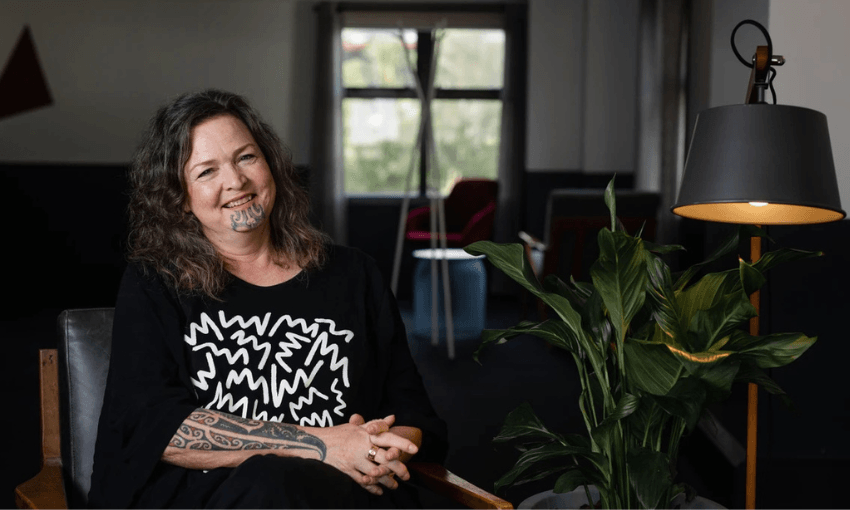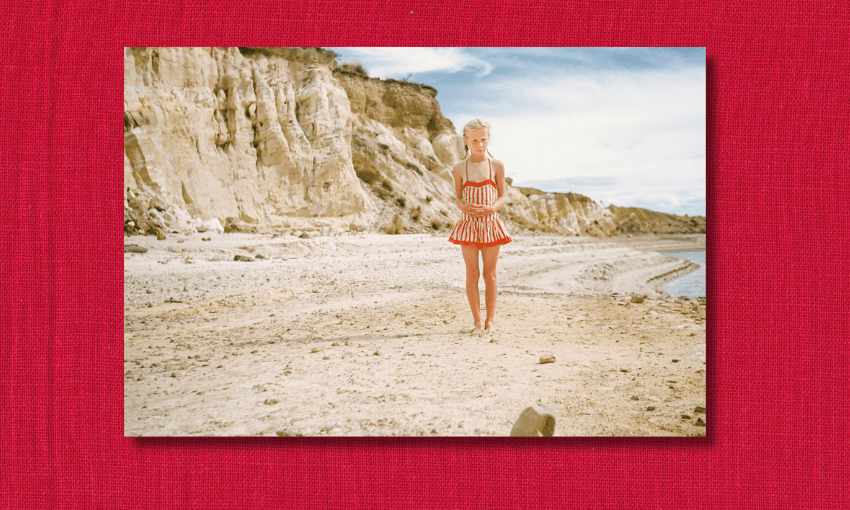



In this excerpt from her book one foot on the bottom, writer and photographer Mary Macpherson combines her mother’s slides with her own photography and weaves memories and reflections between them.

The slide box is a cool green with a mottled metal surface like puckered rain drops on a pond. It’s purpose-built for its job of gripping the cardboard edges of slides and holding them upright in numbered formation.
For nearly 40 years the slides sat in darkness. After my mother catalogued and placed them in order, after I took on the sickly responsibility of inherited possessions and shoved them to the back of a shelf. It was as if they’d been thrown down a well.
My first reaction to opening the box and finding pictures of myself, my brother and father and the places we went, is a surge of joy. My childhood and teenage years existed. I felt jubilant. It’s as if in an unacknowledged corner of my mind, I suspected myself of making them up.

Photographs, if treated as a literal truth, finalise something that is never finished.
Real to me is the circle of brown water fringed with larch trees, known as “the dam”, where we piloted our lilos in fraught adventures. Also, slapping mud and sticks together in the shallows of a stony river to create a mini-dam, like an animal in one of my English storybooks.
My mother’s death has rippled through my life like an absence that’s never filled. Perhaps this is why I get the idea to connect her images of us on holiday in Central Otago to my life now, where in a different part of the country, I head for water and shore.

My continuing desire to swim in the sea or lakes is an incongruent mix of longing to be surrounded by water and its horizons and knowing my severe limitations as a swimmer. Even when floating in the calmest of seas, one foot always wants to know it can reach the bottom. Or is it the past gleaming down there, its outlines refracted by time and distance? It’s like the desire to photograph an idea that haunts you and the many failures on the way, before you reach something that insists on being known on its own terms.

In her memoir, Real Estate, the writer Deborah Levy talks about her childhood in South Africa and her present life in England: “The jacaranda trees of Johannesburg and the daffodils of London are collaged inside me, all mixed together . . .”
I photograph myself in motel mirrors and convenient shop windows. I place these pictures near images of the child in the bathing suits — she, who is a memory of place and me, and a not-remembered me, forever in the materiality of a photograph.

Under the heading “The fifties in retrospect” the online site NZ History says: “Some argue that prosperity made 1950s New Zealand a complacent and conservative, even repressive, place. But for those who had lived through the tough times of the Great Depression and the Second World War, this was a small price to pay for contentment. People rarely thought about how later generations would judge them, but instead focused on day-to-day living.”
The tides have gone out on the fifties and the sixties and the years that followed, revealing what what was missing from those cosy days: any teaching that Māori were the first to settle this land and how the land was taken by British and colonial forces, or any teaching of te reo Māori; any thought about our huge reliance on agricultural exports; any thought that the clear water we swam in might be affected by the little topdressing planes that buzzed merrily over paddocks.
It feels lazy or self-indulgent to be angry with a past, for what it didn’t supply or didn’t know. But sometimes, unreasonably, I am.
The family in the slides are part of an era. They are part of a rising middle class, able to own a house in a new subdivision at the edges of town and build a small crib with a Pinex interior in Central Otago. Being outdoors, loving plants and trees, gardening, swimming, fishing, walking, making clothes, improving property, moving upwards, these were the things.

What did it mean to go north, when you had no knowledge of what north meant or that there was a North Island across a stretch of water? (Knowledge of its Māori name Te Ika-a-Māui would have to wait until I was fished up, decades later, as an adult.)
Flying north for the first time to visit my aunt and uncle meant: having a cold; dressing in layers of wool plus a furry hat with a brooch in centre, knee-length socks and beige chisel-toed shoes; learning the Highland Fling; walking to the dairy (because fresh air is good for colds) and watching my uncle make a roll-your-own beside the river.

Journeys, especially by car, are often about getting there. But sometimes the drive-shaft of travelling slows, like when you are paying attention to the world by photographing it; then every roadside, trail, sign, person, building or bush, can be a site of wonder.

Having my mother’s slides as a backstory makes me worry about my connection to the photographs I’ve taken in the present. Without specific family stories do the contemporary images slide about as if they’re too superficial to take root? Have I put two extremes together and one is driving the interpretation? But I intended that the stories from the past would be visible in, and influence, the present.
Then I remind myself that all photographs from the world are fictional. They become unstable and richer (sometimes) through the meanings that people bring to them.
one foot at the bottom by Mary Macpherson ($80, edition of 100, Rim Books) can be purchased direct from the publisher. Photobook/NZ 2026 will be held at Te Papa between 6-9 August. The Photobook/NZ bookfair will be on Saturday 8 August at Te Papa.