All the finalists in the 2026 NZ Book Awards for Children and Young Adults

All the finalists in this year’s NZ Book Awards for Children and Young Adults. Stack ’em up!
Made possible by
All the books – and their authors, illustrators, translators and publishers – in the race for the prize(s), with commentary from books editor Claire Mabey.
From 159 entries this year’s judges have narrowed this year’s finalists down to just 30 books, each a shimmering gem, a treasure for Aotearoa’s bookshelves. “They made us laugh, cry and stare off into space to think some more,” says convenor of judges Simie Simpson. “And they reflect the diversity of both the children reading these stories, and of Aotearoa in 2026.”
The world is currently going through a technological shift as significant as the industrial age and with it comes an avalanche of anxieties about literacy, reading for pleasure, the health of our children’s very brains. The New Zealand Book Awards for Children and Young Adults is more than just a mechanism for honouring excellence. There’s a whole world of advocacy and engagement and passion that gathers around the awards to tackle such concerns. The remarkable Hell reading challenge, now in its second decade, sees nearly 800 schools and libraries taking part, more than 312,000 pizza wheels distributed and about 2.2 million books read. Pizza-rific stuff.
This year will see the inaugural New Zealand Children’s Book Week – August 15-21 – bookend the awards ceremony. Read NZ Te Pou Muramura will build on the Books Alive events (in which the below awards finalists tour the country to inspire young readers) by rustling up even more bookish events with writers, teachers, parents, librarians, bookshops and literary organisations nationwide.
Now, to the awards. There are six categories: Picture Book, Junior Fiction, Young Adult Fiction, Non-Fiction, Illustration and te reo Māori. Winners are announced at a ceremony at Pipitea Marae in Wellington on August 19 and will each take home $8,500. Of those winners, one will be named the Margaret Mahy Book of the Year and will receive an extra $8,500. The Best First Book prize winner gets $2,500. Herewith are your finalists:
The Bookhub Picture Book Award finalists
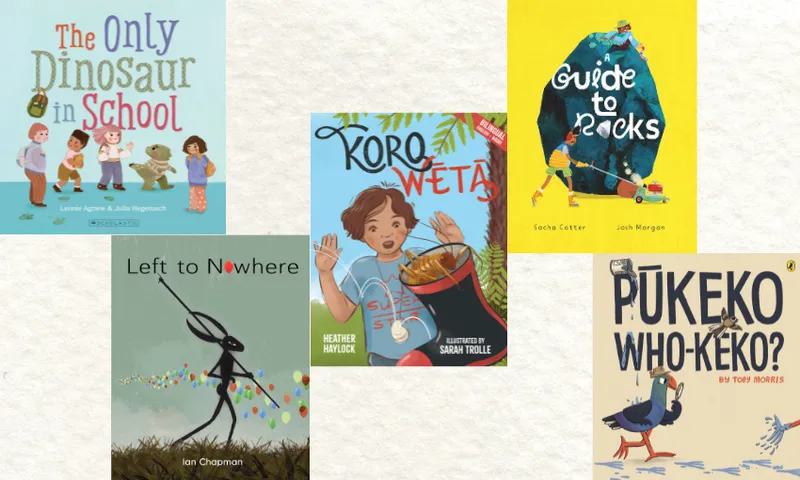
A Guide to Rocks by Sacha Cotter, illustrated by Josh Morgan (Te Aitanga-a-Māhaki, Rongowhakaata) (Huia Publishers)
Koro Wētā by Heather Haylock, illustrated by Sarah Trolle, translated by Ngairo Eruera (Ngāti Ranginui, Tūhoe, Ngāti Awa) (Oratia Books)
Left to Nowhere by Ian Chapman (One Tree House)
Pūkeko Who-keko? by Toby Morris (Penguin Random House)
The Only Dinosaur in School by Leonie Agnew, illustrated by Julia Hegetusch (Muaūpoko) (Scholastic New Zealand)
I cried when I first read A Guide to Rocks by Sacha Cotter and Josh Morgan (creators of such hits as Dazzlehands and The Bomb). It is a poignant book about sharing your anxieties, lightening your load and nurturing a closer relationship with your family in the process. Morgan’s illustrations are always exquisite but in A Guide to Rocks they’re something else: the rocks themselves shimmering, psychedelic manifestations of old wounds and fresh worries with a charming dose of nostalgia. Morris’ Pūkeko Who-keko? is a stone cold classic. It’s got an iconic yet under appreciated Aotearoa bird, dad jokes and those instantly loveable Morris-y images – eyebrows and grins and physical comedy. The Only Dinosaur in School by Leonie Agnew and Julia Hegetusch is another classic – a gorgeous story about being yourself and discovering that everyone is trying to hide something. I haven’t seen Ian Chapman’s Left to Nowhere but the cover image is … unsettling in a way that leaves me wanting more; and Paula Green says the book is “beautifully written and sublimely illustrated”. Koro Wēta by Heather Haylock (of Granny McFlitter fame) honours the wēta and its long-time place in our lives. Five fabulous picture books… my money is probably on A Guide to Rocks for sheer majesty of the imagery and depth of concept. But it might be hard to beat a Toby Morris’ simple but perfectly formed crack-up caper.
Wright Family Foundation Esther Glen Junior Fiction Award finalists
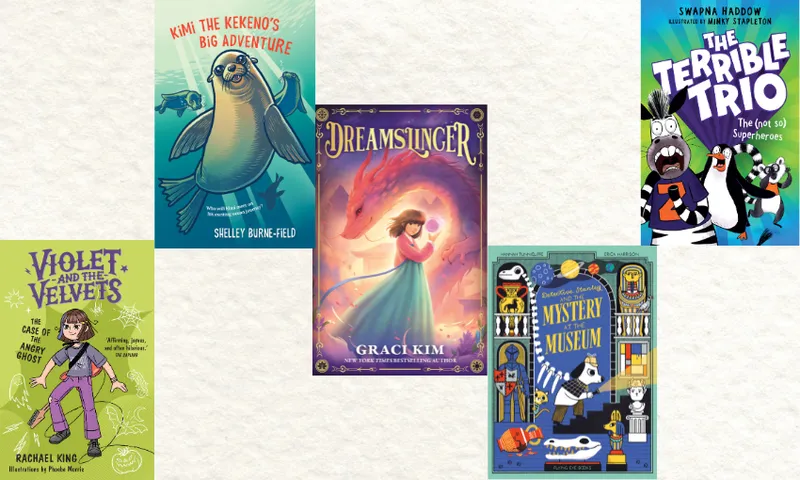
Detective Stanley and the Mystery at the Museum by Hannah Tunnicliffe, illustrated by Erica Harrison (Flying Eye Books)
Dreamslinger by Graci Kim (Penguin Random House New Zealand)
Kimi the Kekeno’s Big Adventure by Shelley Burne-Field (Ngāti Mutanga, Ngāti Rārua) (Allen & Unwin Aotearoa)
The Terrible Trio 1: The (not so) Superheroes by Swapna Haddow, illustrated by Minky Stapleton (Scholastic New Zealand)
Violet and the Velvets 2: The Case of the Angry Ghost by Rachael King, illustrated by Phoebe Morris (Allen & Unwin Aotearoa)
I’m surprised that Sonya Wilson’s The Secret Green isn’t here – a gripping sequel to Spark Hunter which was shortlisted for this award in 2022, and won the best first book category. We also don’t have Stacy Gregg’s epic feline adventure The Last Journey or Ruth Paul’s kid crime-busting caper, Ghost Kiwi. All three of these novels lean towards the upper age range in this category whereas most of the finalists lean towards the younger, junior end (such is the minefield of reading ages) – meaning perhaps that the judges were going for books that would appeal to readers in their earliest days of novel reading.
As for what is here – five books by prolific artists with fantastic backlists (and forward lists) to get young readers jazzed about reading. I do not envy the judges in their excruciating task of picking just one winner when every book here is gas. Last year the brilliant Li Chen took this category out with her hugely popular graphic novel Detective Beans. This year’s graphic novel is the stunning Detective Stanley and the Mystery at the Museum by Hannah Tunnicliffe and Erica Harrison – funny and visually spectacular. All five of these books have gusto in common: from Rachael King’s kick ass kid band, to Graci Kim’s incredibly absorbing dream-fantasy, Shelley Burne-Field’s adorable seal, and Swapna Haddow and Minky Stapleton’s hilarious, monochrome mad-cap animal mates. Readers are the winner here, I reckon.
Wheelers Books Award for Young Adult Fiction finalists
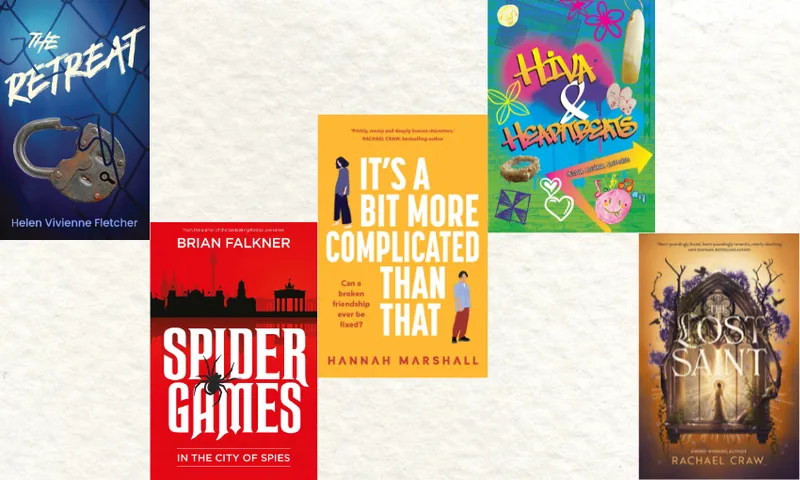
Hiva & Heartbeats by Selina Alesana Alefosio (Mila’s Books)
It’s a Bit More Complicated Than That by Hannah Marshall (Allen & Unwin Aotearoa)
Spider Games: In the City of Spies by Brian Falkner (Bateman Books)
The Lost Saint by Rachael Craw (Allen & Unwin Aotearoa)
The Retreat by Helen Vivienne Fletcher (HVF Publishing Ltd)
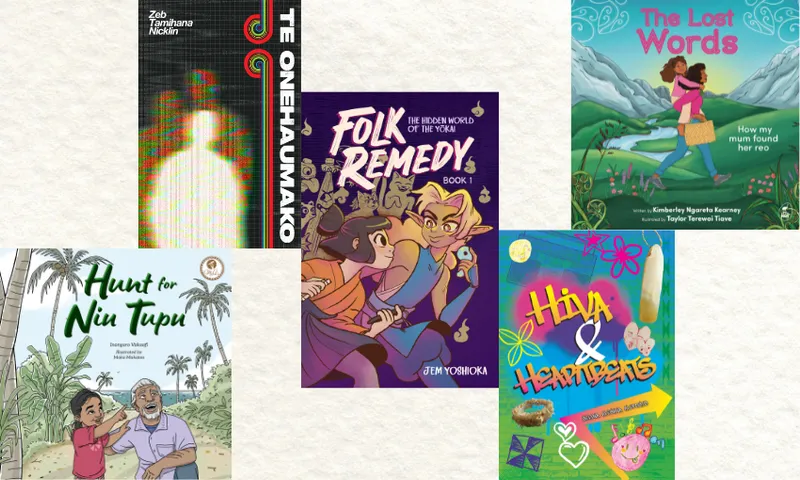
Young adult fiction occupies a strange space in that it’s really fiction for adults, too. My eyes leapt to The Lost Saint by Rachael Craw, which I loved: rich world building, time slippage, romance and pure, joyful escape. Delighted to see prolific writer Helen Vivienne Fletcher here with The Retreat, an unnerving thriller about a creepy cult-like organisation exploiting grief. Brian Falkner’s Spider Games extends his award-winning Katipo Joe series with Nick, Joe’s grandson. Selina Alesana Alefosio’s Hiva & Heartbeats takes us back to the 90s and follows Epi, from Tokelau, and her life in Aotearoa. Hannah Marshall’s debut It’s a Bit More Complicated Than That is an accomplished, complex tale of friendship and all the messy life that can get in the way. Further reading: highly recommend this entertaining and insightful conversation between Craw and Marshall, right here on The Spinoff.
Elsie Locke Award for Non-Fiction Finalists
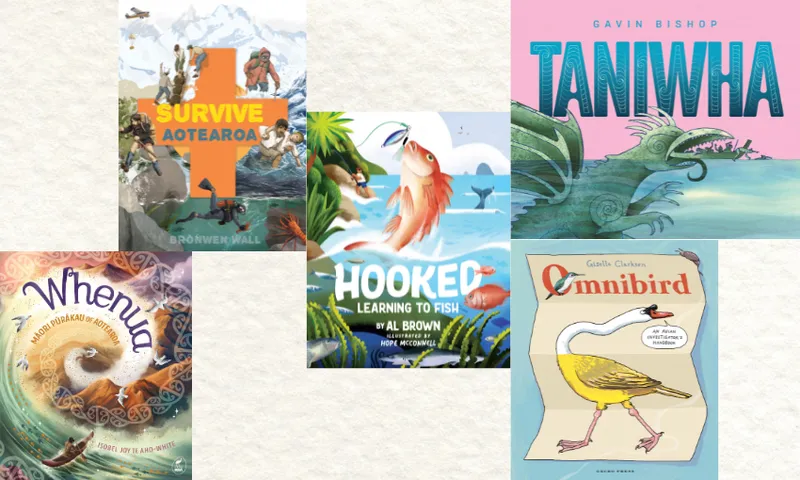
Hooked: Learning to Fish by Al Brown, illustrated by Hope McConnell (Allen & Unwin Aotearoa)
Omnibird: An Avian Investigator’s Handbook by Giselle Clarkson (Gecko Press, Lerner Publishing Group)
Survive Aotearoa by Bronwen Wall and Jonathan Kennett, illustrated by Kimberly Andrews (Kennett Brothers Ltd)
Taniwha by Gavin Bishop (Tainui, Ngāti Awa) (Penguin Random House)
Whenua: Māori Pūrākau of Aotearoa by Isobel Joy Te Aho-White (Ngāti Kahungunu, Kāi Tahu) (Hachette Aotearoa New Zealand)
This has to be the first time that chef Al Brown has hit the kids list – an inspired piece of publishing from Allen & Unwin. Brown finds himself in a list of multi-award winning heavy-weights: Taniwha by Gavin Bishop is yet another sweeping masterpiece; as is the feather and fact-filled wonder that is Omnibird by Giselle Clarkson. Bronwen Wall, Jonathan Kennett and Kimberly Andrews’ Survive Aotearoa is compelling and brilliantly designed. Isobel Joy Te Aho-White’s Whenua is, I think, going to be an enduring staple in libraries all across Aotearoa and might just be hard to beat.
Russell Clark Award for Illustration
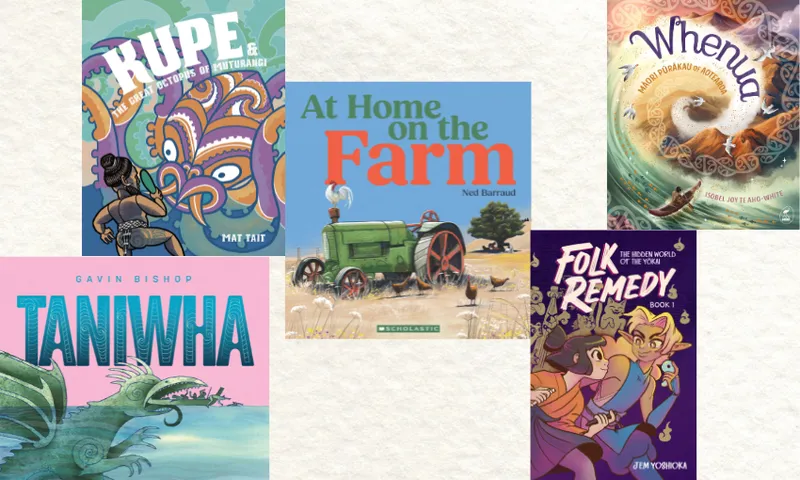
At Home on the Farm by Ned Barraud (Scholastic New Zealand)
Folk Remedy 1: The Hidden World of the Yōkai by Jem Yoshioka (Andrews McMeel)
Kupe and the Great Octopus of Muturangi by Mat Tait (Ngāti Apa ki te Rā Tō, Ngāti Kuia, Rangitāne o Wairau) (Allen and Unwin Aotearoa)
Taniwha by Gavin Bishop (Tainui, Ngāti Awa) (Penguin Random House)
Whenua: Māori Pūrākau of Aotearoa by Isobel Joy Te Aho-White (Ngāti Kahungunu, Kāi Tahu) (Hachette Aotearoa New Zealand)
Great to see Jem Yoshioka’s debut graphic novel Folk Remedy 1 here (which surely must have been hotly in the running for the junior fiction finalist list, too), called “phenomenal” by children’s book buyer Rachel Pilois at Unity Books Wellington. Four very familiar names will be giving Yoshioka some hefty competition, though. Ned Barraud’s work is exquisite; Mat Tait’s Kupe and the Great Octopus of Muturangi is possibly his best yet; Gavin Bishop’s Taniwha is … Gavin Bishop; and Te Aho-White’s Whenua bursts with her familiar, deeply artistic imagery. AI could never.
Wright Family Foundation Te Kura Pounamu Award Finalists
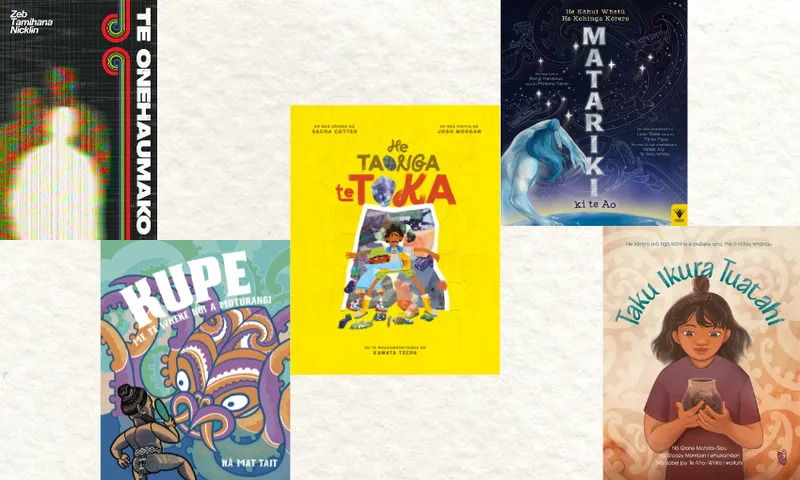
He Taonga te Toka by Sacha Cotter, illustrated by Josh Morgan (Te Aitanga-a-Māhaki, Rongowhakaata), translated by Kawata Teepa (Tūhoe, Te Whakatōhea ) (Huia Publishers)
*Kupe me te Wheke nui a Muturangi by Mat Tait (Ngāti Apa ki te Rā Tō, Ngāti Kuia, Rangitāne o Wairau) (Allen and Unwin Aotearoa)
Matariki ki te Ao by Miriama Kamo (Ngāi Tahu, Ngāti Mutunga) and Rangi Matamua (Tūhoe), illustrated by Isobel Joy Te Aho-White (Ngāti Kahungunu, Kāi Tahu), translated by Pānia Papa (Ngāti Korokī-Kahukura, Ngāti Mahuta) and Leon Blake (Tūhoe, Tūhourangi, Ngāti Wāhiao, Waikato, Ngāti Whāwhākia, Ngāti Porou, Taranaki, Ngāti Kahungunu, Te Whānau a
Apanui by Te Aitanga a Hauiti (Ngāi Tai) (Scholastic New Zealand)
Taku Ikura Tuatahi by Qiane Matata-Sipu (Te Waiohua, Waikato, Ngāpuhi, Ngāti Pikiao), illustrated by Isobel Joy Te Aho-White (Ngāti Kahungunu, Kāi Tahu), translated by Stacey Morrison (Ngāi Tahu, Te Arawa waka) (QIANE+co)
*Te Onehaumako by Zeb Tamihana Nicklin (Pāhauwera, Ruapani, Tūhoe, Tāmanuhiri) (Huia Publishers)
* Indicates a finalist book originally written in te reo Māori
Again some very familiar names here with previous finalists Miriama Kamo, Qiane Matata-Sipu, Mat Tait, Stacey Morrison and Kawata Teepa. Fantastic to see te reo Māori advocate, teacher and writer Zeb Tamihana Nicklin here who writes for adults as well as for children. In 2023 Nicklin won best Māori language essay in the Pikihuia awards and two of his short stories were finalists. Te Onehaumako is a young adult novel about Tawa, a teen who time travels via his garden shed.
NZSA Best First Book Award Finalists
Folk Remedy 1: The Hidden World of the Yōkai by Jem Yoshioka (Andrews McMeel)
Hiva & Heartbeats by Selina Alesana Alefosio (Mila’s Books)
Hunt for Niu Tupu by Inangaro Vakaafi, illustrated by Maka Makatoa (Mila’s Books)
Te Onehaumako by Zeb Tamihana Nicklin (Pāhauwera, Ruapani, Tūhoe, Tāmanuhiri) (Huia Publishers)
The Lost Words by Kimberley Kearney (Ngāti Maniapoto, Tuhoe), illustrated by Taylor Terewai Tiave (Ngāpuhi) (Hachette Aotearoa New Zealand)
Brilliant list of very different books! And a big vote of enthusiasm for Mila’s Books (founded and directed by visionary powerhouse Dahlia Malaeulu) which is bringing Pasifika stories to readers of all ages and all across Aotearoa and far beyond. The Lost Words by Kimberley Kearney is a moving story about a powerful word-collecting mum, affirming and deservedly here. I would hate to have to pick one of these but have a hunch that Jem Yoshioka might just take this one out.
And there we have it! Go forth, buy, read to your kids, get them to read to you! Derive pleasure and knowledge and new synaptic pathways. Fuck AI. Long live actual, human-written, person-illustrated, heartfelt, hard won books.
Bow down to the judges: English and bilingual entries were assessed by convenor of judges Simie Simpson (Te Āti Awa), programmes manager for Read NZ Te Pou Muramura in Te Whanganui-a-Tara Wellington and a returning judge from 2019; alongside award-winning author, editor, and mentor Cassie Hart (Kāi Tahu, Pākehā); Tāmaki Makaurau-based head of English Chris Reed (Ngāti Porou, Pākehā); Mosgiel school librarian and SLANZA representative Lauryn Urquhart; and Pōneke school librarian Lucy Black, who brings over two decades of public and school library experience.
A specialist panel was appointed to assess te reo Māori submissions, with Te Wairere Puāwaitanga O Te Whakaaro Ngaia (Waikato-Maniapoto, Taranaki Tūturu, Te Ātiawa, Ngāruahinerangi, Ngāti Porou, Ngāti Pikiao, Ngāti Whakaue), a Waikato-based te reo Māori kaiako and qualified translator, as convenor. The panel also includes Eva Mahara (Waikato, Ngāti Te Wehi), Content Editor for te reo Māori at the National Library of New Zealand Te Puna Mātauranga o Aotearoa, and Hona Black (Tūhoe, Te Whānau a Apanui, Tūwharetoa), a Māori language academic, writer, educator and Associate Professor at Te Pūtahi a Toi, Massey University.
And prayer hands for everyone who make the awards possible: The New Zealand Book Awards for Children & Young Adults and their associated programmes are made possible through the generosity, commitment and vision of funders and partners: Creative New Zealand, HELL Pizza, the Wright Family Foundation, LIANZA Te Rau Herenga o Aotearoa, Wellington City Council and Libraries, BookHub presented by Booksellers Aotearoa New Zealand, Wheelers Books, New Zealand Society of Authors Te Puni Kaituhi o Aotearoa, the National Library of New Zealand Te Puna Mātauranga o Aotearoa, and NielsenIQ BookData. The Awards are administered by the New Zealand Book Awards Trust Te Ohu Tiaki i Te Rau Hiringa.
You can buy all of the books listed above at Unity Books or direct from the publishers.
The Spinoff Books section is proudly brought to you by Unity Books and Creative New Zealand. Visit Unity Books online today.

Claire Mabey
Claire Mabey is a children's author of The Raven's Eye Runaways, The Raven's Eye Rebellion, and a picture book Cass and the Beast illustrated by Jill Calder. For a long time Claire worked on literary festivals and is the founder of Verb Wellington. She lives in Te Whanganui-a-Tara with her partner and son.


