‘I fear it isn’t going to end well’: What Philip Garnock-Jones is reading now

Philip Garnock-Jones is appearing at HamLit on Feb 21 this year.
Made possible by
Welcome to The Spinoff Books Confessional, in which we get to know the reading habits of Aotearoa writers, and guests. This week: Philip Garnock-Jones, author of He Pūawai: A Natural History of New Zealand Flowers.
The book I wish I’d written
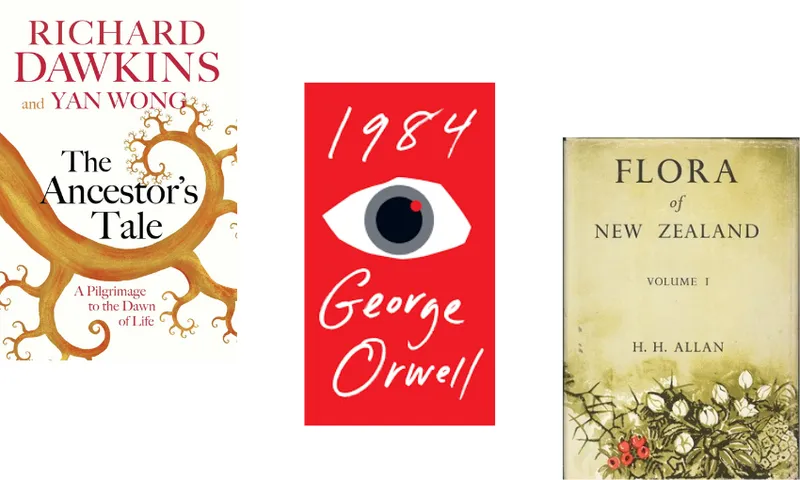
The Ancestor’s Tale by Richard Dawkins and Yan Wong is a riveting global account of biological diversity and how it came to be. Its tree of life structure is very close to my own research interests, but there’s no way I could have written it. Dawkins starts with our own species and tells evolutionary tales about us and each branch of the tree of life in order of attachment to our lineage, backwards through time.
I loved it so much that I adapted the idea for my 200-level plant diversity course, taking the tree of plant life and telling stories based around each of the major branches: fruit evolution in the rose family, poisons and drugs in the nightshade family, and sexuality of mosses.
Everyone should read
I see I’m not the first in this series to say this, but it has to be 1984 by George Orwell. I read it in high school and again recently. George Orwell lived through, and fought against, the rise of fascism that led to the Second World War. The book’s combination of authoritarianism (either from the left or the right) with the surveillance state is uncannily relevant today. I found especially terrifying the requirement to profess something that’s profoundly untrue, whether it comes from the state or from peer pressure to demonstrate tribal loyalty.
The book I want to be buried with
I’m imagining an archeologist digging up my bones in 3025 and asking, “Who was this person?” So bury me with my own copy of H. H. Allan’s Flora of New Zealand Vol. 1 (1961). Floras are compilations of all the plants in a region, with descriptions and identification tools. We’ve had a number of them since 1775 and they’ve been updated at regular intervals, until lately. Allan’s Flora is well out of date and my copy is heavily annotated, but it’s still the most recent complete account and I consult its rice-paper pages almost daily. It hasn’t been superseded because our science funding system hasn’t supported taxonomy – biodiversity discovery, naming and classification – adequately for decades.
The firsts book I remember ready by myself
The first book I remember owning was Elizabeth Our Queen by Richard Dimbleby, which was given to all cubs and scouts at the time of the coronation. I was too young to be a cub, but my brother’s pack had spare copies. I’ve still got it. I grew up on A. A. Milne, Enid Blyton, Rudyard Kipling’s The Jungle Book, 1066 and All That by W. C. Sellar, and Arthur Mee’s Children’s Encyclopedia.
The book I pretend I’ve read
I didn’t read Darwin’s The Origin of Species until my 50s, but I don’t think I ever explicitly pretended I had read it. I certainly felt as if I had read it, because Darwin’s research and ideas are fundamental to biology. When I did read it, I found it a lot easier than I’d expected, with an unusual modesty, clarity of thinking, and open honesty about his own doubts and shortcomings.
Utopia or dystopia
Dystopia. I’m a natural worrier and dystopia helps me to understand the world: nuclear weapons, climate change, fascism, pandemics, misinformation, and biodiversity loss. Dystopian fiction feeds my anxiety for sure, but if I can recognise dangers and think about consequences it’s worth it. For example, Philip Roth’s The Plot Against America, although it’s a fictional reinvention of history around 1940, has a lot to say about our time.
Fiction or nonfiction
Probably nonfiction for me, but it’s a close call. I love good science books – Oliver Sacks, Richard Dawkins, Jerry Coyne, Neil Shubin – and also memoirs and biographies. In fiction, I dislike fantasy and the supernatural, so fiction has to be more-or-less realistic. My favourite fiction writers include Patrick O’Brian, Chaim Potok, Tim Winton, Tracy Farr, Roddy Doyle and Mal Peet.
It’s a crime against language to
I like simplicity. I prefer plots that tell their story in the order that the events happened; jump back and forward in time and you’ve lost me. I dislike seeing the present tense used for the past in story-telling (and for the future in weather forecasting). I have my strong likes (Oxford comma) and dislikes (I can’t abide seeing plural nouns like fungi, algae, larvae and bacteria used as singular). But I’m learning not to rail against language evolution, because no amount of grumbling will stop “a lot” becoming “alot” or “any more” becoming “anymore”.
The book that haunts me
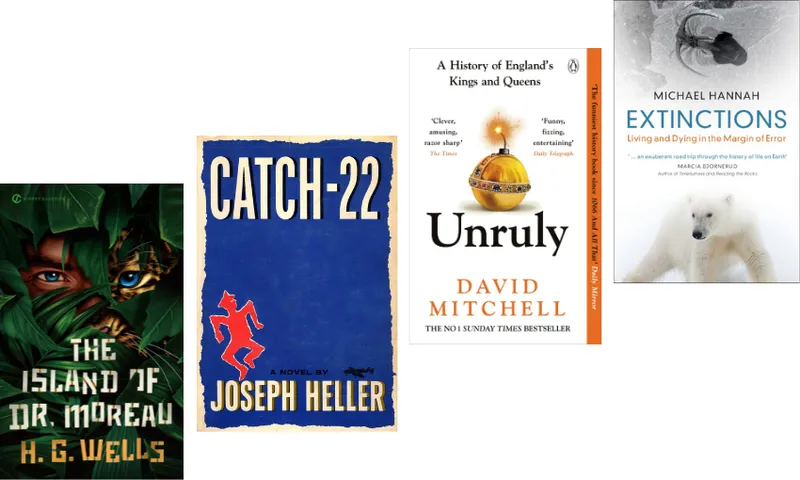
I read The Island of Dr Moreau by H.G. Wells when I was 12. Its grotesque characters stayed with me long after I forgot the story. Dr Moreau’s surgeries failed to transform one species into another, resulting instead in pain, confusion, and horror. More widely, it’s a dystopian warning about the pursuit of science – or at least experiments – in a moral vacuum.
The book that made me laugh
Lots of books are amusing, but only a few have made me laugh out loud. I think Catch 22 was the first and I’ve always found Bill Bryson’s writing laugh-out-loud funny. Most recently I’ve loved David Mitchell’s Unruly. Unruly is a very funny book, but it’s also hugely educational, so deeply satisfying as well as entertaining.
The book character I identify with most
Probably Dr Stephen Maturin, Captain Jack Aubrey’s particular friend in the series of historical novels by Patrick O’Brian. He’s by no means a 1:1 match with me because, although he is a naturalist and an unashamed nerd with a taste for adventure and new discoveries, unlike me, he also is a medical man, an accomplished cellist, a spy with a ruthless streak and deadly with a sword. I think nowadays he’d be diagnosed with ADD. I love how O’Brian’s characters develop, and I think his writing gets better, and funnier, as you read through the series in order.
Greatest New Zealand writer
I don’t think I’ve read enough to choose a greatest writer, but I’ve loved everything I’ve read by Maurice Gee and Katherine Mansfield. Maurice Gee’s Plumb trilogy was an early favourite, and I’ve read and enjoyed his more recent books. Katherine Mansfield’s stories are beautifully crafted and somehow make me feel nostalgia for a time long before I was born. The sadness of her own life and early death seems to connect with her writing. For New Zealand nonfiction I’m very fond of Awa Press’s Ginger Series, especially the contributions by Harry Ricketts and Steve Braunias.
Best place to read
I have a small blue art deco armchair where I used to read as a boy. I associate it strongly with reading and still love to sit there to read. When I need to concentrate, there’s nowhere better than a busy cafe. I can turn off to all the hubbub and sometimes even forget where I am. Mostly though I read in bed, which can become uncomfortable.
What I’m reading right now
Right now I’m reading Michael Hannah’s wonderful book Extinctions. Mike’s a palaeontologist and he describes the latest global research and the development of ideas about how the diversity of life has changed through deep time. Even better, he carefully explains how we came to know as much as we do about our planet’s past. It’s meticulous and complete science writing that both educates and entertains. I’m half way through, taking it slowly, and I fear it’s yet another story that isn’t going to end well.
Philip Garnock-Jones is appearing at HamLit on February 21 at The Hamilton Gardens. There he will introduce some of the flowers from his book which can be viewed through 3D glasses. Garnock-Jones’ book He Pūawai: A Natural History of New Zealand Flowers can be purchased at Unity Books.
The Spinoff Books section is proudly brought to you by Unity Books and Creative New Zealand. Visit Unity Books online today.

The Spinoff Review of Books
A smorgasbord of books thoughts and formats by The Spinoff.


