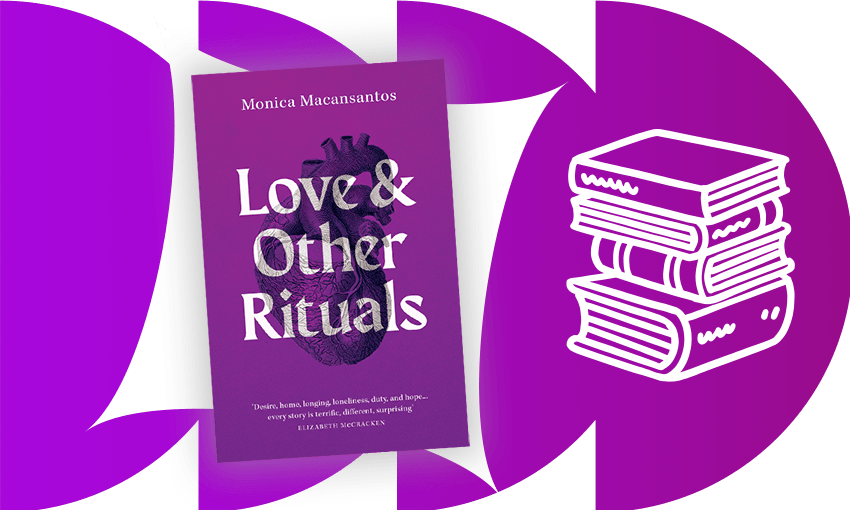


Mikee Sto Domingo wrestles with a collection of short stories that survey the Filipino diaspora.
Monica Macansantos’s debut collection is described on the back cover as “bringing us the darkly beautiful perspectives of characters lost both in and out of their homeland, the Philippines”. The draw of the book for me as a Filipino New Zealander is what it promises to convey about the Filipino experience, and about Filipinos. When you peel back the niceties, the assimilated habits, the faintly Denisovan skull, how darkly beautiful is the Pinoy mind?
After my first read through, I was troubled by what the book seemed to say about the “Filipino experience” and wondered whether thinking about it in these terms was the best approach. When asked in an interview with Liminal Mag how best to represent culture without pandering to a “universal (read: white) experience”, Macansantos responded that she writes from her cultural context, but that she sees her characters, rather than as Filipinos, as “human beings first”. This seems to me a pre-emptive move, an evasion of minority literature’s “self-exotifying” tendencies by self-division into “human” and “Filipino”, like a neurotic post-colonial manananggal.
Taken on these terms, Love & Other Rituals requires an interpretive angle that parses this split. It’s often said, write what you know, but surely what you know is not just personal experience, but language, form, convention. When Macansantos writes a “human being”, by what knowledge is this construct informed?
The stories in Love & Other Rituals stories are set across the Philippines, USA, and Aotearoa, a sprawl that echoes the itinerancy of Macansantos herself, who spent some of her childhood in Delaware and has connections, through her writing career, to Austin Texas and Te Whanganui-a-Tara. Given this background, it’s natural that her literature is one of exile, a preoccupation at its most substantial where it indexes the socioeconomic positions of its characters, showing how sources of social status, such as gender, sexuality, and class both enmesh and estrange. This is most evident in the titular ‘Love & Other Rituals’, a story about a closeted gay professor, Rene, and his relationship with a married, working-class man, Kardo, whom he pays for sex, and in ‘Playing with Dolls’, in which a disgraced wealthy man has an affair with his maid, “Gina, the mud-complexioned aswang.”
Macansantos, in an interview with Grattan Street Press, describes herself as “a very privileged middle-class Filipino with very educated parents”, and it is perhaps for this reason that, when the impoverished lover in each of these stories expects their paramour to benefact them and their family, it’s the perspective of the wealthier lover the narration centres. The affluent man in ‘Playing With Dolls’ says of his mistress’s shack-dwelling family, “she expects me to feed and clothe them all.” In ‘Love & Other Rituals’, Rene’s encounter with Kardo’s wife and children in the shack they tenant establishes the central romance as a primarily economic arrangement. Rene’s position is described with increasing obliqueness until his focalisation undermines its own authority:
“It wasn’t within his powers to do what was right – to walk away from this woman’s husband, to stop exploiting this woman’s desperation. It seemed that Elena depended on him to not walk away from them […] This was probably what Rene had wanted all along.”
Wealth disparity deepens the mutual reliance between Rene and Kardo even as it emotionally alienates them. Anyway, whatever feelings they may have for each other in this context seem bluntly incidental to material incentives and the limited partners available to repressed gay calculus professors. In an ideal world, maybe Rene would rather date someone whose penis he doesn’t view as “an ugly, veined and vulnerable thing” that, “coated in virgin olive oil […] tasted a little less revolting […]” Whether Kardo would even seek a relationship with Rene without the promise of financial gain is uncertain. The same could be said of Gina towards her ex-employer. The corollary is that love, in the affective sense, is only pursued by those who can afford it.
In general, Love & Other Rituals is rather bereft of love. While cultural or class differences may account for this dearth in stories like ‘Playing With Dolls’, elsewhere the work’s solipsism reads as social frigidity. Intimacies arrive as protocol, stilted by performativity, disassociation, or disdain. In ‘Inheritances’, when a character says that his depressed father is having a nervous breakdown, his girlfriend responds with the banality, “you poor thing.” A hug between friends in ‘Stopover’ is less affection than it is etiquette: “In America, Cathy had learned the habit of spreading her arms as a friend approached.”
While it’s tempting to view the characters’ disaffection as a failure of empathy on their part, instead it seems the point is that to be “human” is essentially lonely, notwithstanding our best efforts. In ‘The Autumn Sun’, after his friend’s baby dies, the character Tony finds it impossible to “deny [his] feeling of helplessness” towards his friend, an empathy that elaborates to the conclusion, “even love couldn’t fill that emptiness.” Such impotent resignations occur in Love & Other Rituals with enough frequency that they constitute an element of style. This is plot-light, vibe-reliant writing in an Alice Munro vein, with subjects whose sombre moodboards are dotted with strained relationships, doomed romances, and sad, unappealing sexual encounters. Perhaps this explains the lack of warmth in Macansantos’s work. Maybe frigidity is generic, a consequence of favouring interiority over action, of conventions of bleakness. Maybe a “human” is just a Filipino having a moderately bad time.

In her interview with Liminal Mag, Macansantos explains that she avoids viewing her characters as “Filipino” so as not to treat them like “anthropological specimen[s] and less like human being[s]”. This element of characterisation then becomes passive, with the anthropological lens turned outwards, so that Filipino-ness in Macansantos’s work is achieved partially by negation. The text inverts and repurposes the “white gaze” by othering and homogenising its non-Filipino characters, almost all of whom are of a white, Aryan make. In ‘Playing With Dolls’, the white interloper, Sarah, is described as having “blonde hair and blue eyes”. When a Texas bar is visited in ‘Stopover’, the Filipino protagonists watch “blonde after blonde walk past them”. Science of recessive genes aside, this exaggerated othering further amplifies the work’s alienated perspective. The deracinated Filipinos, like their white-gazing counterparts, betray hints of condescension in choice lines like “white guys suck at sex”, or “Cathy stared at the abundance of food […] no one else in this country [USA] seemed to take notice of this habitual overindulgence.” This is othering for laughs, an inside joke between Filipinos about our absurd ex-occupiers, the Americans.
Where the joke abruptly ends, however, is in the book’s representation of non-white, non-Filipino characters. In ‘Leaving Auckland’, the collection’s only story set in Aotearoa, three races appear: Filipino, French-Belgian (blonde), and “Pacific Islander”. There are two representations of this latter group. The first is “a stocky Pacific Islander constable” who drives the character Paolo home after an attempted suicide, talking “throughout the trip about […] how all his problems could be solved if only he turned to the Lord.” The second is this:
“Paolo remembered the night he had been mauled outside a bar in South Auckland. He had never thought of reporting the incident to the police, for what was a Filipino boy doing late at night in a neighbourhood infested by Islander gangs? To the police, there were no distinctions […] they were all troublemakers […] brown boys picked fights with each other all the time.”
It’s hard not to flinch at this Stuff-article-esque passage. A generous interpretation would be to say that here the story is fleshing out an imperfect character’s viewpoint, that we’re meant to be critical of him even while being encouraged to see him, sympathetically, as human. But there isn’t enough in the text to make this reading entirely convincing. We’re trapped in a racist interiority. Most damningly, there are not enough representations of Pacific Islanders in the story or the book to leaven the vicious racism of the line “infested by Islander gangs”. The nearest salve is the character Maya’s complaints about the police faulting her for being hit by a car while crossing the road, an anecdote perhaps meant to illustrate how the police discriminate against Filipinos as much as they do all brown people. Yeah ACAB, but to make this equivalence ignores history. The statement “to the police there were no distinctions,” is demonstrably false in New Zealand, home of the Dawn Raids, where Pasifika make up 12 per cent of the incarcerated population, compared to a larger Asian diaspora’s 2 per cent. Love & Other Rituals sets out to portray “human beings” but, by privileging the Filipino-gaze, inadvertently excludes everyone else.
In truth, there’s no way to win when you’re tasked with representing a minority. If you are a minority, there’s no way to even avoid it. Thankfully, the intellectual and artistic schism caused by this issue is wonderfully generative: with each new work trying, or rejecting, to “represent” this group or that one, and thereby contributing to its own pleasures, nuances, innovations and disappointments. It’s a toothsome, often duplicitous game, which is why I can understand Macansantos’s reluctance to see her writing reduced to identity politics. Love & Other Rituals is an ambivalent, alienated work, and the right readership will likely discover something productive in its merits and frustrations. In time, perhaps the book will be read in its ideal form, as a text whose cultural markers have been absorbed into the mainstream by a new hegemony of lonely, middle class Filipinos. For now, however, it remains an interesting experiment.
Love & Other Rituals by Monica Macansantos (Grattan Street Press, $39) can be requested from Unity Books, and purchased from Good Books.