How to Paint a Nude: the dark horse of the 2026 Ockhams shortlist, reviewed

How to Paint a Nude is Sam Mahon’s first novel and is shortlisted for this year’s Ockhams.
Made possible by

Claire Mabey wrestles with the novel nobody saw coming at this year’s Ockham New Zealand Book Awards.
When the shortlist for this year’s Ockham New Zealand Book Awards was announced, the biggest surprise, for me, was the line-up for the $65,000 Jann Medlicott Acorn Prize for Fiction. Specifically, the inclusion of How to Paint a Nude by Sam Mahon; or rather, the exclusion of Dominic Hoey’s 1985, which I considered a shoo-in.
I’ll admit I had heard nary a whisper about How to Paint a Nude, published by indie publishers Ugly Hill Press, in the lead-up to the awards announcements. Even now, a good couple of weeks after the shortlist was announced, there’s still a dearth of critical, or even social, conversation about this book, the wildcard that might just nab the most cashed-up literary award this country is able to muster. Who is Sam Mahon? And what’s so great about his novel that it muscled past some of the best, and most discussed, books in the country to compete against Catherine Chidgey’s The Book of Guilt, Ingrid Horrocks’ short story collection All Her Lives, and Laura Vincent’s debut, Hood’s Landing?
Now that I’ve got through How to Paint a Nude I can see why, on some levels, the novel has been given the honour of a shortlisting. The writing – the micro and macro, from syntax to structure – is mostly excellent. The project of the book, on the other hand, is complex and took me the entire 250 pages to get to grips with. How to Paint a Nude had me veering from intrigue to boredom to outrage to pleasant surprise. It is unlike any other New Zealand novel I’ve read in terms of its central preoccupations and approach to how literature can serve them.
Because the novel is drawing heavily on the author’s own life and historical events, it’s useful – though arguably not essential – to have some background information. Mahon is 72 years old and this is his first novel, though not his first book. In 2002 he published a memoir called The Year of the Horse, which traces a year of creating a bronze sculpture and is written in letter form; in 2003 it won best first book at the book awards. In 2012 he published My Father’s Shadow, an intimate biography/memoir about the life of his father, Judge Peter Mahon, best known for leading the inquiry into the Erebus disaster.
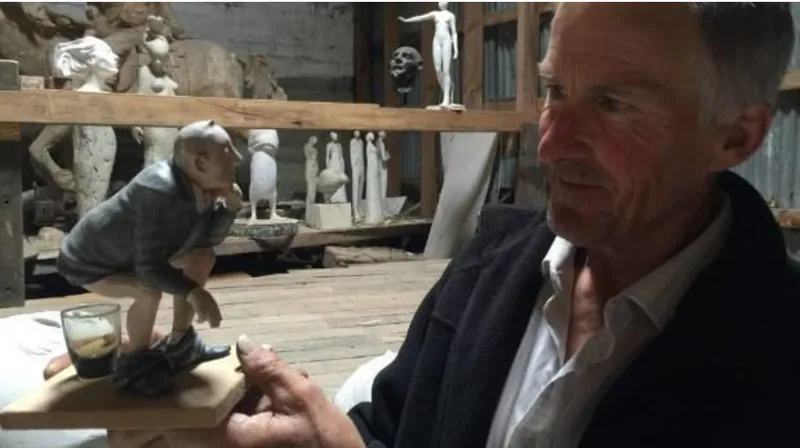
Mahon is better known in the visual arts world, where he’s renowned for his bold activism and, I’ve now read several times across various interviews, as something of a contrarian. In 2009 Mahon made a bust of then environment minister Nick Smith (who ordered an inquiry into Environment Canterbury just as the government were looking to de-regulate water management measures in the region) out of cow shit to protest the pollution of the Hurunui River; and in 2017 used horse manure to construct a large-scale sculpture of Smith, pants around his ankles, squatting and about to shit into a glass of water. In the lead-up to the 2011 election, Mahon painted then prime minister John Key dead in an alley which was made into a game which invited online visitors to guess who killed him – those who guessed correctly were announced on election day and given prizes, including a cast bronze of a dying dove which Mahon described as “a metaphor for dying hopes”.
How to Paint a Nude is set in 2011, and follows the conversations of two men, “Sambo” and “Gregor Kerensky”, over a year of meetings at a cafe in the Christchurch Arts Centre. Gregor is a refugee from Belarus who had hoped to find freedom in New Zealand compared to his home country repressed by Lukashenko’s authoritarian regime. Both men are artists and the central concern of the book is defining what “Art” (always capitalised in the novel) is, and what its purpose ought to be.
At first, I found the tone and manner of both men intensely annoying. There is an unavoidable pretension in the set-up: two men talking “Art” and women and politics over coffee and brioche. For a long time, too long for me, women are side-parts, walking on to deliver the men their sustenance, or offering a body for the artist to draw, or an opportunity for romantic or sexual awakening. Sentences like the following almost propelled me to toss the book over the balcony for the worms: “She undressed in the same way as another woman might put on an apron to make bread” … “She’s pretty in an obvious kind of way […] she looks like a high-school rowing champion, large shoulders, blonde ponytail, flawless skin, very white teeth” … “Instead she had a peasant beauty; the brow a little board, the nose a little too flat perhaps. And her eyes were like muddy opals.”
Learning that Mahon was brought up in a wealthy family, and that he went to Christ’s College but chose a life in the arts and art activism unlocked some insight into his characters’ sensibilities: How to Paint a Nude exudes the unmistakable whiff of highly educated, privileged disdain for the status quo with a particularly masculine flavour. A reverence for Egon “loved women too much” Schiele and what felt to me like romanticised memories of art-sex experiences in European locales, together with a grounding in the male dominated art scene of Sutton’s Christchurch, tended to rub my comparatively contemporary education the wrong way.
In this novel, the male gaze is inescapable and it’s only in the final quarter of the book that we get some relief from the plotting, posturing and posing of agitated men trying to wrestle with disappointment in a democracy behaving badly. Rilke, waitress, girlfriend of Gregor and model for his nudes, finally comes into her own at the end of the book quoting Woolf (one of the relatively few female artists name-dropped in the novel) and, through Sambo’s shifted attentions, launches some sense of personhood into the void created by Gregor’s absence (he returns to Belarus). The phrase “that bloody woman” is used repeatedly: once in a conversation about Helen of Troy (though, notably, a woman uses the phrase in this particular situation: Jesse, a lively character who rails against the commercialisation of art, against galleries, against the sidelining of artists for the egos of patrons and sponsors), and in another about Dame Margaret Bazley, who headed the panel of commissioners after John Key sacked the Christchurch Regional Councillors in 2010.
This political incident, alongside environmental damage particularly to Canterbury’s rivers, is a catalyst for momentum in How to Paint a Nude. The tension ramps up when Gregor’s ambitions for “Art” are activated by what he perceives as threats to democracy. For Gregor, Art is and must be political: “Of course, for us, because there are no elections, we have to be a little more clever. That is where Art is such a potent tool. Art in repression is not decoration, Sambo, it is a weapon.”
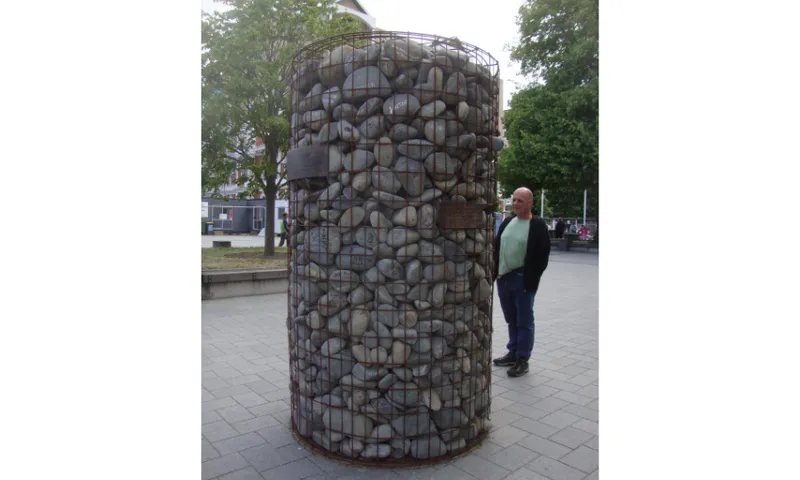
Gregor’s ambitions, even his arrogance, help the novel come alive. The chapter called ‘Cairn’ describes how Gregor inspires Sambo with “a new form of protest”; the pair rally representatives of “all the fresh water recreation clubs […] and, oddly, a representative of the social justice arm of the Anglican church” to attend a meeting. Sambo describes how Gregor effortlessly convinces them to call upon their networks and amass enough hands to give out 250,000 fliers inviting the public to a gathering at Cathedral Square to construct a cairn of river stones “as a mark of public unease”.
This is all taken directly from Mahon’s work of the same name, created at the same time and for the same reason (as documented by Newsroom in 2019). The autobiographical nature of How to Paint a Nude (which also covers Mahon’s shit sculpture of Nick Smith) begs the question of to what extent Gregor is a real figure, and Rilke too, particularly as the book is peppered with Mahon’s own drawings of a woman, from face to full body by the end. The cover image – a nude woman swimming in algae-tinged water populated by trout and lilies, called ‘Lake Hallwil’ – is attributed to Gregor Kerensky, 2010. Elements of the painting – the fish and the lake – surface in the novel when Sambo describes his relationship with an art patron called Lady Celia Robertson. I found this blurring fascinating.
There is, I think, a deliberate bleeding of the two men: at times it’s difficult to discern exactly who is speaking (this is one of those novels sans speech marks; and lines run on rather than step down into clear paragraphs) and at the beginning of their relationship, as they embark on a year of storytelling, Gregor says: “Listening is the hard part. For example; if I tell you a story about a car accident that I have seen on the way here you will immediately think of a car accident you once saw, and you’ll stop listening to me […] We dredge our memories for similarities out of empathy, we want to say, yes I understand, I have been in this position too. But your story can never be as important as mine until you’ve heard it.” This idea echoes with the very first entry in the book, in which Sambo says: “A priest once told me that we fall in love with people with whom we have wounds in common, that in caring for them we’re really nurturing ourselves […] I have often wondered if my respect for Gregor was this narcissistically simple. I like to think it was the other way round, that he saw the gaps in me and sought to fill them with his excess of optimism.”
It’s tempting to consider the novel as one artist’s attempt to derobe: to feel out his own gaps and wounds by conjuring a mirror of sorts – a character whose wounds are harder won, whose convictions are harder fought. And yet the question of Gregor’s veracity doesn’t need to be answered for the novel’s purpose to be understood: in the end the book is “Sambo’s” attempt, at Rilke’s suggestion, to render “Art” in written form. To work from the inside rather than from the outside.
The activist in me was stirred by the fight against nihilism, and by the idea that democracy can fail and that New Zealand can disappoint even the already bitterly disappointed. The artist in me found some resonance in the tension between making art for “decoration” (for money) versus as a tool of protest and expression of discontent. The feminist in me balked, nearly abandoned the novel half way through, but I’m glad I persisted, for Rilke’s sake.
In the end How to Paint a Nude will, I suspect, reward slow reading and even re-reading. There is a lot to think through and pick apart. Gregor isn’t a likeable character and to a certain extent neither is Sambo: the reader has to work to decide where they stand between them, even if they’re on shaky ground. Nature, in the end, lends her powerful voice to the piece: earthquakes making a mockery of all involved.
How to Paint a Nude by Sam Mahon ($40, Ugly Hill Press) is shortlisted for the Jann Medlicott Acorn Prize for Fiction which is announced at a ceremony in Auckland on May 13. The novel is available to purchase at Unity Books.
The Spinoff Books section is proudly brought to you by Unity Books and Creative New Zealand. Visit Unity Books online today.

Claire Mabey
Claire Mabey is a children's author of The Raven's Eye Runaways, The Raven's Eye Rebellion, and a picture book Cass and the Beast illustrated by Jill Calder. For a long time Claire worked on literary festivals and is the founder of Verb Wellington. She lives in Te Whanganui-a-Tara with her partner and son.


