Do self-help books actually help?

Made possible by
Josh Drummond explores the enduring appeal of self-help books and asks what they’re really doing for us.
This self-help book isn’t like the others you may have read. Those didn’t help, did they? Well, you’re in luck. This self-help book will actually help.
That’s how a lot of self-help books begin. I would know; I’ve read a truly upsetting number of them.
“But why?” is an excellent question. A few years ago I started an experiment: I would read self-help books, analyse them with a sceptical eye, but still try to put their lessons into practice. I’d blog about it, or rather, Substack about it, which was the style at the time. Readers could thrill to my adventures as I became… I’m not sure what. The terms of reference were always a little hazy. I know what I wanted to get out of it, though; the experience of being consistent with something. Which, apart from things like eating food and going to the toilet, is something I have never had.
The experiment has, by nearly all possible measures of success, been a colossal failure. The only thing I’ve managed to be consistent with is inconsistency, and relatively few lessons from self-improvement have been put into place.
This is a shame, because self-help remains incorrigibly popular. And despite my failure there is one thing that I do feel wildly overqualified to discuss: the form and content of self-help books; and the itches that readers seek to scratch with them.
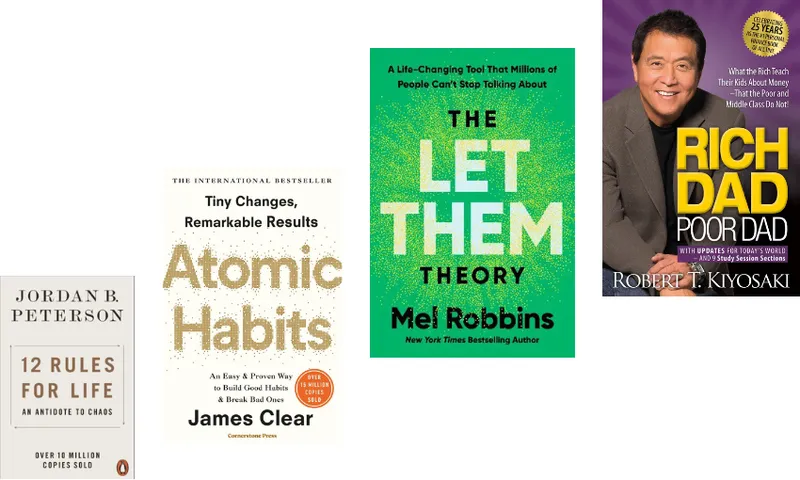
At the time of writing, Mel Robbins’ awkwardly-titled self-help tome, The Let Them Theory, is dominating sales charts. To be clear: I haven’t read this book and I’m not planning to. I don’t need to, and neither do you. If there’s one thing that I’ve learned about self-help books it’s that nearly all of them are one or several core aphorisms stretched across hundreds of needless pages, like butter scraped over a factory’s worth of bread. (Others are remixes of stuff like Stoicism that, while genuinely useful, was old when Romans were discussing it.)
In the case of The Let Them Theory, everything you need to know and possibly more is contained in the first four sentences of the back cover blurb.
What if the key to happiness, success, and love was as simple as two words? If you’ve ever felt stuck, overwhelmed, or frustrated with where you are, the problem isn’t you. The problem is the power you give to other people. Two simple words – Let Them – will set you free.
That’s it. That’s the book. I hope you find something fun to do with the dozen or so hours that I have just saved you. I’m being serious; I have nothing but disdain for the sort of people who try to render down most books into bite-sized but nutrition-free chunks (ChatGPT, give me a hundred-word summary of The Brothers Karamazov including bullet points of the three main themes) but self-help is an exception. Even the good self-help books should be substantially shorter. The mediocre ones would benefit from being bullet points. The bad ones would be better off as actual bullets; I’ve certainly felt the urge to shoot them out of an old-timey circus cannon when reading.
Of course, this raises the question: if self-help is just obvious and often very old aphorisms repeated and remixed into a slurry, then why is it so popular?
It turns up some strange answers.
The idea of the “first ever book” is a contested notion, but one of the serious candidates is a Sumerian tome called The Instructions of Shuruppak. This book was already centuries old when the internet’s favourite copper merchant Ea-nāṣir received his famous complaint letter, and in its opening passage it claims to be even older.
In those days, in those far remote days, in those nights, in those faraway nights, in those years, in those far remote years, at that time the wise one who knew how to speak in elaborate words lived in the Land… The instructions of an old man are precious; you should comply with them!
You should not buy a donkey which brays; it will split your midriff.
Shuruppak is an example of what’s called “wisdom literature,” which can be found in many places, including religious texts like the Bible. My contention is that this stuff is basically self-help, and that humans have been gravitating to that particular form of words since we’ve been able to write. Look at that introduction again; even the repetition is present! And if you skip to verse 65, there’s this:
The eyes of the slanderer always move around as shiftily as a spindle. You should never remain in his presence; his intentions should not be allowed to have an effect on you.
There you go. That’s The Let Them Theory, in the oldest book known to humanity.
Saved you a click.
If you accept that wisdom literature shares DNA with self-help, we can agree that the genre has essentially always been with us. But that doesn’t explain its eternal appeal. To attempt that – and in the navel-gazing spirit of self-help – I’m going to start with me.
My first self-help book was something my parents got me when I was about 12. I’ve forgotten the title, and I’d rather not remember it. It was some kind of Christian approach to improving your self-esteem, and to a kid who was incredibly self-critical, it seemed like a godsend. To me it promised something I’d long dreamed of: the cheat code to how people worked. If I could crack that – and the book hinted tantalisingly that I might – then I might understand how to make it so people were less mean to me, and perhaps even how to be less mean to myself. That, and I read every book I touched. I used to read the phone book. It was better than some of the self-help I’ve read since.
I’ve since learned something that will probably not surprise anyone who read the previous sentence or so but still came as a shock to me: that I am autistic, and I have ADHD. As a kid, my parents were keen to avoid labels like “Asperger’s Syndrome” (as my flavour of autism was then called) worrying that it would attract bullies. They found me anyway; it turns out children who wear the same flight jacket to school every day in 1994 kind of print their own labels. Without a more accurate understanding of why I was the way I was, books offered an escape and an explanation. I don’t know how I’d verify this, but one of my pet theories of self-help’s perennial popularity is that the world is stuffed with non-neurotypical people who are desperate for an instruction manual, a way to carve off the square-peg points of their personalities with a prose adze, in order to fit into society’s round holes.
Even for so-called neurotypical folks, self-help’s appeal might be easily understood given the right framework. We all inhabit bodies that evolved to gather food, to hunt, to socialise in close proximity, often outside. Today, many of us spend our waking hours almost entirely indoors, alternating between a big screen where you are entertained, a medium screen where you work, and a small screen where you incur psychic damage. Across all three screens, a lot of time is spent reading. Small wonder that so much self-help concerns itself with fundamental human needs: eat! exercise! socialise! avoid things that harm you!
Here is my book-cover-blurb-worthy hot-take: Self-help functions as a virtue simulator, a way to feel good about yourself for a few hundred pages as you embody the hero of a better life. In that respect, self-help is essentially the same as fiction; only (often) less well-written. While reading, you are the person who keeps a tidy house or keeps time or keeps track of personal finances. But upon finishing, the prose fragments into figments of your imagination, and you return to being the person you already are.
I am painting a pretty dire picture of self-help, but that’s not really my intention. A lot of the actual advice given in self-help isn’t bad so much as it is belaboured. Some of it is excellent! The more deliberate, meditative forms of self-help — such as Stoicism — have a lot of value. There is of course some terrible self-help advice out there, such as Jordan Peterson’s commandment: “Put your life in perfect order before you criticise the world.” If followed, this would ensure no-one (including Jordan Peterson) did anything, ever. Objectively bad advice aside, the difficulty lies not just with the fact that the world is complicated, too much so for any one or even several books. It’s also because of something true a psychiatrist told me – in the moment before he recommended a self-help book – “You can’t out-think the thinker”.
Perhaps, if we’re being honest, we might admit self-help comes from that specific hope. That through the mere act of reading, of thinking someone else’s thoughts, we might become someone else. Obviously that’s an unfair expectation for any book, but I still think that’s the subconscious substrate of the genre. The fundamental problem, since the Instructions of Shuruppak, seems the same: prose, on its own, is a poor teacher, and it’s a mistake to put the prose cart before the actually-doing-shit horse. Imagine trying to learn to play the violin, or to do woodworking, from a book of inspirational stories about virtuoso violinists or woodworkers. The idea is absurd, and yet that’s what a lot of self-help consists of.
I’m sure that some folks do triumphantly snap shut their copy of Rich Dad, Poor Dad and immediately set about building an extortionate rent-seeking empire, but most probably don’t. For the rest of us, the idea of improving by yourself is inherently flawed; it requires a community. Whether you’re learning an instrument or forming atomic habits, you’ll do better if you’re doing it with others, while taking deliberate, somatic action that’s much more than turning pages or imbibing inspirational TikToks.
Perhaps this isn’t like the other self-help articles you’ve read. Perhaps it’s exactly the same. But when you shut the book, close your browser, or end the scroll, it will still be true that the best help comes from other selves.
The Spinoff Books section is proudly brought to you by Unity Books and Creative New Zealand. Visit Unity Books online today.

Josh Drummond
Josh Drummond is someone who writes things and makes art, neither as frequently as he’d like. Most of what he does can be found at tworuru.com


