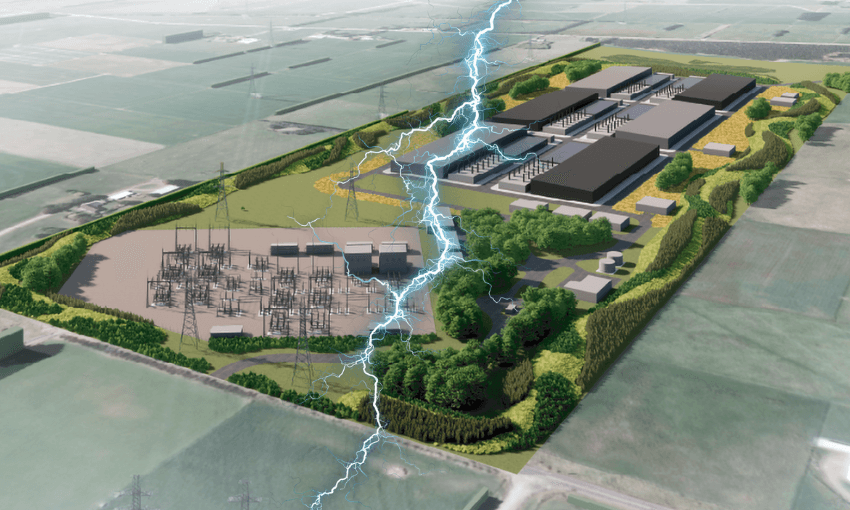



Running the Datagrid data centre in New Zealand rather than China could save the equivalent annual emissions of half a million cars.
For the last decade, tech evangelists have stared at lush green farmland on the outskirts of Invercargill and dreamed of covering it in grey warehouses full of servers. Because of the area’s cold climate, high rainfall and proximity to hydroelectric dams, Southland has long been posited as an ideal environment for a large-scale data centre industry.
The first major test of that thesis is under way now. In March, Environment Southland granted resource consent for the Datagrid Data Centre Park in Makarewa, about 7km from Invercargill. It will span 49 hectares of farmland and cost $3.5 billion to build.
It will be by far the largest data centre ever built in New Zealand – and the first in the South Island that meets the technical requirements of hyperscale companies like Amazon, Meta, Google and Microsoft.
At 280 megawatts, it will single-handedly increase New Zealand’s current total compute capacity by 65% when it opens in 2028. It will be the second-largest energy user in the country after Tiwai Point Aluminium Smelter, consuming more each year than the entire city of Wellington. It’s permitted to draw up to 220 million litres of groundwater per year – roughly equivalent to seven Southland dairy farms. It will also destroy a nearby wetland (which Environment Southland says is of “very low ecological value”) and is likely to disturb native marine species at Ōreti Beach when it is connected to a new undersea cable.
Datagrid is majority-owned by Remi Galasso, a French-born tech entrepreneur, and is expected to create 1,200 short-term jobs during the construction phase, as well as requiring an ongoing staff of 50 people. The company has signed a 15-year agreement with Mercury to supply 140mw of power per year, about half of what the data centre requires.

It was largely supported by local politicians and didn’t prompt strong opposition from environmental groups, though a public petition on Change.com calling to stop the project topped 26,000 signatures. Some of the comments highlighted the risks of power or water shortages but many more clearly responded on an emotional level.
Around the world there is a growing resentment towards data centres, big tech and AI in general. A 2025 Ipsos survey found that 66% of New Zealanders are nervous about AI and that 84% prefer articles, images and videos that are made by humans rather than AI (the highest rate of all surveyed countries).
There are many valid concerns with AI, and it’s important to debate how they can be addressed through regulation, especially when it comes to consumer access to water and power. But the data centres could also present an opportunity for climate change mitigation and New Zealand’s renewable energy industry.

The International Energy Agency reported that “data centres connected to electricity grids with lower shares of generation based on fossil fuel produc[e] less associated emissions, and hold enormous potential to help (or hinder) global clean energy transitions”.
Based on average emissions intensity of electricity production, powering a data centre the size of Datagrid in the US would produce about one million tonnes of Co2 annually, even though many data centres there claim to be zero-emission due to buying carbon credits. In China it would produce about 1.4 million tonnes. A fully coal-powered facility, like many of the Chinese-owned centres in Inner Mongolia, would emit as much as two million tonnes.
In Southland, running on hydropower and wind energy, its emissions will be virtually zero. Of course, this is a best-case scenario. It could cause some indirect emissions if it causes power shortages that need to be made up for elsewhere using fossil fuels.

The annual carbon emissions saving from running Datagrid in New Zealand rather than China could be equivalent to taking almost half a million cars off the road. Ten of them would offset the equivalent emissions of the dairy industry. Forty would offset New Zealand’s entire carbon footprint. You don’t have to like AI to agree that it is better to run it on hydropower than coal. Even if we can’t slow the advancement of technology, we can do our bit to lessen its impact on the environment.
The technological breakthrough that makes this possible isn’t anything to do with LLMs or machine learning. It’s the cable: the Tasman Ring Network, a 6,000km subsea cable that will give South Island a direct connection to Australia rather than routing everything through Auckland. Datagrid claims it will reduce latency by up to 35%, which is essential for AI workloads. Without that connection, Southland could never credibly compete for contracts from major firms.

That means for the first time New Zealand will be able to “export” renewable energy produced in the South Island to international customers by letting them run their most energy-intensive processes on our zero-emissions network.
Imagine if a country had an enormous oil reserve but no way of exporting it. Then someone built a pipeline connecting it to the world. And unlike most oil reserves, this one will never run out. That’s what this project could mean for New Zealand’s renewable energy industry.
New Zealand already produces about 85% of its power through renewable sources, mostly hydropower. There is almost unlimited capacity to build more dams, solar farms and wind turbines but it has been held back by a lack of demand in the domestic market. No major power plant has been built since the Clyde Dam in 1992. No one wants to spend millions of dollars producing energy they won’t be able to sell.
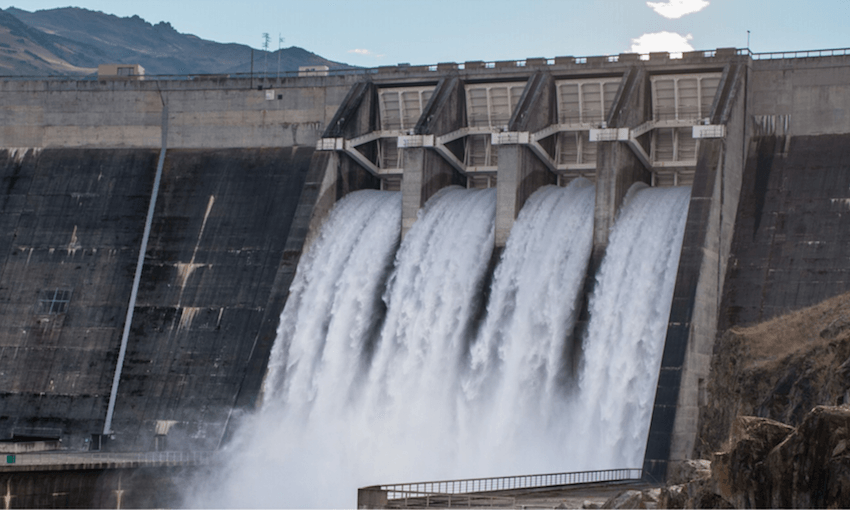
The data centre industry can offer a predictable source of demand that has completely reshaped the fundamentals of the renewable energy market. Rather than producing just enough power to keep New Zealand running, the gentailers now have a profit incentive to generate more power and sell it to the rest of the world.
It’s already happening. Contact Energy’s Te Huka Unit 3 geothermal power station near Taupō was built because of backing from Microsoft for its Auckland data centre region. Mercury’s Turitea South wind farm was supported by a contract from Amazon Web Services. The current buildout is adding new generation capacity around 25% faster than the Think Big era of the 1970s and 1980s.

The construction of new data centres and power plants will undeniably cause some environmental harm. The Slopedown Wind Farm, about 50km from Datagrid, was initially rejected by the Environmental Protection Authority due to the impact on birds, bats and lizards. Last month a fast-track panel gave it the green light. It will be New Zealand’s largest wind farm.
The changing economics of renewable energy puts New Zealand’s environmental movement at a crossroads. Up until now, the strategy has primarily been about punishing large energy generators by suing them, taxing their emissions, or otherwise disincentivising their progress. Now, you could argue climate activists could align themselves with energy corporations, tech firms and the investment funds that finance them, actively cheering on their efforts to build, baby, build.