


First they came for the Toffee Milk bars…
A few years ago, while driving on a South Island road trip, we stopped at a corner dairy to buy some milk for our toddler son. At the counter, a box of Whittaker’s Toffee Milk bars sat temptingly. A handwritten sign perched on top. It read: LIMIT 5.
I paid for my milk and, ever the impulse purchaser, asked the shopkeeper for 10 Toffee Milk bars. She looked at me and said, “Sorry, it’s a limit of five.”
In my greed, I had misunderstood the sign to mean that you must buy at least five. Linda Evangelista famously once said she wouldn’t get out of bed for less than $10,000 a day, and I had assumed this dairy owner operated on a similar principle – except her minimum threshold was five Toffee Milk bars.
But no. As she explained to me with the patience of someone who had clearly been forced to elaborate before, there was a limit of five bars per customer because Toffee Milk bars had been discontinued, and this was, in fact, the last box in New Zealand. It wouldn’t be fair to other customers for a gluttonous Christchurchian to snaffle the lot in one go.
I apologised for my faux pas and purchased my milk and five Toffee Milk bars at the inflated price of 50 cents each, before heading back to the car to explain my windfall to my husband.
He – being British – had never actually tried a Toffee Milk bar before. I explained the lore. Legend had it that a Toffee Milk bar required such forceful mastication that the consumer expended more calories chewing it than the bar actually contained. The perfect guilt-free snack.
We shared them evenly: him one, me four. On my fourth and final bar, I managed to rip a filling out of my back molar, making it the most expensive Toffee Milk bar ever consumed.

But we were not merely enjoying a sweet treat. We were experiencing a moment in history, and it was part of a much larger extinction event happening quietly inside New Zealand dairies. The discontinuation of Toffee Milk bars was just the tip of the iceberg. Sparkles, Snifters, Jaffas, Tangy Fruits and roughly 80% of the flavour varieties of K Bars have now joined the great sugary graveyard.
But it’s not just the lollies themselves that are being discontinued. It’s the purveyors of sweets, too. Not too long ago, it was commonplace (and a basic human right) to have a corner dairy close enough to your house that you could dash there during an ad break – remember those? – of your favourite show, and be back in time to see whether Dr Ropata was in Guatemala or not.
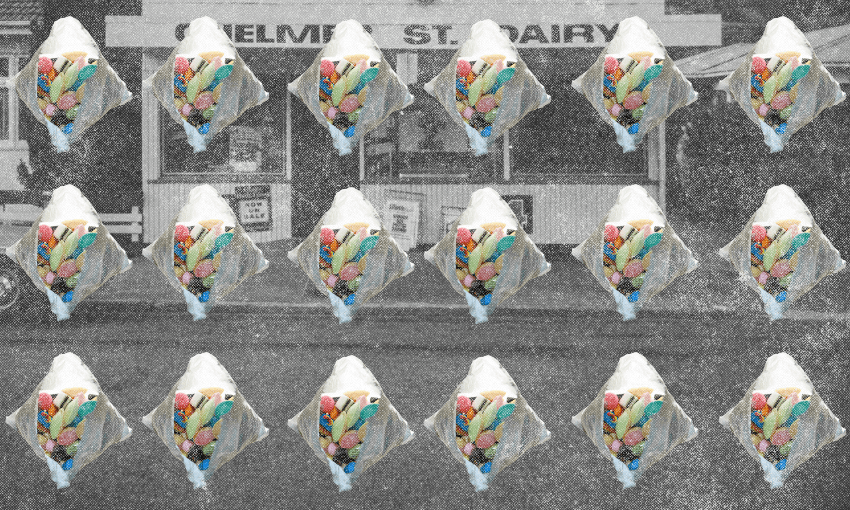
Now, corner dairies are shutting faster than you can say Z Energy. And the dairies still in operation have removed their greatest allure of all: the white paper bag and the autonomy to choose.
Growing up in New Zealand in the 90s, it was every child’s rite of passage to stand in front of the dairy counter , hopping from one jandaled foot to the other, coins jangling in a grubby hand, dithering over an array of lollies and carefully selecting which ones to choose while the owner waited, tongs poised with the patience of Mother Teresa, for your decision.
At 5c each – or sometimes even two for 5c – the possible combinations felt endless. You were in charge of choosing your own destiny, and no two weekend pocket-money hauls were ever the same.
The lollies were usually kept in glass jars behind the counter, the perfect conditions to keep them at their textural prime. The gummy fried eggs were permanently sunny-side up, the blue and pink shells perfectly al dente, and the Pineapple Lumps a satisfying medium-rare. For the more daring customers with taste buds of steel there were Bulldog Sours and Warheads.
For the time-pressed youngsters with urgent handball tournaments to attend, there was the time-efficient yet slightly risky gamble of plumping for a preselected white-paper-bag $1 or $2 mix.
For those unconcerned with aesthetics, there was the Ka-Bluey: a lolly so radioactively blue it would coat your tongue and lips in a fashion that could be mimicked only by chomping down on a cyan printer toner – a colour that lingered for days, like evidence.

Childhood lollies in the 90s also required a surprising amount of engineering to consume. Some even needed tools. Take sherbet sticks – a product so tantalisingly delicious, yet so fiendishly difficult to extract. One drop of ill-placed saliva would render the vessel an impotent, gummed-up mess. But no matter: you could always use Mum’s sewing scissors for their real purpose – slicing it into convenient, tasty sections of sherberty straw to chomp on, so you could enjoy them like a small cowboy chewing tobacco while watching What Now? And we’re worried about microplastics now.
But something changed – whether health and safety regulations, profit margins, or both. Now lollies are sold in sterile plastic bags, their contents so uniform and clinically selected it’s enough to bore you to tears.
But what about selection bags? Are they still as delightful as ever? Short answer: no.
Last week I witnessed a true crime against humanity. After a sporting event, we were given a family-sized bag of Party Mix lollies. Being a sweet tooth and a greedy one at that, I eagerly ripped open the package. What I found inside left me appalled. Jelly snakes so stiff they could double as doorstops. Banana puffs hard enough to rattle like loose gravel. Eskimos with the texture of Nerf gun bullets. Solidified jet planes in a dismal array of anaemic colours. And not a single milk bottle in sight. A lolly selection so bleak and depressing it was less suited to a party and more in keeping for a candle-lit vigil.
I feel blessed to have grown up in New Zealand’s great lolly heyday, when any child with $2 could feel like a confectionery venture capitalist, carefully diversifying their bonbon portfolio across sour, gummy and chocolate assets. I was lucky enough to experience this golden age.
But what becomes now of Aotearoa’s youth? Won’t someone – anybody – think of the children? Or at the very least, bring back the white paper bag.