Once, newspapers ruled Auckland’s suburbs. Now they’re almost all gone

Image: The Spinoff
The closure of Stuff’s seven remaining Auckland community newspapers this week marks the end of an era: the supercity has not had as few newspapers as today since the 1850s. Derek Whaley charts their rise and fall.
Not long ago, nearly every suburb and rural community in Auckland had its own newspaper. Publishers differed. Content and quality were inconsistent. Delivery to your letterbox could be monthly, weekly, or more frequent. But every resident could rest easy knowing that local news and events would be covered by their local rag. Until now.
On July 4, 2025, Stuff Ltd announced the impending cancellation of its remaining Auckland community newspapers: Central Leader, Western Leader, North Shore Times, Manukau & Papakura Courier, Eastern Bays Courier, Rodney Times and Franklin County News. Such an action was not unexpected. Since Fairfax Media (rebranded in 2019 as Stuff) acquired Independent Newspapers in July 2003, it has slowly reduced local content in its community publications and consolidated its list of titles throughout New Zealand.
Auckland suffered losses the same as any other region. The Auckland City Harbour News was the first to fall in September 2017, followed in May 2018 by Waiheke Marketplace. The first Covid-19 lockdown in March 2020 prompted Stuff to reduce its twice-weekly publications to weeklies, simultaneously shrinking the content of its remaining Auckland newspapers until each issue averaged twelve pages in length.
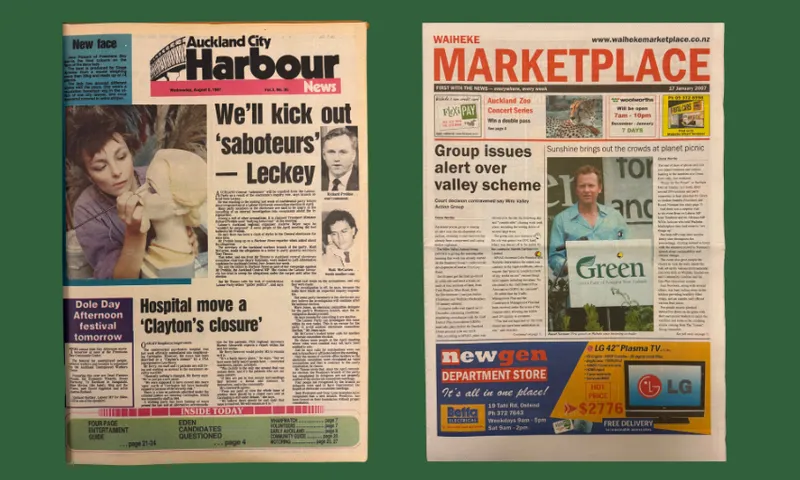
Jump ahead to April 2024, Stuff cancelled both the North Harbour News and Nor-West News without notice or explanation. At the same time, the four Courier-branded newspapers in south and east Auckland were consolidated into two (both of which are now closing). In just seven years, Stuff had reduced its Auckland community newspaper titles from 13 to seven. And now there are none.
Such a fate is not without precedent. In late 2024, NZME, owner of the New Zealand Herald, discontinued 14 of its community papers, though none in Auckland. Over a decade earlier, in 2012, it had pulled out of the Auckland market entirely when it cancelled The Aucklander – a lifestyle and news magazine that contained the essence of at least five Wilson & Horton-owned community newspapers that had been forcibly merged following the company’s purchase by APN Holdings NZ Ltd in 2003.
In truth, Wilson & Horton never had much of a foothold in Auckland. Instead, Suburban Newspapers Ltd ruled the community presses. The company was created by New Zealand Newspapers Ltd, publisher of the Auckland Star, on March 29, 1961, to manage the newly acquired South Auckland Courier and the North Shore Times. The Courier and Times, begun in 1939 and 1949 respectively, were already prominent newspapers in their areas and gave Suburban Newspapers a strong base from which to expand.
Throughout the 1960s, Suburban Newspapers spread its reach far across Tāmaki Makaurau. In January 1963, it acquired all of District Newspapers Ltd’s titles, which encompassed most of the suburbs along Great North Road from New Lynn to Ponsonby. These eventually became the Western Leader and Central Leader. In 1966, it purchased the North Shore Advertiser, consolidating its dominance on the North Shore. And in 1968, it acquired the West Auckland Gazette and incorporated it into the Western Leader.
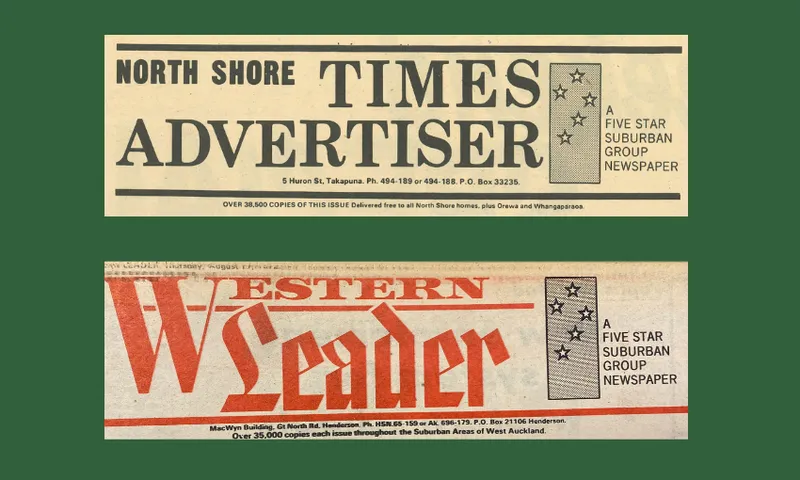
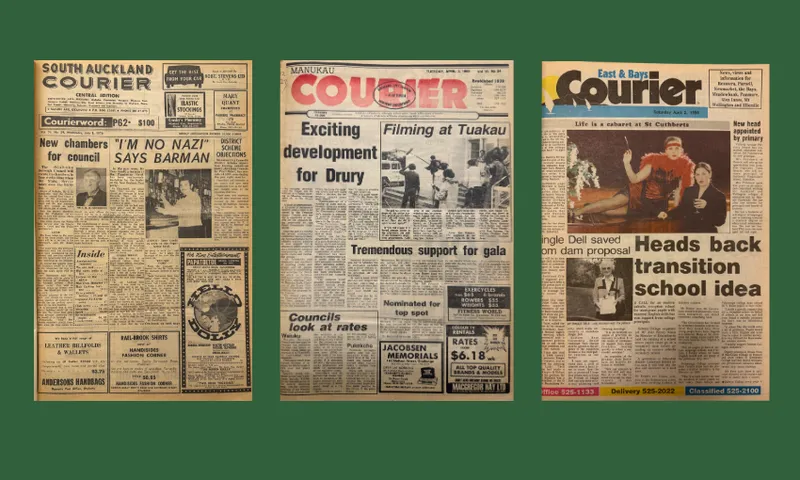
Meanwhile in 1964, the South Auckland Courier was split into central and east editions, the predecessors of the Manukau Courier and Eastern Courier. This was followed in 1965 with the purchase of Manurewa’s South Auckland News Advertiser, 1966 with the eastern bays’ News Echo, 1967 with east Auckland’s Tamaki Times, and 1968 with Papakura’s Ribbon News-Pictorial, all of which were incorporated into the two editions of the Courier.
Suburban Newspapers achieved its last local milestone in January 1971 when it purchased the Franklin Times, solidifying its influence over most of South Auckland. This newspaper, after several permutations, emerged as the Papakura Courier in 1992. Its cousin, the East & Bays Courier, came a year later as a spin-off of the Eastern Courier. Both new titles were the products of a new owner: Independent Newspapers Ltd.
INL was the original publisher of Wellington’s The Dominion, dating back to 1906. However, in 1964 nearly 30% of the company was purchased by Rupert Murdoch and his News Ltd took the helm. INL acquired Suburban Newspapers in July 1989 and promptly cancelled several community titles such as the Saturday Courier and Broadway. On the other hand, it brought with it the Franklin County News, first published in 1971 and acquired by INL in 1985. Over the next decade, INL also bought the North Harbour News, originally published in 1991, and the Nor’west Newsbrief, with its origins dating to 1971.
Fairfax Media was responsible for acquiring Stuff’s final Auckland community newspaper titles. In 2005, it purchased the Rodney Times. This was Auckland’s oldest continuously running community newspaper with its first issue dated 29 March 1901. Fairfax Media’s other acquisition was the Waiheke Marketplace, begun in 1998, which it purchased in 2007. From this date, Fairfax Media produced 13 community newspapers for Auckland, covering the entire region and beyond, from Mangawhai to Pōkeno.
By cancelling these newspapers now, Stuff concludes more than 124 years of community journalism in the Auckland region. It also ends the last remaining trace of the Auckland Star’s dominance over Auckland’s newspaper industry. For over a century, the Star was a thorn in the side of the New Zealand Herald and was the city’s self-proclaimed newspaper until its closure in 1991. Either directly or through its periodic circulars, the Star influenced local politics, economics and everyday life. It was in every Aucklander’s home every week, if not every day. And the owners of the Star worked hard to secure this dominance.
All considered, more than 75 unique community newspapers titles contributed to the creation of the seven newspapers just cancelled. Most of these had their roots in a local entrepreneur pouring out their soul – and money – to provide their own communities with vital news and relevant advertising. In an era when television either didn’t exist or had only two channels, community newspapers filled the gap, with local sports results, public notices, weather reports, school calendars, upcoming events and all manner of classifieds. Even after Suburban Newspapers took over, each newspaper still retained local editors and reporters, allowing some newspapers to swell to 80 or more pages twice a week free of charge.
The rise of the internet and digital publishing ended the dominance of print news across the world and the industry has been in a downward spiral ever since. Yet the cancellation of Stuff’s seven remaining Auckland titles marks a major turning point in community journalism. The supercity has not had as few newspapers as today since the 1850s. While some local newspapers survive, such as the Hibiscus and Mahurangi Matters, the Devonport Flagstaff, the Eastern and Franklin Times, and the West Franklin Breeze, these are exceptions rather than the rule. No newspapers now represent great swaths of Auckland, from Helensville to Manurewa and Piha to Glendowie.
Newsstands now sit empty at community centres and on street corners, the papers they advertise a memory of an earlier time. Perhaps some of the cancelled newspapers will return under different owners or new newspapers will arise to fill the vacuum. Either way, it is the end of an era, a time when newspapers ruled the suburbs.
Derek Whaley is a lead on the research and heritage services team at Auckland Council Libraries, whose heritage collections hold back issues of all Stuff’s Auckland-area newspapers on hardcopy and microfilm. For more information or to arrange a viewing, fill in a research enquiry form. All views expressed in this article do not represent those of Auckland Council.

Derek Whaley
Derek R Whaley is a lead on the research and heritage services team at Auckland Council Libraries.


