The many complex truths in the lack of Black Ferns coverage

Braxton Sorensen-McGee scores during the Black Ferns’ third-round match against Ireland (Photo: David Rogers/Getty Images)
Is a lack of mainstream media coverage for the Black Ferns simply because newsrooms don’t care, or are there many other bleak factors at play? Madeleine Chapman breaks it down.
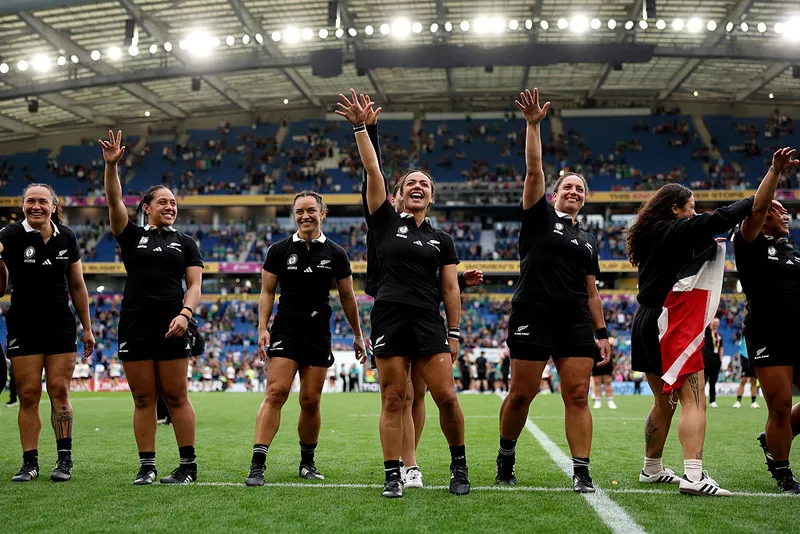
The Black Ferns will play South Africa at midnight tonight (New Zealand time) in the quarterfinal of the Women’s Rugby World Cup. There are plenty of New Zealanders who will have no idea. Due to a confluence of factors including time zones (the tournament is being played in England), resource and good old fashioned sexism, the world champion rugby team continues to struggle for mainstream attention.
This week in particular, fans have pointed out the lack of mainstream media coverage for the Black Ferns, especially compared to the All Blacks. Social media influencer How To Dad called it out on his platform, as did Tegan Yorwarth on the Girls Uninterrupted podcast.
Outside of the obvious “mainstream media will never value women’s stories over men’s, particularly in sports”, what might be behind this apparent apathy?
Truth #1: Getting the obvious out of the way, the Black Ferns have never had coverage remotely comparable to the All Blacks. They are not unique in this. Literally every New Zealand team that is not the All Blacks bemoans the lack of media coverage they receive in comparison.
Truth #2: However it is more egregious for the Black Ferns because they are both under the same New Zealand Rugby umbrella and therefore should have the force of the machine behind them. And there’s a World Cup happening.
Truth #3: The Black Ferns entered the 2025 Women’s Rugby World Cup as reigning champions and second favourites behind hosts England. This should have made for an easy media narrative and bandwagoning from New Zealand fans.
Truth #4: New Zealand hosted the World Cup in 2022 and did the bare minimum. There were no fanzones, virtually no merch for the host team (Black Ferns), barely any local marketing and New Zealand Rugby literally scheduled an All Blacks match in Japan at the same time as the Black Ferns’ quarterfinal in New Zealand because they forgot the Black Ferns were playing. Despite that, the tournament was a huge success almost exclusively thanks to the team being incredibly charismatic and winning a dramatic grand final against England.
Truth #5: England is years ahead in its embrace of women’s sport and in hosting this year, there are record ticket sales, multiple huge fanzones around the country and a genuine sense of hype from local fans.
Truth #6:Time zones are a very real factor. Even major events like the Olympics see a marked drop off in engagement and coverage when live events are happening at 3am New Zealand time. But if it was a Men’s Rugby World Cup, there would be New Zealand reporters on location, filing throughout the night, and even editors on night shift to ensure there’s ample coverage once the rest of New Zealand wakes up.
Truth #7: This hasn’t happened at all with the Black Ferns’ World Cup campaign. But that doesn’t mean there hasn’t been coverage. The 48 hours before the Black Ferns play South Africa, there’s the usual suite of preview articles. I’m typing this at 2pm on Friday and there have been six RNZ articles on the Black Ferns published in the past 24 hours (though only one written by a named RNZ sports reporter). What people are likely noticing is the (lack of) Black Ferns coverage alongside All Blacks coverage on the 6pm news when they both have upcoming matches.
Truth #8: New areas of interest (yes I know many would argue women’s sport is not a new area of interest) require enthusiasm from media outlets to expand coverage areas and investment, particularly in new writers to cover new beats. It’s much easier to keep doing something (men’s rugby) than it is to start doing something (anything else).
Truth #9: Media in New Zealand has been actively diminishing over the past two years. No one is investing in anything new, and in fact, existing beats have been disappearing. Sports reporters have been made redundant across a number of major newsrooms, and there are now pretty much no arts and entertainment reporters on salary in New Zealand. Coverage across the board has decreased.
Truth #10: “But there’s still so much All Blacks coverage!” Yes, but not as much as there used to be. And because the sports reporters still with jobs have spent decades writing about the All Blacks so it’s an easy, cost-effective (and popular) beat for newsrooms to maintain given the history of knowledge and ease with which those reporters can analyse the team and its matches.
Truth #11: In order to have similar coverage for the Black Ferns, reporters would need to be hired (unlikely) who have a similar level of knowledge about the women’s game, its players and its systems (even more unlikely). Currently, I’d wager the only writer with that level of knowledge is Alice Soper.
Truth #12: Alice Soper can and does write for the papers, but unlike the old-school All Blacks reporters, she gets arguably more reach on social media and her own website and podcast (with former Black Fern captain Les Elder). This may be because newer fans of rugby have a more holistic interest in the sport, and want to know more than just who’s in the team or who played well and who didn’t. That “preview/review” approach has always been extremely popular for mainstream All Blacks coverage but replicating it for the Black Ferns and expecting it to resonate just as well is a fool’s errand.
Truth #13: The Black Ferns are a relatively young global team playing for a relatively young global fanbase. I may not wake up and expect (or want) to read a knowledgable analysis of the Black Ferns’ latest match in the paper but I can watch the game highlights, Soper’s match analysis, see Katelyn Vaha’akolo talking about the team selection, watch the players training mid-week and catch half a dozen of them posting their silly dances with each other all on TikTok and Instagram.
Truth #14: If the future of women’s rugby fandom exists online and all over the world, what role does traditional media even have to play? At this stage, it feels more likely for new, specialist publications to be launched on social and audio platforms than for the oldest newsrooms in the country to suddenly change their approach to sports coverage. The old newsrooms should be adapting to new audience needs but as we know, the track record in that regard is not great.
Truth #15: Where media coverage (particularly from the big outlets) used to be the make or break for public awareness, it’s now a crowded field for people’s attention. Which doesn’t excuse mainstream media for not even trying, and certainly doesn’t excuse the lack of attention paid by every other player in the rugby eco-system.
Truth #16: When the All Blacks have played in a World Cup in Europe, parliament passed a law to allow bars to open outside of their licenced hours in order to show the early-morning games. This has not happened for the Black Ferns.
Truth #17: Tonight’s match is at midnight, after the All Blacks’ match, when bars are typically closing. I asked two local and popular sports bars (very near Eden Park so rugby focused) if they would be showing the Black Ferns’ quarterfinal. One said they would “if there’s enough people hanging around after the All Blacks’ match” and the other had no idea the Black Ferns were playing and “definitely won’t be showing it”. That bar had multiple posters with the All Blacks’ 2025 season schedule, a number of Warriors decals, and not a single reference to the Black Ferns or the WRWC.
Truth #18: Sky has the exclusive rights to the 2025 Rugby World Cup and is playing matches both live (paid) and delayed (free). Tonight’s match is only available to watch live for paid subscribers, which means for the majority of New Zealanders, the match will be unwatchable at midnight due to no Sky subscription and barely any bars playing it.
Auckland Council has confirmed that so far only one licenced venue in Auckland has applied for a special licence to open for the Black Ferns’ RWC games. That bar is The Fox at the Viaduct.
Truth #19: Establishments in New Zealand have yet to figure out that there is a whole new market of women’s sports fans ready to be tapped into. Again, it would require a concerted effort to cater to a crowd that is not your bog standard rugby lads, but the economic potential is huge. The hospitality industry plays a key, often unacknowledged, role in public awareness of sports, and appears to have little interest in expanding its reach.
Truth #20: But really the push should be coming from New Zealand Rugby, who benefit the most from the success of the Black Ferns and yet have consistently, and borderline disrespectfully, failed to do even the bare minimum in promoting the game or making it accessible for both journalists and punters alike. At least they’ve got merch now.
Truth #21: While it may be shockingly difficult to watch the quarterfinal tonight, if the Black Ferns progress, the semifinal and final will be free to air and available for anyone to watch at home. And I suspect, despite everyone’s worst efforts, the viewing numbers will be huge.
Truth #22: The women’s game will continue to grow in spite of the persistent lag from both traditional media and its own sporting body. The real question is whether or not mainstream media will be left behind entirely as a result.

Madeleine Chapman
Madeleine Chapman is a contributing editor. She was editor of The Spinoff 2022-2025.


