The legal challenge to New Zealand’s ‘incoherent’ climate plan, explained

Climate policies like EV subsidies will be compared to tree planting in court. (Image: The Spinoff)
Today, March 16, a judicial review hearing in the Wellington high court will consider whether New Zealand’s current climate policies are adequate. What argument are the lawyers making, and how will the Crown respond?
OK – what’s this hearing, and who’s involved?
Non-profit groups Lawyers for Climate Action and the Environmental Law Initiative are challenging the Crown, specifically Simon Watts, the minister of climate change, on how the government sets targets for reducing emissions, and what legal protections emissions-reducing policies have. Given that New Zealand has domestic and international targets for reducing emissions, what process should a government have to follow if it is removing policies that would help meet those targets?
What argument are the lawyers making?
There are two aspects to the argument, says Jessica Palairet, the executive director of Lawyers for Climate Action. The first is about policies that were included in the first emissions reduction plan in 2022, like electric vehicle subsidies, which were discontinued by the current government – by their count, they number 35. “The way they scrapped those policies was unlawful,” Palairet says, adding that the process was “incoherent and internally contradictory”.
The second part of the argument is about the second emissions reduction plan, which was released in 2024. Because emissions-reduction policies had been removed, the plan relies on carbon offsetting through planting trees to make up for New Zealand’s ongoing reliance on fossil fuels. The two groups of lawyers are saying that New Zealand may not reach its 2030 climate targets, especially the methane target, and there isn’t enough proof that the policies will work. They say that climate policies need to have more confidence, not be a “coin toss”.
Essentially, it’s about whether governments can “flip flop” over climate goals in the future, Palairet says. “We are seeking declarations to clarify the law to never end up in this position again.”
What is an emissions reduction plan?
New Zealand has a variety of different climate goals it’s signed up to. There are international climate goals, like the Paris Agreement – a pledge to keep global warming under two degrees Celsius and as close to 1.5 degrees as possible. We also have domestic climate goals, like the Zero Carbon Act, which promises that New Zealand will have net zero climate emissions by 2050.
Emissions reduction plans are a map for how New Zealand now will get to net zero. Each plan covers five years, and contains specific projections about how much emissions New Zealand will produce.
The current ERP is for the period from 2026 to 2030, but also contains projections into the future. It has received criticism because while it meets emission targets until 2030, the policies in it do not meet the targets for 2035.
What will the Crown say?
“The Crown will say ‘we’re on track, we’re fine, we will meet those targets,’” Palairet says. That’s why focusing on the means – tree planting – is important too. Lawyers for Climate Action and ELI will draw on scientific evidence showing that planting trees to absorb carbon is not as robust a climate policy as reducing emissions, and has reviewed hundreds of documents about how the policy decisions were made. The Crown will also call on expert evidence to argue its perspective that it did follow the law in making climate policy.
The lawyers believe this is the first time that using trees to offset emissions has been legally tested in this way. “Reductions and removals aren’t fungible – forestry has obvious risks,” Palairet says. Trees can be damaged in extreme weather or by forest fires. “[This ERP] locks us in a tree-planting frenzy for decades to avoid reducing emissions at source.”
How does this fit into international law?
The International Court of Justice ruled last year that states have obligations to reduce emissions at source. Specifically, developed countries should “take the lead in combating climate change by limiting their greenhouse gas emissions and enhancing their greenhouse gas sinks and reservoirs”. This ruling is contributing to the legal argument that Palairet and her team are making.
“New Zealand has to use all available means to rapidly and urgently reduce emissions at source,” Palairet says. “Planting pine trees doesn’t line up with the best available science.”
When will the judge deliver the ruling?
“We’ll have three days running through the evidence, then the judge will defer the judgment and deliver it later this year” Palairet says. “It can be a slow process.” A judgment would likely be followed by an appeal and further court appearances. But a legal judgment would have a permanent impact, she says. “It will set a precedent for what should happen if a new government gets elected and wants to change climate policy.”
Climate law is a new area – although Palairet says it’s increasingly well-established – and no results are guaranteed. In 2022, for example, Lawyers for Climate Action’s case against the Climate Change Commission, asking for a review of how New Zealand set its contributions under the Paris Agreement, was dismissed. But a case against Z Energy (also in association with the Environmental Law Initiative), saying the petrol company had engaged in greenwashing, was settled out of court, ending with an apology from Z in 2025.
How is the legal system part of climate action?
Palairet says that while legal cases have to nail down specific, defined terms, focusing on the ERP could lead to broad change, even if a potential judgment is a few months away. “Emissions reduction plans touch every sector of economy and society, from agriculture to transport to steel and industry and manufacturing – this is an important process to scrutinise the guardrails.”
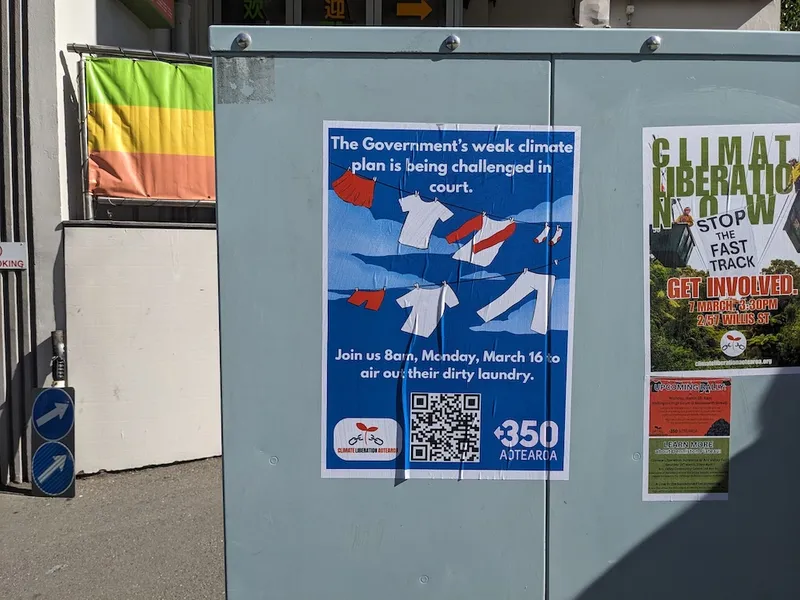
Climate advocacy groups 350 Aotearoa and Climate Liberation Aotearoa are encouraging people to attend the hearing. They are hosting a protest themed around “airing the government’s dirty laundry”, where laundry items painted with the climate policies the government has cut are hung outside the high court during the hearing.
“It’s a moment to show just how bad the government’s approach to climate change is, the fact that New Zealand made a promise to an emission plan that won’t be kept,” says 350 spokesperson Adam Currie. “Even if you don’t care about climate change [this case] shows the government is not trustworthy.”
While litigation is just one way to take climate action, Palairet says it’s an essential one. “The law used well is one of the most powerful tools we have to respond to the climate crisis.”
Simon Watts did not respond to a request for comment by deadline.

Shanti Mathias
Shanti is a contributing writer at The Spinoff with a focus on Christchurch and the South Island. Email her at shanti@thespinoff.co.nz


