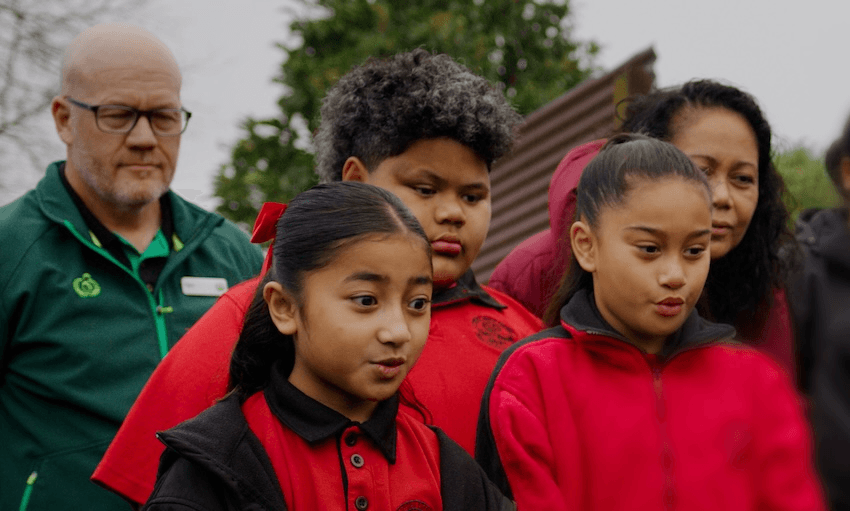

In Ōtara, primary school students are tending their own hives – and learning why bees are an essential part of Aotearoa’s ecosystem.
Flat Bush Primary School teacher Sela Togiatu is passing around a wooden paddle, inviting students to taste. They touch their fingers to the paddle and then to their lips. They’re tasting honey made by their own bees, from their own school hives.
Togiatu came up with the idea for the beehives three years ago, when a student approached her holding a dead bee. “She was very upset. I think it really impacted her,” Togiatu says.
“That stuck in my mind and I thought I needed to do something about that.”
From a couple of beehives, the project has grown into a full outdoor learning experience, with a garden full of natives like mānuka.
The community rallied around to make the garden a reality, says principal Banapa Avatia. “The amount of work, the amount of support and the amount of labour that has gone into uplifting the space that we now have, has been incredible.”
Part of that support has come from Woolworths, whose Growing For Good grants go to schools around the motu for environment-focused projects. The bee-friendly garden is exactly the sort of project the fund was designed for, says Woolworths’ Ryan McMullen.
“Seventy percent of the fruit and veg that we sell every day requires bees – that’s 200,000 crates a week, through our network, that would not exist without the bees.”
In this episode of ‘A little better every day’, we spend the day at Flat Bush Primary School’s bee garden project, where students are learning about the importance of bees to our ecosystem – and to the food we eat every day.