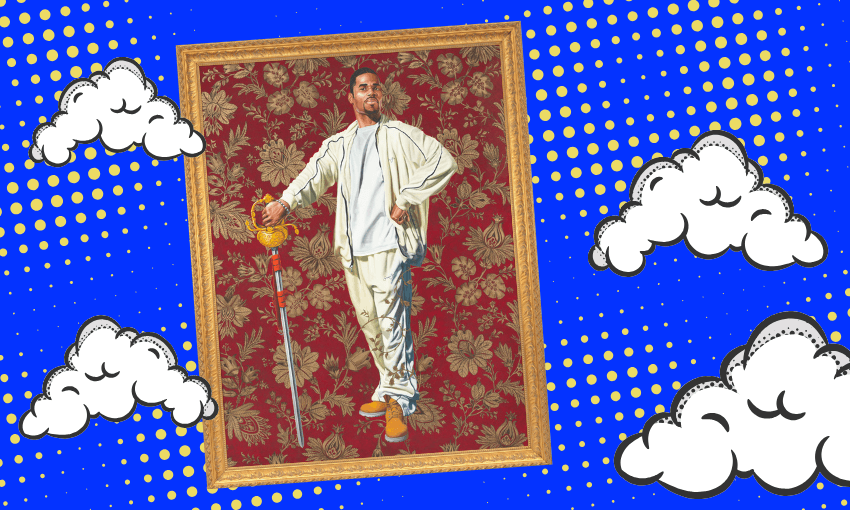



The international exhibition visiting Tāmaki Makaurau from Virginia aims to rewrite history. The Spinoff’s Emma Gleason went to see what it had to say.
Jackson Pollock, Mark Rothko, Alma Thomas, Cy Twombly, Helen Frankenthaler and, of course, Andy Warhol. The canonical names of modern American art can all be found in Toi o Tāmaki Auckland Art Gallery right now. “This exhibition is not just about Jackson Pollock splatters,” explains the gallery’s senior curator of international art, Sophie Matthiesson. “In some ways, it’s a response to them.”
Pollock’s splatters – glossy, expressive drizzles of enamel paint – are actually the first thing we see when we enter Pop To Present: American Art from the Virginia Museum of Fine Arts. His piece ‘Number 15, 1948: Red, Gray, White, Yellow’ is the earliest work in the exhibition. It acts as an entree to the large abstract expressionist works in the exhibition’s first room.
Next, we find Hedda Sterne’s surreal, hazy vision of New York, created using the then-new medium of aerosol paint. Darker still is a big inky Rothko that sucks me into the canvas like a vortex. It’s entrancing. Turning around we spot a dynamic duo, with two vibrant de Koonings – Willem’s ‘Lisbeth Painting’ and Elaine’s ‘Bull’ – hanging side-by-side with their rough sweeps of colour. Cy Twombly’s Synopsis of a Battle intrigues me, rendering a classical battle in a chaotic frenzy of abstract expressionism.

Pop art is a big draw for this show, and many of its biggest names are represented. There’s Roy Lichtenstein’s ambiguous ‘Gullscape’, which leaves me wondering where those vapour trails came from. Ed Ruscha’s ‘Noise, Pencil, Broken Pencil, Cheap Western’ and Andy Warhol’s ‘Brillo Soap Pads Box’ – fittingly – sit together, happy in their commercial subversion. Warhol’s famous ‘Triple Elvis’ hangs ominously before the next room where the exhibition begins to take us far beyond pop art.
In the minimalist section are restrained, colourful panels by Ellsworth Kelly and boxes by Donald Judd, while in the photorealism room we’re confronted by Duane Hanson’s lifelike sculpture ‘Hard Hat Construction Worker.’ He’s clutching a can of Coke and is surrounded by hyper-real paintings. Urbanists will love the street scenes of Richard Estes (Paris), John Baeder (Manhattan) and Robert Cottingham (Los Angeles) that hang nearby.
Curated by Alexis Assam and Dr Sarah Powers of the Virginia Museum of Fine Arts (VMFA), the show presents a comprehensive survey of post-war American art. There are 52 impressive pieces on loan. Together they span eight decades of American art and the movements that emerged from a modern nation in the throes of 20th-century flux.
Pop to Present also surveys the history of activism in modern art. “We have many of the African American and Native Indian artists who are working in these movements, but got dropped out of the record, and they had very important things to say and original innovations to contribute to the story,” explains Matthiesson. “So it’s a much richer story than we might have had 20 years ago.” As it introduces visitors to many artists who had, until recently, been ignored by history, Pop to Present offers an opportunity to rediscover and recontextualise modern America.
Artists in the show like Native American pop artist Jaune Quick-to-See Smith addressed indigenous rights and politics, while pioneering artist Benny Andrews advocated for better inclusion of black artists in New York’s galleries and museums. Do works like theirs help us to reappraise America’s past and our own, I ask Matthiesson. “I certainly hope they do,” she says. “There are many artists trying to bring the lived experience of racism into the popular conversation about art.”

There are many mediums represented in this show, but the sculptures are particularly engaging. Two of the most moving can be found, facing each other, in the Politics of The Figure room. There Alison Saar’s figure expresses the duality of suffering and resistance, with nails roughly rammed into the beseeching body. It’s mirrored by Kiki Smith’s life-size bronze ‘Ice Man’, a moving exploration of mortality made in the aftermath of the AIDs epidemic.
The exhibition is bursting with deeply human stories. And with feelings drawn from the rebellious and radical subtext of post-war America. “Emotion, I don’t think, was terribly cool in many of these movements,” says Matthiesson. “Women got suppressed, homosexuality got suppressed. It was a very tough man’s world in a lot of post-war American art.” Many artists in the show worked to reclaim feminine art, decorative art and crafts as a form of liberation.
You can find them in the Pattern and Decoration room, which is dedicated to the avant-garde movement that saw female and male artists embrace femininity, decoration, craft and applied arts. It’s tempting to touch the lusciously thick, raised brush strokes of Cynthia Carlson’s ‘Horseman’ in a palette of cosmetic shades (though resist I do). Lucy T Pettway’s quilt, meanwhile, is a deeply moving example of the art form, laden with traces of the human touch. With its inclusion in this show, it’s among many works that challenge the very premise of recent American art.
The most recent work on display is ‘Screaming into the Ether’, painted in 2020 by Gary Simmons. Who is this wailing figure? “This is from a 1929 cartoon about a character called Bosko who jumps out of an ink bottle and sings black minstrel songs,” Matthiesson tells me. Part of Simmons’ erasure series, it’s about the memory of racism from childhood and how it can be perpetuated by cartoons. “He’s saying that there is great harm in the entertainment industry and that these are stereotypes that continue to hurt, but it’s also a way of disempowering that racism, this is reclaiming it. And he believes that that little image of Bosko with his mouth screaming is almost a universal symbol for all of us.”

Here, as in all the other 51 works, the past and present are in dialogue. “That is one of the great strengths of this exhibition,” says Matthiesson. “What it shows is that even if we’re looking at a pop artist like Andy Warhol, he did not reject what went before. All of these artists were absolutely steeped in other people’s art, in other movements.”
By treating pop art as an anchor, one that’s part of a wider story, Pop to Present provides a rich view of recent American art. “One of the things that we see in this show is how these artists were working in the present, but always referring back to the past,” says Matthiesson. “This is going to be the new canon of the future.”