

Yes there are perfect beaches with crystal clear water – but did you know there’s also a bright orange dove with a green head?
Fiji is a paradise we associate with long stretches of white sand beaches and crystal clear waters. Postcards with palms and bungalows built over the sea. Stunning, and true, but the archipelago is much more than its shores. It’s got range. Lush rainforests and gnarly volcanic peaks lie behind the beaches, and deep beneath the water, the seabed drops into ravines edged by volcanic rocks and dramatic coral reefs. These diverse natural environments are full of cool critters that have adapted to them, and often can be found nowhere else. Here are three of these curious and beautiful animals that deserve your attention.

Fiji crested iguanas
Brachylophus vitiensis for the science nerds, and sweet little monsters (non-derogatory) for the visual learners, Fiji crested iguanas are, in fact, movie stars. They starred alongside Brooke Shields in 1980’s The Blue Lagoon, and showed off their white bands in the more PG 2013 film Return to Nim’s Island. These days, the iguanas are content to spend most of their time in Vau trees, eating their favourite snack, sweet yellow hibiscus flowers. Luckily they have long toes and very long tails to keep balance and move through trees.

You can distinguish a Fiji crested iguana from other Fijian iguanas because they’re bigger, growing about as long as a human adult’s arm (75cm), because of the three creamy white (not blue) bands on the males, and because they have a tall spiky crest running along their spines (tall in this case meaning 1.5cm). Although Fiji crested iguanas change colour, bob their heads, and pounce when threatened, this has not been enough to protect them from becoming critically endangered. They only live in tropical dry forests, which are found on northwestern islands of the Fijiian archipelago, and are one of the most threatened vegetation types in the Pacific and the world. Along with habitat loss, the Fiji crested iguanas have had to contend with rats, cats, mongooses and goats that prey on their eggs and young, and destroy their habitat – such mean mammals!
Most Fiji crested iguanas, about 4,000 individuals, live in a legally protected area on Yadua Taba island which cannot be visited thanks to a poaching incident in 2005. But on Malolo island, where it was thought the iguanas were extinct till 2010, small populations have been supported by conservation efforts run by resorts, and are now growing in number. Likuliku Lagoon Resort runs an invasive species management program and forest restoration, and Six Senses Fiji is planting native trees essential to the iguana’s diet. To see those little yellow nostrils IRL, Malolo is where I would start.

Reef manta rays
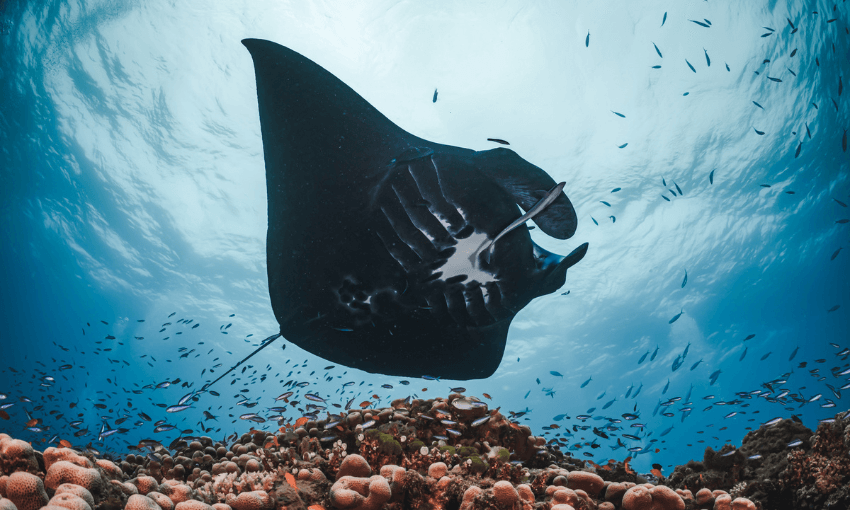
They’re majestic, a little intimidating, and glide into their watery world filter-first. In Fiji, manta rays are usually reef mantas (Mobula alfredi) whose wingspans can grow up to five metres – about the length of your car. They’re gentle giants, with no teeth or barbs or anything else to hurt with, though their tails do look a bit like a whip. They have a strange appendix on either side of their mouths – cephalic fins. These flare out to channel water into the ray’s mouth, and roll up into spirals for swimming with less drag.
As well as filtering for zooplankton, reef manta rays like to hang out at cleaning stations – coral patches and rocky outcrops where cleaner fish live. The rays present their bellies to these fish, floating still above their homes, so that the fish can eat away dead skin, ectoparasites, and any infected tissue there. This is a symbiotic and cooperative behaviour. It seems reef manta rays have a tendency towards mutual relationships – in 2019 groundbreaking research showed that they have complex social lives and close friendships. The lead scientist told National Geographic that reef mantas are “reasonably intelligent” and “are not the solitary, mindless, socially bereft animals that we perhaps thought them to be in the past”.
If you’re wanting to make friends with a manta, Fiji’s “Manta Ray Passage” between Drawaqa and Naviti Islands, any day between May and October, is where you should shoot your shot. If you want to take it a step further, you can even adopt a manta through the Kokomo Manta Conservation Project, and receive bi-monthly updates on your newest family member.
Orange fruit doves
Is it a splash of sunset, a fuzzy mango, a giant peach pip? No! It’s an orange fruit dove, one of the most vividly coloured birds in the world, found only in the subtropical and tropical moist forests of six islands in Fiji’s archipelago. The male orange fruit dove is covered in brilliant, shaggy, flame-orange feathers up to its neck, where an olive green cap defines its little head. The females aren’t quite so bright, as is often the way with birds, they’re green-ish with a blackish tail, but at least have a touch of orange on their undertail coverts.

Both sexes are about the same size – if you held up your hand, their green beaks would be by your pinkie and their short pointed tails would be by your thumb. Not that you’d get that close. These splashes of colour are often high in the canopy, eating little fruits and berries, and a caterpillar or two. Their song is as strange as those long, hair-ish feathers. Instead of a whistle, or a tune or a melody, it’s simply a series of clicks, as if a tap was dripping or your friend’s toddler had just learned to click their tongue.
You’ll have to head inland to elevations of 420-980 meters on Vanua Levu, Taveuni, Rabi, Kioa, Qamea, or Laucala to hear their mesmerising clicks, but it will be worth seeing the blaze of orange, and garnering the envy of all your bird-nerd friends.