The New Zealand fuel crisis laid bare in nine simple charts

Photo: Phil Walter/Getty Images; additional design: The Spinoff
Ways of looking at the economic shockwaves of a war 15,000km away.
Let’s begin at the pump. As you will almost certainly have noticed, prices are angling skyward. Not all fuels are created equal, however. Diesel, which tends to have a crucial role in rural, manufacturing and transportation sectors, has especially shot up, beyond even 91.
According to Gaspy.nz, petrol has increased by a little over 35% and diesel by more than 87%.
As for jet fuel, Air New Zealand suspended earning guidance earlier this month in response to the Hormuz Strait disruption, saying fuel prices had doubled.
The fuse for all of the above was lit one month and almost 15,000 kilometres away. As part of its response to the strikes from the US and Israel in an asymmetric conflict, Tehran moved, in effect, to blockade the Strait of Hormuz, that thumbnail of water on the Persian Gulf.
Here’s what has happened to traffic in the Strait of Hormuz – you might detect a bit of a drop following the attacks.
So how much of the actual goop do we have here in New Zealand? Let’s begin with the oil that is already onshore.
New Zealand fuel importers are legally required to have a “minimum stockholding”: 28 days for petrol, 21 days for diesel and 24 days for jet fuel. It doesn’t have to be onshore – fuel on tankers within New Zealand waters (the exclusive economic zone) also counts.
On that measure, the stocks, as of 11.59pm Sunday, are 33.6 days of petrol (+5.6 on the obligation), 30 days’ diesel (+9) and 33.5 days’ jet fuel (+9.5).
There are a further 10 ships bound for New Zealand outside that EEZ, according to MBIE’s latest reporting. Taken together, the stocks (as of the middle of last week) tally like this:
At a glance, that looks pretty sweet, actually. The trend hardly shouts crisis. And yet, as the prime minister acknowledged, there was a more sombre tone to this week’s post-cabinet press conference, which laid out plans to explore the trading of fuel tickets held with the International Energy Agency to bolster reserves as well as offshore storage options.
A big part of the reason: the lag.
A map created by JP Morgan, which estimates those delayed shockwaves, has been getting some circulation.
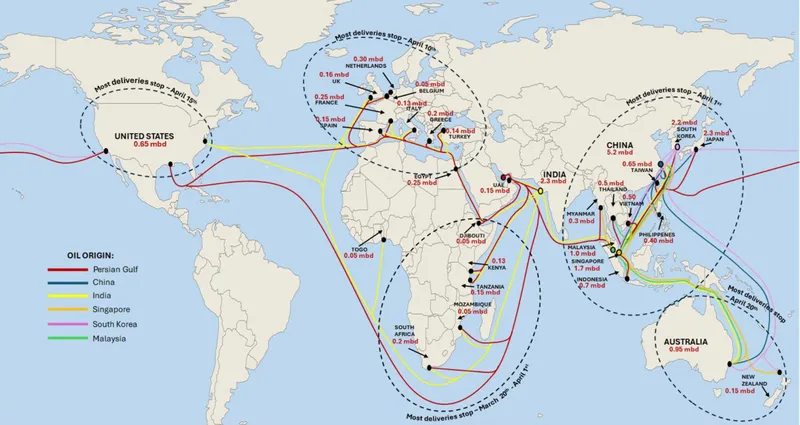
Zoom in, please!
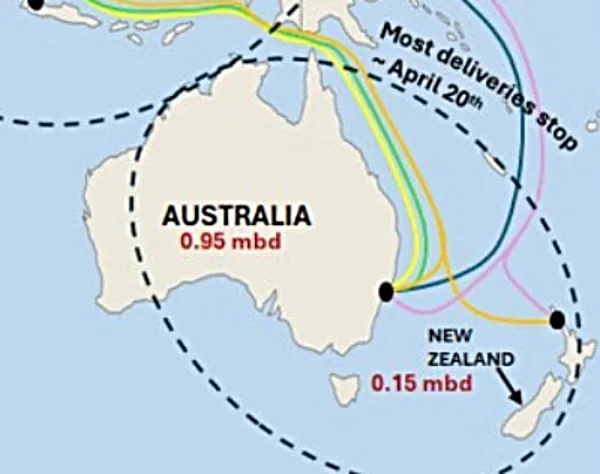
By this measure, things would start to get crunchy for New Zealand in around three weeks. Given the conflict shows no obvious sign of ending, lag + uncertainty = plan for the worst.
New Zealand oil imports aren’t, however, coming from the Middle East, at least not directly.
Let’s fire up the most derided but delicious member of the chart family, the pie chart.
The Middle East slice of the pie (green) disappears from 2022, the year that Marsden Point’s oil refinery operation was closed by its owners (largely the big fuel importers). That means we no longer import any crude oil for refining, only oil that’s already been refined.
Approximately 85% of that comes from refineries in Asia, which in turn import most of their crude oil via the Persian Gulf. All of which means about 60% of the fuel in New Zealand originally transited the Strait of Hormuz.
Four out of every five litres imported into New Zealand come from either South Korea or Singapore. Importantly, Christopher Luxon has established good relations with the leaders of both countries. But pressure is growing to limit exports, especially in South Korea, which NZ associate energy minister Shane Jones calls “a bastion of protectionism”. They might ask, for example, how it is that New Zealand is in level one, while South Korea, which also has a four-level system, is in level two. And the South Korean president has in recent hours started talking about issuing an “emergency economic decree”.
New Zealanders – like most of the world – have suddenly became amateur Hormuzologists.
Here’s the Google search interest. (Note, Google measures the peak interest as “100”, rather than providing details on the total number of searches.)
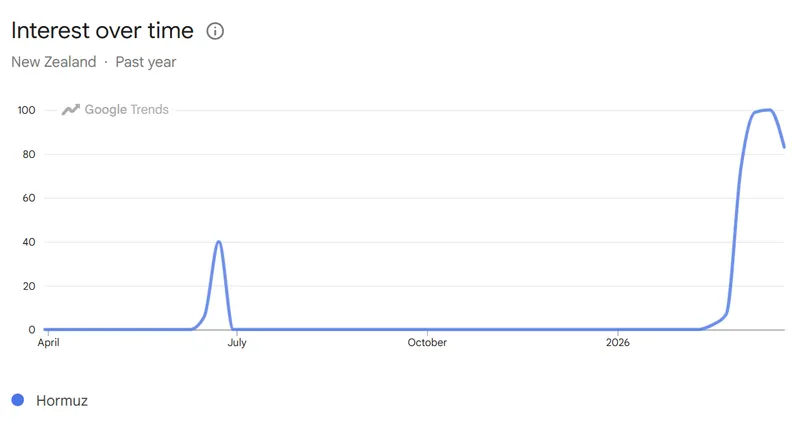
The June 2025 mini-spike is the result of the 12-day war between Israel and Iran, which prompted threats from Tehran to close the strait and various warnings at the time from analysts that, for example, “closing the Strait of Hormuz would influence the entire commercial shipping in the Gulf. Much of it is oil and natural gas. This will get energy prices up. This will influence the entire world’s economy.”
There’s a bit of interest in petrol prices, too.
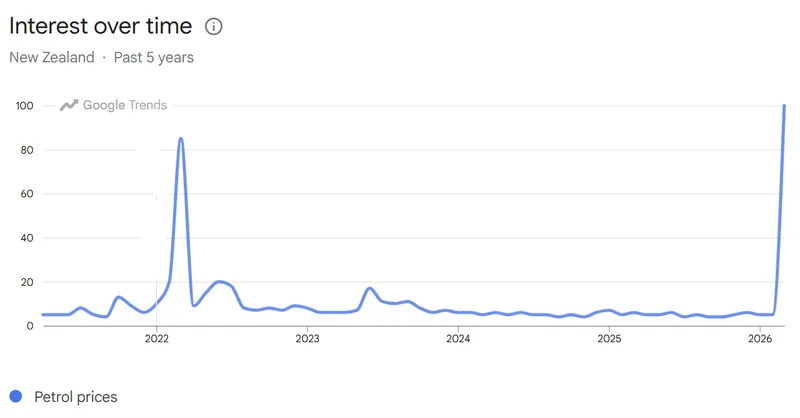
The spike in March 2022? That’s just after the Russian invasion of Ukraine.
As for the impacts on New Zealand’s fledgling economy, the outlook is sober.
Staring out at a volatile global economy and a conflict without any obvious endpoint, ASB chief economist Nick Tuffley introduced the bank’s fresh forecasts, published this week, with his tongue in his cheek: “it’s pretty easy to forecast what will happen.”
They had a go, all the same, on the basis it is “reasonably likely that we will face a prolonged period of high oil prices”, that “high prices will be sustained to the end of the September quarter, and that there will not be any material disruption to the NZ economy from any fuel supply shortages”.
In those circumstances, their best effort is a forecast inflation peak of 4.2% for the year to June 2026.
This post was updated at 6pm on April 1 to incorporate the latest data released earlier in the afternoon.

Toby Manhire
Toby Manhire is editor-at-large at The Spinoff. He loves to cast a pod, whether it's Gone By Lunchtime, At Large or Juggernaut. He is a former editor of The Spinoff and has worked as a journalist in NZ and the UK since the last millennium.


