Budget 2026: The great Spinoff hot-take roundtable

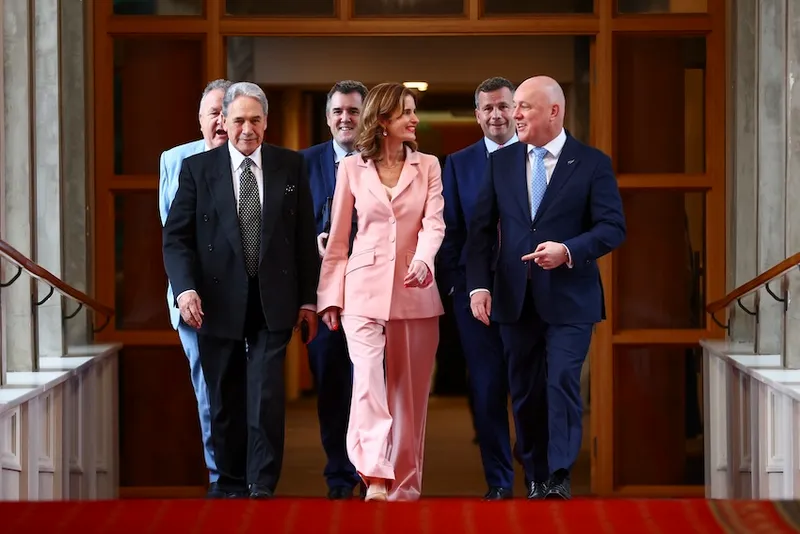
The budget held by finance minister Nicola Willis and her associate ministers Chris Bishop, David Seymour and Shane Jones (Image: The Spinoff)
Finance minister Nicola Willis says she’s delivered ‘a responsible budget to secure New Zealand’s future’. But what do the experts think?
Read Lyric Waiwiri-Smith’s report from the budget lockup here and Joel MacManus’s analysis here.
Belinda Himiona: Bricks and mortar put ahead of struggling families
In a time of scarcity, frustratingly, this year’s budget places a premium on infrastructure, defence and law and order, but not on easing the enormous cost pressures facing whānau and the community services that support them.
We welcome measures in the budget around child safety, and it was good to see more funding for responding to an increase in reports of concern made to Oranga Tamariki, and an increase for support for children in care with high and complex needs.
In the bigger picture though, fuel prices and cost-of-living pressures are hurting whānau and the community services that support them, and more children are living in material hardship than two years ago. Community-based social providers are being stretched to almost breaking point as they continue to assist whānau in need. While some sectors have been given relief from rising fuel costs, nothing is outlined for the community sector.
It is disheartening to see such large investment in bricks and mortar projects when so many whānau need relief now and access to critical social services. A budget is about choices and trade-offs, but there is no balance in this budget and no relief in sight for struggling families.
Belinda Himiona is chief executive at Te Pai Ora SSPA (Social Service Providers Aotearoa)
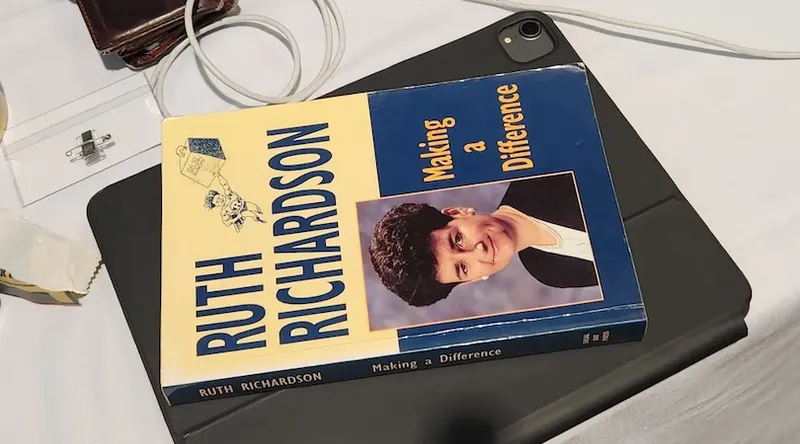
Terry Baucher: A typical National budget with a guest appearance by Ruth Richardson
This was a typical National budget with plenty of talk about fiscal responsibility enabling increased spending in key areas such as health, education and law and order.
From a tax perspective, there was also the usual sleight of hand of paying for these increases with “reprioritisations” and disguised tax increases such as the new prudential levy on the financial services sector. At $209 million raised over the four years to 2029-30, it’s the biggest single fund-raising initiative in the budget. The levy will be paid to the Reserve Bank supposedly to recover costs of administering the sector, but the expectation is that the revenue will flow through to the government “through an increased dividend”.
A long-standing tax tactic by governments of both hues is to use “fiscal drag” to help balance the books without attracting too much attention. This is where growth in salaries means average tax rates for individuals increase as they cross tax thresholds that have not been increased since 2024. It falls particularly heavily on middle-income earners when their annual earnings exceed $53,500 and the tax rate jumps from 17.5% to 30%. The budget predicts that total tax revenue will rise by $38bn over the period to June 30, 2030. $2.9 billion or 7.6% of this represents fiscal drag: a tidy sum that will only increase over time without adjustments to tax thresholds. We got no indication of when that might happen.
There were changes to the research and development tax incentive which overall means the government will gain $87.3m over the forecast period. The changes expand the range of R&D expenditure mining businesses can claim, which sounds like someone might owe Shane Jones a monster crayfish.
It wasn’t all bad though. The $100,000 cap on donations and other changes to not-for-profits are welcome. The proposal to impose a tax charge on shareholders owing money to a company that goes into liquidation is sensible. (That measure is actually now in force as it was part of proposals announced last December and retracted after Act and New Zealand First objected).
To be fair, this sort of giving with one hand and taking with the other is very much a feature of most budgets. This time it has enabled Nicola Willis to claim a surplus will be achieved. Whether the flinty Ruth Richardson – who was present in the spirit of the Taxpayers’ Union – will approve, I’m not so sure. As for the electorate, we shall see.
Terry Baucher is a tax specialist
Nicola Gaston: Research and renewable energy rejected
Well, haven’t we made a dog’s breakfast of the once-in-a-generation opportunity afforded by our science sector reforms?
I’ve been thinking quite a bit about accountability lately. Partly because there seems to be an assumption that scientists or academics are not sufficiently accountable, and that this justifies the costly reform processes that are under way. But on the other hand, any scientist, any researcher, any academic is held accountable repeatedly and frequently through mechanisms of peer review. Through the need for reproducibility, and to demonstrate impact through citation or research use.
It occurs to me that our politicians need to take the same lens to assess their effectiveness in funding research. Or in making sector-wide decisions.
When this government rejected the emphatic advice from the Science System Advisory Group that increased funding was necessary to achieve the objectives of reform, it rejected those objectives. It should have drawn a line under the whole project then. The ongoing attrition in the sector – the cancellation of funding rounds, and what looks a whole lot like the death of the Marsden Fund in the recent announcement of “transition funding” – well, yes. That’s what you get when you blunder about like a bull in a china shop in the name of “efficiency”.
Oh yes – and Crown funding is being discontinued for Ara Ake. It was set up in 2020 in New Plymouth for the sake of a “just transition”, and to move our energy sector towards a sustainable future. I guess it is no surprise (cough, LNG, cough) that this is not where this government’s heart is.
But in the context of the prices we are all paying at the pump at the moment, it is hard to see this government’s rejection of anything related to renewable energy as anything other than ideological.
Nicola Gaston is a professor in the department of physics at the University of Auckland and co-director of the MacDiarmid Institute for Advanced Materials and Nanotechnology. (Nicola Gaston receives funding from the Tertiary Education Commission as the director of the MacDiarmid Institute. She also receives funding from the Marsden Fund. All research funding goes to the University of Auckland to pay the costs of the research she is employed to do.)
Holly Bennett: A simple tax change to target unscrupulous business owners
The centre-right is doing what it always should have been doing: being clear with unscrupulous business owners that if they do not take their financial duties seriously, Inland Revenue will do it for them.
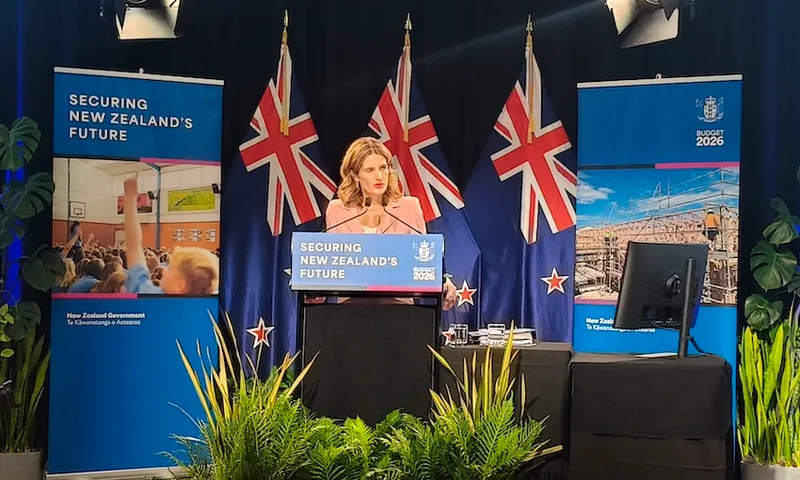
In the unsexy portfolio of revenue, Simon Watts has announced that Budget 2026 will introduce tax on company loans to shareholders that remain outstanding six months after a company is removed from the companies register.
Once a company becomes defunct, any shareholder loan still outstanding six months later will attract tax. In other words the government is targeting any shareholder who uses their business to withdraw money tax-free by taking “loans” that were never truly intended to be repaid.
Simple, niche and an important policy direction. I couldn’t agree more with the minister’s comments: “Not taxing it is unfair to all the other New Zealanders who pay income tax and contribute to the costs of public services.”
Given the government expects to raise $160m over four years, it suggests that this is a reasonably common pattern.
Holly Bennett (Te Arawa, Ngāti Whakaue, Ngāti Pikiao) is the managing director of lobbying firm Awhi and a former adviser to National ministers
Alan Johnson: Undeserved relief for landlords
The 2026 budget delivered the previously announced $361 million spending switch between social housing tenants and private tenants. In doing so it has provided no doubt welcome relief to the tens of thousands of mum-and-dad landlords out there in voterland.
This switch requires social housing tenants to pay a higher proportion of their generally meagre income in rent (25% to 30%), with the savings channelled into slightly higher accommodation supplement payments to low-income private sector tenants. This change is justified by ministers on the basis of fairness – that social housing tenants are paying less of their income in rent than private tenants with the same before housing cost incomes.
Missing from such arguments of fairness within our housing system is the tax-privileged status of landlords who have received a tax write-off opportunity of $3 billion over four years and a much shorter bright-line test to reap untaxed capital gains. Also absent is any mention of the tax inequities between tenants and owner-occupiers.
But times aren’t great for mum-and-dad landlords. Rents are falling, tenants are disappearing to Australia and corporates are moving in with various build-to-rent offers which are probably soaking up the better-paid and more reliable tenants.
Budget 2026 signals two unsurprising things. Firstly, the National-led Government has no vision for what social housing might do and become. Secondly, it has confirmed again that this is a government of the rentier class.
Alan Johnson is a South Auckland based housing activist and researcher
Eric Crampton: Government spending still very high
The minister of finance’s budget speech emphasised the importance of fiscal discipline, getting the deficit and debt under control, and avoiding election-year lolly scrambles.
The government’s accounts show that spending is coming down from Covid peaks. But it is still very high relative to government revenue and relative to the state of the economy.
The government is still in deficit. Deficit can be expected in an economic downturn. But Treasury estimates that about 60% of the current deficit is structural: if the economy were not in a downturn, the books would still be in substantial deficit.
Very tight spending control is forecast to bring a return to structural surplus in 2029. But it will be very hard to maintain that track through an election, through ongoing fuel price turmoil, and through post-election coalition negotiations.
Even sticking to that promised track, government spending will be a much larger fraction of overall economic activity than it was under the first term of the Ardern government.
During questions, National and Act’s commitment to campaigning on superannuation reform was very clear. Without changes, transfers to the often-wealthy elderly will consume an untenable proportion of government expenditure.
Dr Eric Crampton is chief economist with the New Zealand Initiative
Vanessa Cole: Robbing Peter to pay Paul’s landlord
The National-NZ First-ACT Government’s decision to give 5% rent hikes to state and community housing tenants and put those “savings” into the accommodation supplement for low-income private renters is not about rebalancing an unfair system. It’s about increasing property investors’ profits, and control over our housing system, while driving divisions between renters.
If the government really wanted to make the system “fair” for low-income private renters they would freeze the rents, implement rent controls, and build state housing at scale that increases its availability.
Low-income renters who access the accommodation supplement should be in state housing but the government has completely withdrawn from the construction of housing, cancelling builds across the country and selling off our homes while more of our neighbours struggle to secure a roof over their heads.
State housing was intended to be permanent and secure homes for people – not emergency housing or a stepping stone to the private market. State housing creates secure homes so kids can grow up together and people can build community in places close to work and services. In an economic downturn that is hurting families across the country, we need political leadership with real solutions to the housing crisis, not one that robs Peter to pay Paul’s landlord.
Vanessa Cole is a campaigner with Public Housing Futures
Rod McNaughton: More like a collection of components than a coherent pathway
On first reading, Budget 2026 signals fiscal discipline and a focus on infrastructure, energy security, frontline services and vocational education. Those are important economic foundations. But it does not strongly signal that the government sees SMEs, startups, research commercialisation or entrepreneurial scale-up as central to New Zealand’s productivity challenge.
New Zealand’s long-run problem is not just public infrastructure or fiscal pressure. It is also weak productivity, uneven firm capability, too few firms growing through innovation at scale, and an underpowered pathway from public research into commercial value.
There are useful components in the budget: funding for science-system investment, commercialisation and partnership, advanced technology, founder support, early-stage capital-market development and small-business services. But the budget still feels more like a collection of components than a coherent pathway.
There is also more visible innovation-specific support for startups, early-stage capital and R&D-active firms than for the broad base of SMEs that are struggling with costs, capability constraints and low productivity. Startup support matters, but most New Zealand firms are not venture-backed startups. They are small and medium-sized businesses trying to survive, adopt technology, find staff, improve management capability and lift margins.
The risk is that we fund parts of the innovation system without designing it from the perspective of the firms that need to use it. The issue is not whether government has programmes, but whether those programmes form a simple, accessible and credible pathway to capability, innovation and growth.
Rod McNaughton is a professor of entrepreneurship at the University of Auckland Business School
Claire Achmad: A missed opportunity to prioritise ending child poverty
With my first look at Budget 2026, I’m asking: how does it improve children’s lives, especially disadvantaged children? That’s core to my mandate as children’s commissioner, and children tell me they want to grow up safe and without poverty. It’s good that Budget 26 focuses on improving children’s safety and preventing child abuse. That’s something I’ve consistently advocated for, including through my Dear Children campaign. I’ve also called for strengthened funding so Oranga Tamariki can better respond to reports of concern. It’s good the budget delivers that.
But I’m deeply disappointed Budget 26 misses the opportunity to make ending child poverty an enduring project of national significance. That’s urgently needed by the almost 170,000 children living in material hardship. The budget invests in another “road of national significance”. If successive governments can elevate roads to national priorities, why not our children most in need?
While food security initiatives in Budget 26 help, many children will still be going without things like warm healthy food, hot showers, essential school supplies, clothing and transport. We are a small, relatively rich nation. Poverty in the lives of children is preventable. Even in tough financial times, we’ve got to prioritise ending poverty, so all children reach their full potential, rather than struggling to survive.
Dr Claire Achmad is the children’s commissioner
Ah-Leen Rayner: Keeping the lights on is not a long-term solution
An additional $54 million for Pharmac over four years does little more than maintain the status quo. That’s simply not good enough when too many New Zealanders with breast cancer are still being forced to shoulder the cost of unfunded medicines themselves.
This funding helps Pharmac manage rising global supply and cost pressures, but it does not meaningfully improve access to new medicines for patients. Keeping the lights on is not a long-term solution.
For people with breast cancer, medicines sitting on Pharmac’s waitlist – treatments already assessed as cost-effective that could provide more time and better quality of life – remain out of reach.
This budget misses a crucial opportunity to address the growing pressure facing our health system as cancer diagnoses continue to rise. New Zealand continues to underinvest in medicines compared with similar countries, and patients are living with the consequences every day.
Ah-Leen Rayner is chief executive of Breast Cancer Foundation NZ
Russel Norman: No plan to decarbonise the economy
In 2026 we are facing twin climate and biodiversity crises, overlaid by a cost of living crisis directly caused by our economy’s dependence on fossil fuels.
Unfortunately, Budget 2026 has no plan to decarbonise our economy and hence simultaneously address the cost of living and climate crisis.
In particular, there is no plan to decarbonise the transport sector, which is highly dependent on expensive imported fossil fuels and produces a fifth of all New Zealand’s climate pollution.
The budget has money to repair state highways being damaged by extreme weather events but no plan or money to cut the climate pollution that is causing the damage.
There is no plan to support everyday New Zealanders’ uptake of rooftop solar and batteries which would actually help with the cost of living crisis.
On the positive side there is an investment of $1 billion in rail and the previously announced, yet begrudging, loan scheme to support businesses to reduce fossil gas use.
Undermining that, on the biodiversity front, there are further cuts to the Department of Conservation. And the use of $100m of the International Visitor Levy simply replaces existing baseline funding.
Now is not the time for business as usual. Now is the time to embrace our renewable energy future.
Russel Norman is executive director of Greenpeace Aotearoa
Georgina Stylianou: A pretty good budget, but not exactly inspiring
Nicola Willis has delivered the Bare Necessities Budget, putting fiscal restraint over short-term relief and sugar hits.
Many will enjoy that, but there’s no denying it’s a hard sell in election year, especially for the thousands of middle New Zealanders who are struggling.
Delivered against a backdrop of sluggish growth, elevated debt and a worsening global fuel crisis, the government can claim one big win – we’ll be back in the black a year earlier than forecast. Whether that fiscal milestone resonates with households under pressure is another question.
The government’s core political argument is that economic discipline now will deliver long-term stability later. But the trade-offs are becoming increasingly visible.
One of the starkest examples is child poverty. The latest figures show New Zealand is not on track to meet any of its legislated reduction targets, with hardship rates for many families either stalled or worsening. Yet the budget contains few new child poverty initiatives, relying instead on economic growth, employment and education participation to improve outcomes over time.
The clearest winners are health, defence and security. I’m pleased to see a big focus on cybersecurity in Budget 2026 too – an area where we are chronically exposed and vulnerable.
Overall Budget 2026 has done a pretty good job given we’ve got no money, but it’s certainly not inspiring, nor enough to stop Kiwis flocking overseas.
Georgina Stylianou is the managing director of government relations and public affairs firm BRG, and a former adviser to National and NZ First ministers
Brian Roper: Chronic underfunding of tertiary education continues
This budget continues the chronic cumulative underfunding of tertiary education by successive Labour and National governments. Factoring in Treasury’s forecast of 4.0% CPI inflation in 2026, forecast spending of $5,437 million on tertiary education in 2027 will be $97 million less than is required to maintain the same level of funding in real terms in 2027 compared with 2026. In other words, our universities and other tertiary education institutions are being expected to maintain the same range of teaching, research and service activities with declining funding.
According to the Ministry of Education, in 2005 there were just under 500,000 predominantly young people enrolled in some kind of tertiary education. The corresponding figure for 2025 is 395,095. In other words, during this 20-year period when the NZ population increased from 4.2 to 5.3 million, the number of tertiary students fell by 104,475.
Although economic and demographic factors have played a role, the neoliberal funding model has clearly been a major cause of this dramatic decline in participation. Comparatively high tuition fees, low levels of student income support, and consequently high levels of student debt have clearly discouraged young people from participating in tertiary education. The government claims that it is focused on economic growth, but it should be obvious that this dramatic decline in participation is not good for labour productivity, innovation and economic growth. It also undermines the capacity of our universities to act as the critic and conscience of society, and to contribute positively to the economy and society in all sorts of other ways.
Brian Roper is an associate professor of politics at the University of Otago
Kassie Hartendorp: A smash-and-grab budget
All over the country, people in our communities have been pulling together to get through the hard times we’re facing. We are doing everything we can to look after each other and keep the doors of our local businesses and community infrastructure open. To clean up after floods and fires. We have shown who we are as a people: caring, responsible and not afraid of a challenge.
In Budget 2026, this government has shown us who they are. This is a smash and grab. They have chosen to use our collective resources to funnel money into the pockets of corporations and make further cuts to the people, communities and support systems that support us. They’ve invested in guns, roads and prisons while taking money out of the incomes and communities who need it the most.
We deserve leaders who believe in this country and its people. Who will create opportunities for our young people and build the public services and infrastructure we need to met the challenges we face, now and into the future. In Budget 2026 this government has made it clear it is not those leaders.
Kassie Hartendorp (Ngāti Raukawa, Ngāti Pareraukawa) is director of ActionStation

Group Think
Multiple Spinoff contributors coming together to collaboratively author a post, video or podcast.


